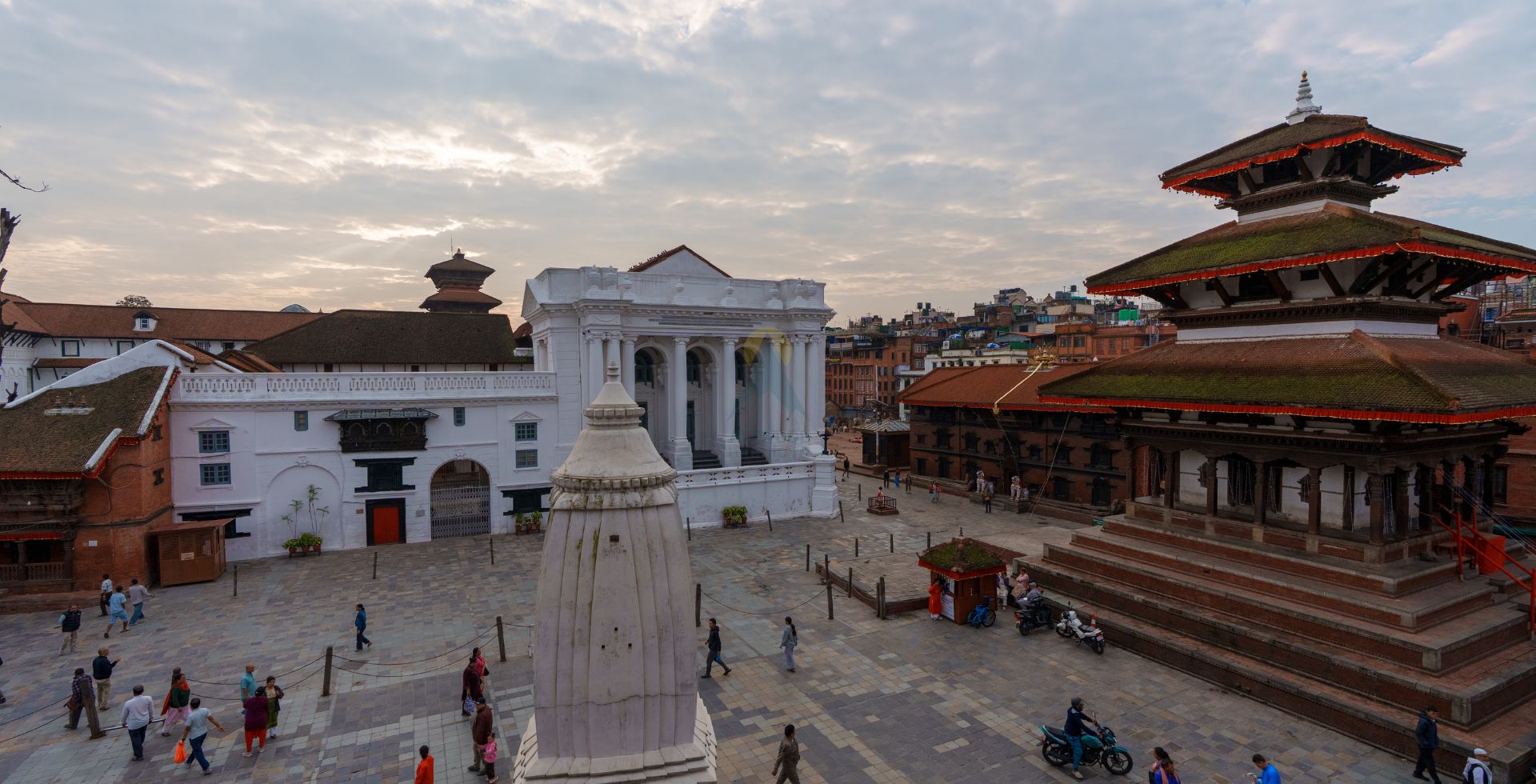
Kathmandu, the city of temples, has many historical and interesting places to visit, and among them, Kathmandu Durbar Square stands out! Kathmandu Durbar Square is one of the historical sites with a collection of ancient landmarks.
It is one of the three Durbar Squares inside the Kathmandu Valley and one of the UNESCO World Heritage Site monument zones.
The old royal palace has been converted into a museum that is home to centuries-old artefacts. The local traditions and culture have also thrived around the palace. The square has hundreds of visitors every day, and they go away with a wonderful experience of its beauty and amazing history.
So if you are a history lover, a photography lover, an architecture student, a culture lover, or a traveller who loves to explore, then I highly recommend you visit Kathmandu Durbar Square to see its beauty!
Kathmandu Durbar Square Quick Facts
|
Location
|
Kathmandu District, Bagmati Province
|
|
Also Known As
|
Hanuman Dhoka Durbar Square, or Basantapur Durbar Square
|
|
Listed as a UNESCO World Heritage Site
|
1979 AD (alongside other monument zones of Kathmandu Valley)
|
|
Core Zone Property
|
5.09 ha (100 Ropani) approx.
|
|
Buffer Zone
|
6.47 ha (127.18 Ropani) approx.
|
|
Major Attractions
|
Hanuman Dhoka Palace Museum, Kumari Ghar, Taleju Bhawani Temple, Jagannath Temple, Kal Bhairav, Shiva-Parvati Temple, Nasal Chowk, Big Bell, Kasthamandap, Gaddi Baithak, etc.
|
|
Built By
|
Erected since the Lichhavi era and developed by the Malla Kings and the Shah dynasty later.
|
|
Historical Importance
|
Former royal palace where Nepal’s kings ruled and were crowned.
|
|
Famous For
|
Ancient temples, royal courtyards, wood carvings, Living Goddess Kumari, cultural festivals, museums, statues, etc.
|
|
Major Festivals
|
Indra Jatra, Kumari Jatra, Fulpati (7th day of Dashain), Gai Jatra, Holi, Seto Machhindranath, etc.
|
|
Entry Fees
|
- Nepalese: Free
- SAARC and BIMSTEC Nationals: NPR 500
- NON-SAARC Nationals: 1000
- Free for children below 10 years
|
|
Opening Hours (Ticket Counter)
|
Every day, 9:00 AM to 5:00 PM
|
History of Kathmandu Durbar Square
Imagine a place that could tell you the story of Nepal’s kings, gods, festivals, temples, and people. Yes, Kathmandu Durbar Square has been doing this exactly!
Let’s look into its history timeline first:
|
Date
|
Events
|
|
Lichhavi Period (4th-8th Century)
|
The area thrived as the settlements of Koligrama and Dakshin Koligrama. The modern palace later sat near the ancient Dakshin Rajkula royal compound.
|
|
Early 13th Century
|
The Malla Dynasty formally began in Nepal under King Ari Malla.
|
|
1562 AD
|
Mahendreswor Temple was built during the reign of Mahendra Malla.
|
|
1563 AD
|
The image of Jagannath inside the Jagannath Temple was placed during the reign of King Mahendra Malla.
|
|
1564 AD
|
King Mahendra Malla built the large Taleju Temple in the Durbar Square premises.
|
|
1641 - 1674 AD
|
King Pratap Malla ruled Kantipur. Most of the parts of the Durbar complex were built by him.
|
|
1648/49 AD
|
Chyasin Dega, the temple of Vansagopal (Krishna in the act of playing the flute), was built by Pratap Malla in memory of his two dead queens.
|
|
1672 AD
|
Statue of Hanuman established by King Pratap Malla at the entrance of the Royal Palace, Hanuman Dhoka.
|
|
1673 AD
|
Dhansa, also called Kabindrapur, was built by Pratap Malla.
|
|
1679 AD
|
Trailokya Mohan Narayan Temple was built by Parthivendra Malla.
|
|
1692 AD
|
The massive Maju Dega Temple was constructed by Queen Mother Riddhi Lakshmi.
|
|
1722 - 1736 AD
|
King Jagajjaya Malla constructs the Mahipatindreshwar shrine in memory of his grandfather.
|
|
1757 AD
|
Kumari Ghar was built by Jaya Prakash Malla.
|
|
1768 AD
|
King Prithvi Narayan Shah conquers Kathmandu during Indra Jatra, establishing Kathmandu as the capital and Hanuman Dhoka as the Royal Palace of unified Nepal.
|
|
1770 AD
|
The nine-storeyed (Nau Talle) Basantapur Palace was built in the palace complex by King Prithvi Narayan Shah.
|
|
1775 - 1777 AD
|
King Pratap Singh Shah adds the Bhaktapur and Kirtipur Towers surrounding Lohan Chowk.
|
|
1797 AD
|
King Rana Bahadur Shah and his queen Rajeshwori built the Tago Gan (Big Bell).
|
|
1822 AD
|
King Rajendra Bikram Shah remodels Mohan and Sundari Chowks and commissions the sacred Chandi Murals.
|
|
1886 AD
|
The royal residence permanently shifts to Narayanhiti Palace following the marriage of King Prithvi Bir Bikram Shah to the daughters of Bir Shumsher.
|
|
1908 AD
|
The iconic neo-classical Gaddi Baithak lounge constructed by PM Chandra Shumsher during King Prithvi Bir Bikram's reign.
|
|
1967 AD
|
The Chyasin Dega Temple was renovated.
|
|
1979 AD
|
Hanuman Dhoka Royal Palace was included in the protected monument zone under the Kathmandu Valley UNESCO World Heritage Site.
|
|
2011 AD
|
The historic palace complex formally transitioned into the Hanuman Dhoka Palace Museum under a unified development committee.
|
Although the exact date of establishment of Hanuman Dhoka is unknown, some historical evidence suggests that it was built during the Lichhavi era in the 4th-8th centuries.
Later, in the 17th century, King Pratap Malla extended the property significantly. Additionally, other development works in Hanuman Dhoka as well as the Durbar Square area were initiated by other Malla and Shah Kings.
All the royal families from both the Malla dynasty of Kantipur and the Shah dynasty pf Nepal resided in Hanuman Dhoka. It was only in 1886 that the royal residence of the Shah Kings moved to Narayanhiti Palace after the daughters of Bir Shumsher married King Prithvi Bir Bikram Shah.
Later, in 1979 AD, Hanuman Dhoka was listed as a UNESCO World Heritage Site, and the palace complex was converted to a museum in the year 2067 B.S. (2011 A.D.)
How to Reach Kathmandu Durbar Square?
The best way to visit Kathmandu Durbar Square is by walking because you will get to see other nearby attractions, courtyards, and shrines, along with hidden streets, bahal, bihars, and many more.
If you plan to visit Kathmandu Durbar Square, then it is easy to reach from many parts of Kathmandu, but exploring the square with other nearby streets and markets on foot might be something unique and worthwhile!
Whether you have only 1-2 hours, half a day, or a full day to explore the Durbar Square, courtyards, and ancient temples, I have prepared a walking route that will suit your schedule.
Here are the multiple routes that will lead you to Kathmandu Durbar Square and make your visit interesting and memorable.
A Full-Day Visit to Kathmandu Durbar Square
This route is going to be the best for those who want to explore the streets of Thamel before reaching the Durbar Square, and also for those who have enough time for exploration:
Thahity > Banghemudha > Ason Bazaar > Kel Tole (Keltole) > Indra Chowk > Gangalal Marg > Nardevi > Yatkha > Kumari Ghar > Hanumandhoka Durbar > Return the same route or explore Freak Street and Juddha Salik-New Road (your choice).
As you have enough time, be sure to enter the Hanuman Dhoka Palace Museum and have lunch in any rooftop restaurant in Freak Street.
Best Route for Half-Day Visit
Here is a suggested route if you are planning for a half-day visit to the Durbar Square and continue your Kathmandu sightseeing to another heritage site:
Lekhnath Marg > Narsingh Chowk > Kwa Bahal > Thahity > Ason Bazaar > Indra Chowk > Makhan Tole > Kathmandu Durbar Square > Optional museum entry
The route is a shorter version of the full-day one, and depending on your time, you may or may not stop for lunch. Timing for museum entry can be a little difficult, but if you think you can manage, definitely opt for it!
Best Route for a Short Trip
If you are busy and have limited time, i.e., only about 1-2 hours, then there is no need to worry because I have prepared a short route that will take you to visit the Durbar Square:
New Road > Juddha Salik > Kathmandu Durbar Square
For a short trip, you may simply reach Juddha Salik in a private vehicle and start to walk from there, exploring the streets of Basantapur. Once the tour ends, you can hop onto a vehicle and continue your city tour.
Well, if you’re planning to cover all the main tourist destinations in Kathmandu in a single day, good news! We at Altitude Himalaya already offer these dedicated packages:
No matter how long your journey is, make sure that you visit Kumari Ghar. It’s home to Nepal’s Living Goddess, Kumari, and she’s the major highlight of this durbar square.
Taleju Bhawani Temple: The Sacred Shrine Open Once a Year
Taleju Bhawani Temple is one of the famous Hindu temples in Nepal. All three former royal palaces (in Kathmandu Durbar Square, Bhaktapur Durbar Square, and Patan Durbar Square) have Taleju Bhawani Temple inside them.
The oldest one is located in Bhaktapur, and the Taleju Bhawani of Kathmandu was built as its representation. However, it is exceptionally grand in comparison to other Taleju!
It was built by King Mahendra Malla in Magh 1620 BS, and Goddess Taleju is the main deity of this temple, who was the Kul Devata (family deity) of the Malla Kings.
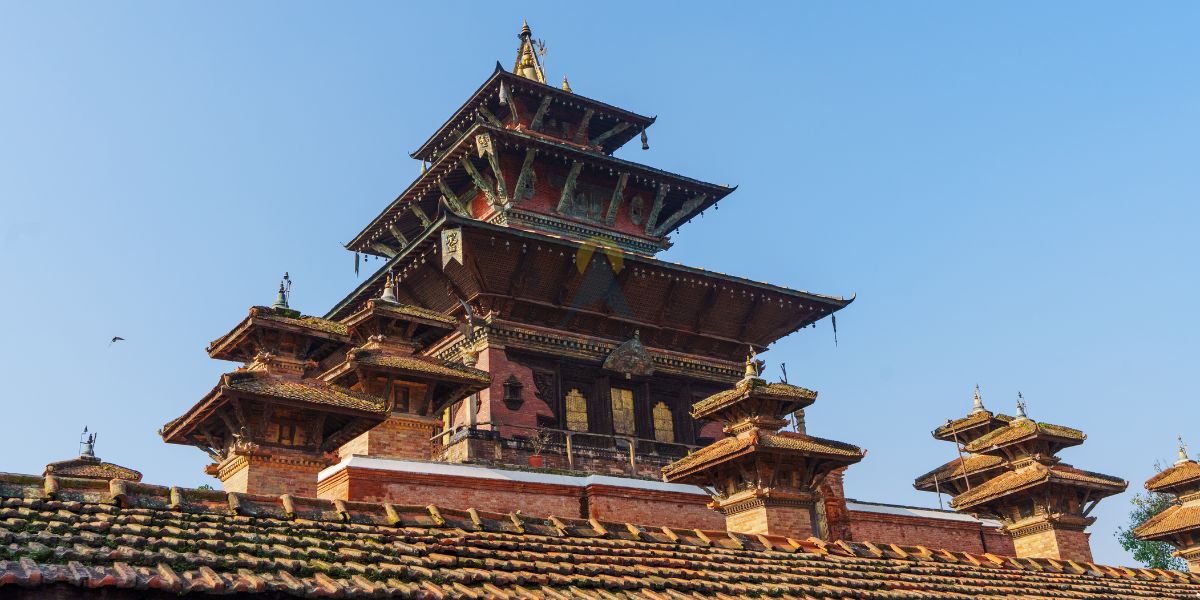
This huge temple stands still in a large area with a pinnacle on the top and four decorative gates that are guarded by stone lions.
The most interesting fact about Taleju Bhawani Temple is that it remains closed throughout the year (except for the priests who perform daily worship here). But every year on the ninth day of the Dashain festival (Navami), the temple is open, and devotees can visit for worship. The Living Goddess, Kumari, also visits the temple on this day!
Some people believe that the temple is in the shape of Sri Yantra, a mystical diagram with magical powers, as advised by the Goddess Taleju. Whereas there are folklores mentioning that the Taleju Bhawani herself appeared as a bee at the temple’s dedication ceremony. Additionally, it is also said that she was originally from South India before being brought to Mithila! But how did Taleju reach Kathmandu? Allow me to explain.
How Taleju Bhawani Reached the Kathmandu Valley?
The popular version goes like this: King Harisimha Deva of Mithila saw Taleju in a dream, carried her to Kathmandu, and installed her there. It is a good story, but Prof. Dr. T.R. Vaidya disputes the part where the king installs her himself, and the person at the centre of the other version is actually his queen, Devaladevi!
Well, Harisimha Deva was the last king of the Karnat dynasty of Mithila. He ruled from Simraungadh, on today's India-Nepal border. His queen, Devaladevi (also written Devalakshmidevi), was born in 1300 AD. She was the sister of Rudra Malla, the de facto ruler of Nepal Mandala at that time.
Bhaktapur then had two palaces: the Tripura palace housed the de jure royal family, while the Yuthunimam palace belonged to the de facto ruler. Here's the thing: the title of king and real power often sat in different hands.
Rudra Malla probably had arranged his sister's marriage to Harisimha Deva to protect Nepal from repeated invasions, which prevented Harisimha from invading the valley afterwards.
In the mid-1320s, Sultan Ghiyasuddin Tughlaq of Delhi devastated Simraungadh. That led Harisimha Deva to flee to the northern hills with his family and followers, but he died on the way.
Devaladevi, along with her son, Jagatsimha, and their followers, reached Bhaktapur, where Rudra Malla gave them asylum in the Yuthunimam palace. It was the natural next step for her to return to her maternal home.
After Rudra Malla died, his daughter Nayakadevi was seen as his successor but was too young. So, Padumaladevi (her grandmother) and Devaladevi (her aunt) took responsibility for the royal family from 1326 to 1332.
Devaladevi was not very active at first. She captured power in 1336 and ruled as the de facto ruler for 30 years, until her death in 1366. It was far from smooth: she faced revolts by nobles and feudatories, and in November 1349, the worst thing happened: the Sultan of Bengal, Samasuddin Iliyas, invaded the valley.
In 1354, she was the one who brought Jayasthiti Malla from the south and married him to her granddaughter, Rajalladevi. You see, Jayasthihi was not a Malla by lineage and the only outsider to rule the country.
Coming back to our Taleju Bhawani story, the Rising Nepal reports that after Harisimha Deva's death, Devaladevi was the one who installed the kalash (sacred pot) of Taleju Bhawani she had brought with her inside the palace!
Some historians still disagree, though. For instance, the same news article mentions Tirthalal Naghavani and Mary Slusser arguing that Taleju Bhawani has been the royal deity of Nepal long before Harisimhadeva, from the Licchavi period!
The original yantra (a geometric diagram used in tantric worship) is believed to be kept in Bhaktapur Durbar Square's Mul Chok even today.
So, you see, Taleju Bhawani did not reach Kathmandu district first. Bhaktapur got her, and the other cities followed once Nepal Mandala split into three kingdoms.
And according to a famous legend, Taleju Bhawani is the same goddess who, centuries later, comes in a dream to Jayaprakash Malla, the last Malla king of Kantipur. His story leads to the Kumari tradition, which is where we go next!
Taleju Bhawani and the Kumari Tradition
Jaya Prakash Malla, the last Malla King of Kantipur, was a great devotee of the Goddess Taleju Bhawani. According to a legend, the goddess and the king used to play dice late at night.
Taleju, the goddess, used to visit the palace in a human form after Jaya Prakash Malla opened Shree Yantra (a divine instrument) and emitted the sacred mantra.
There are two versions of stories connected to this legend from here:
- One night, the Goddess felt that the king was having inappropriate thoughts about her. So, she stopped visiting him. The king then realized his mistake and requested countless forgiveness. He also performed several purification rituals. Later, one night Taleju appeared in his dreams and clarified that she would never appear in front of him in a human form and guided the king to select a young, pre-pubescent girl from the Shakya clan who had thirty-two auspicious qualities and establish her as the Living Goddess Kumari.
- Another one says that Taleju had promised that if the king kept this secret from everyone, then she would visit him daily. But one night, when they were playing dice, the Queen (wife of Jaya Prakash Malla) saw them. After Taleju realized this, she disappeared from there, saying that if the king wanted to see her again and if he wanted to protect the nation, he should search for her among the high-caste Newar girls, as she would be incarnated as a young girl among them.
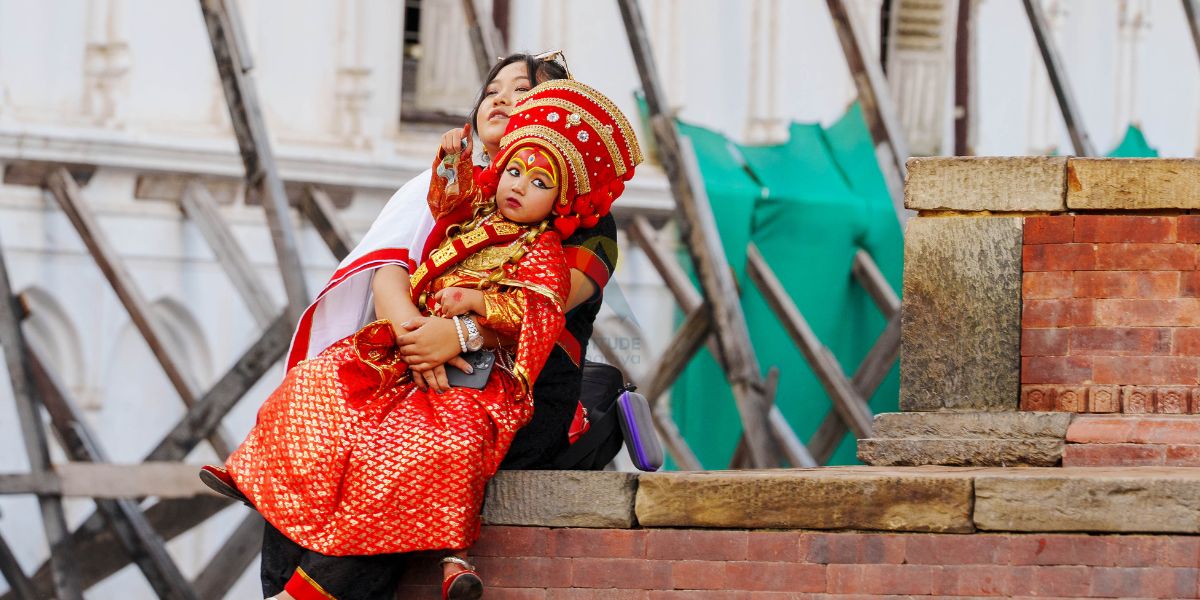
The meaning of the word Kumari is “a virgin girl”. While Kumari is believed to be a physical embodiment of the Goddess Taleju in Hindu culture, she is believed to be the deity Vajradevi in Buddhism.
She is selected through several ancient and religious processes, and she serves as the living goddess until she has her first menstruation.
There is a specially designated Selection Committee with the head priest of Taleju Temple, government officials, astrologers, and other cultural and religious authorities for carrying out the selection process.
The girl who is chosen as Kumari should be a prepubescent girl with 32 divine qualities and should belong to the Shakya Clan with no cuts, bruises, or birthmarks on her body.
Kumari Ghar
Kumari is believed to be the divine protector of the nation and safeguard the country from evil or misfortune. She has a designated place to live in, and that is Kumari Ghar, located near Gaddi Baithak and Trailokyamohan Temple, and the area is also known as Kumari Chowk.
Until her tenure, she resides there; then she moves to her own home with a grand send-off. Where can you see the Living Goddess Kumari?
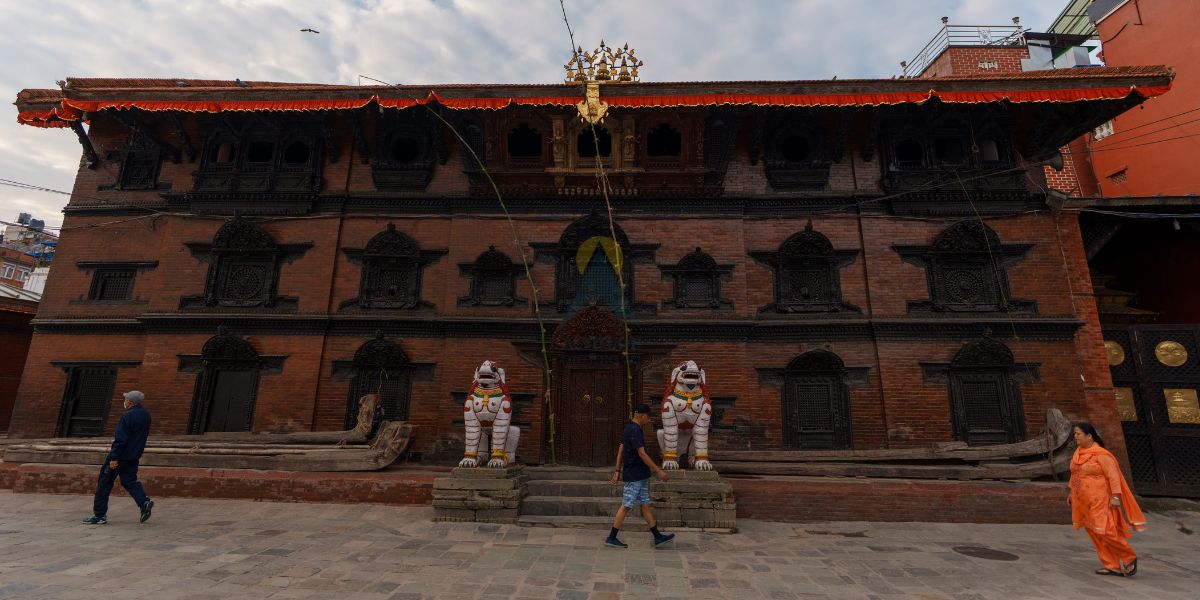
You need to stand down in the courtyard to see Kumari. Usually, she makes an appearance at 11 AM - 12 PM and 4 PM - 5 PM in the late afternoon from a window on the top floor.
Additionally, you can see her during major festivals like Indra Jatra, when she is carried and paraded in a ceremonial chariot.
To learn more about her, please go and read our detailed blog: Kumari, Living Goddess.
Other Significant Temples
Every corner of Kathmandu Durbar Square portrays a unique story, and there are several Hindu temples inside the Kathmandu Durbar Square complex. Here is the complete list.
Trailokyamohan Temple
This temple is located in front of Gaddi Baithak, near Kumari Ghar (in Kumari Chowk). The temple displays interesting depictions of Lord Vishnu’s Dashavatara (ten incarnations) throughout the Indra Jatra festival.
Hence, Trailokyamohan Temple is also known as Dash Avatar Dewal or Dashavatara Temple. Likewise, the temple has four entrances, and the main one faces east.
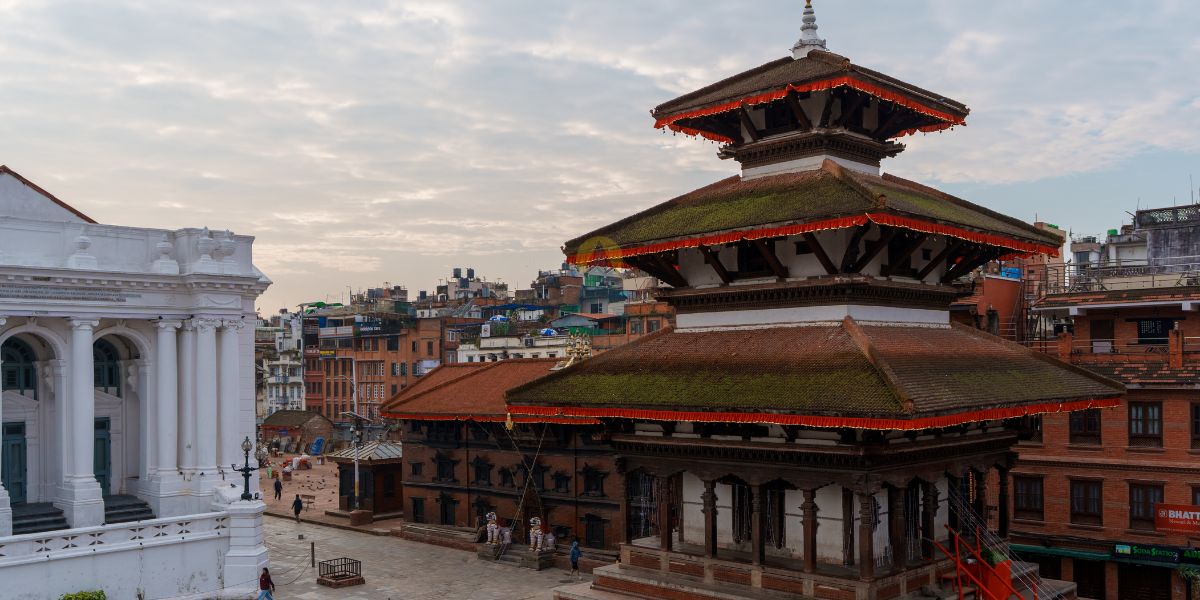
The struts of the temple are carved with various deities, all three roofs of the temple are decorated with wooden brackets, and the pinnacle (Gajur) is gold-plated. It was built during the reign of Parthivendra Malla.
A big statue of Garuda showing devotion to the Lord Vishnu in a Namaste position at the entrance of the temple is another attraction here!
Degu Taleju Temple
Degutale, or Degu Taleju, is located just beside the Swet Bhairav and to the south in front of the Pratap Dhoja pillar. It is one of the tallest temples of Kathmandu Durbar Square and was built by King Shiva Singh, according to the genealogy.
Later, in 1727 BS, Bhadra, King Pratap Malla, added a golden roof with a pinnacle to the temple and renovated it!
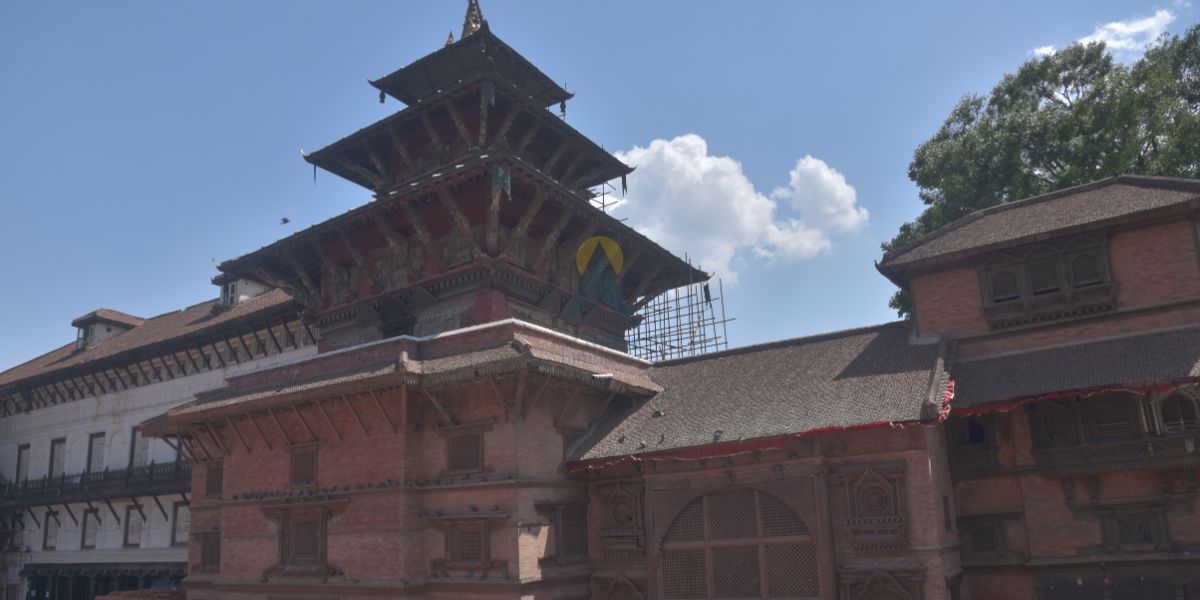
Malla Kings used to perform Dewali Puja (tradition of worshipping their tutelary deity) here in this temple, along with other special worship. When Deguli Puja used to be performed, this Devi was worshipped as their guardian deity, which is the reason the temple was named Degu Taleju.
Sasthi Devi and Kumar were also worshipped on the day of Sithi (Sithi Nakha), the sixth day of the waxing moon (Shukla Paksha) here.
Shiva Parvati (Navadurga) Temple
Shiva Parvati Temple, also known as Navadurga or Nava Yogini Temple, is located to the west of Gaddi Baithak, near the Big Bell, and was built in the late 18th century by Prince Bahadur Shah. In the beginning, a Panchayatana shrine (five deities) along with the Tarkeshwar Shiva Lingam was established in the temple.
If you notice the statue observing the surroundings from a window at the top of this temple, remember they are Shiva and Parvati. The statue is decorated with intricate artistic carvings and vivid red coloring.
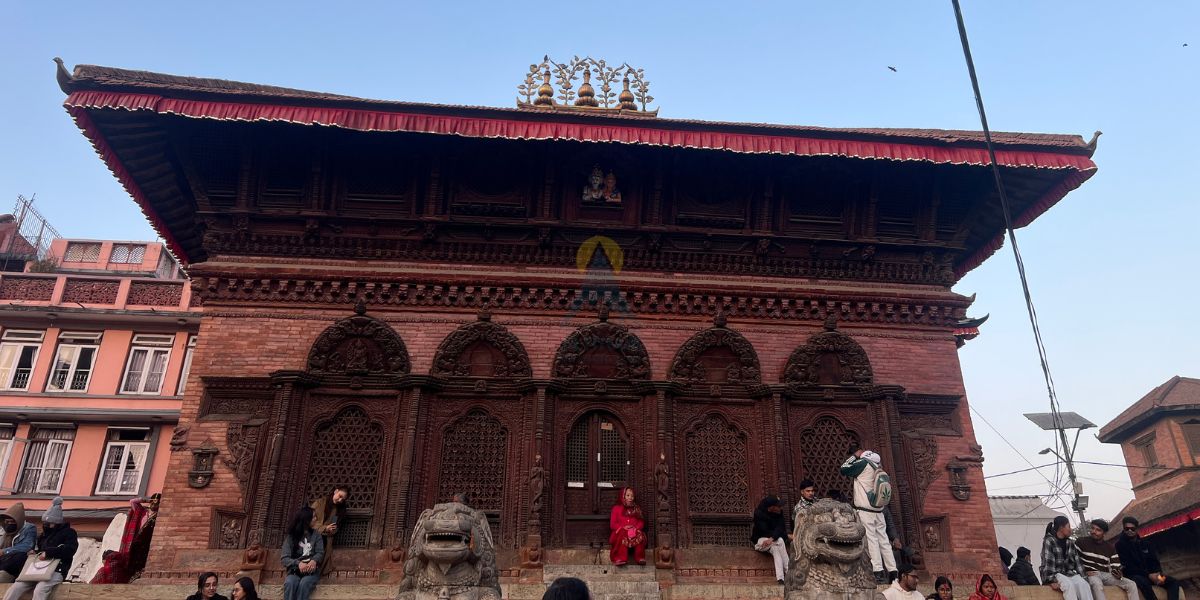
A priest here told me that people visit this temple either to show devotion to Shiva and Parvati or to perform Graha Shanti Pooja (worshipping the Nava Graha (Nine Planets) along with their mothers, Nava Yogini).
Festivals like Ashare Dashain, Sesh Puja in Chaitra, Asoj Dashain, and Mangsir Dashain are celebrated in this temple, where secret worship and offerings are done to the deities.
Do not miss the images of the owl and crow carved at the bottom of the entrance door; it is believed that the crow guards the temple during the day, whereas the owl guards it at night.
Krishna Temple
Just behind the Shiva Parvati Temple, there is a big bell, and near it there is a Krishna Temple, also called Shree Krishna Temple or Krishna Dewal. This temple was built in 1705 BS by Pratap Malla.
You may find the look of the temple a bit different from others because it appears to be circular but is actually built in an octagonal form!
Although King Pratap Malla had several wives, he built this Krishna Temple in remembrance of Queen Rupmati and Rajmati, who died before 1705 BS.
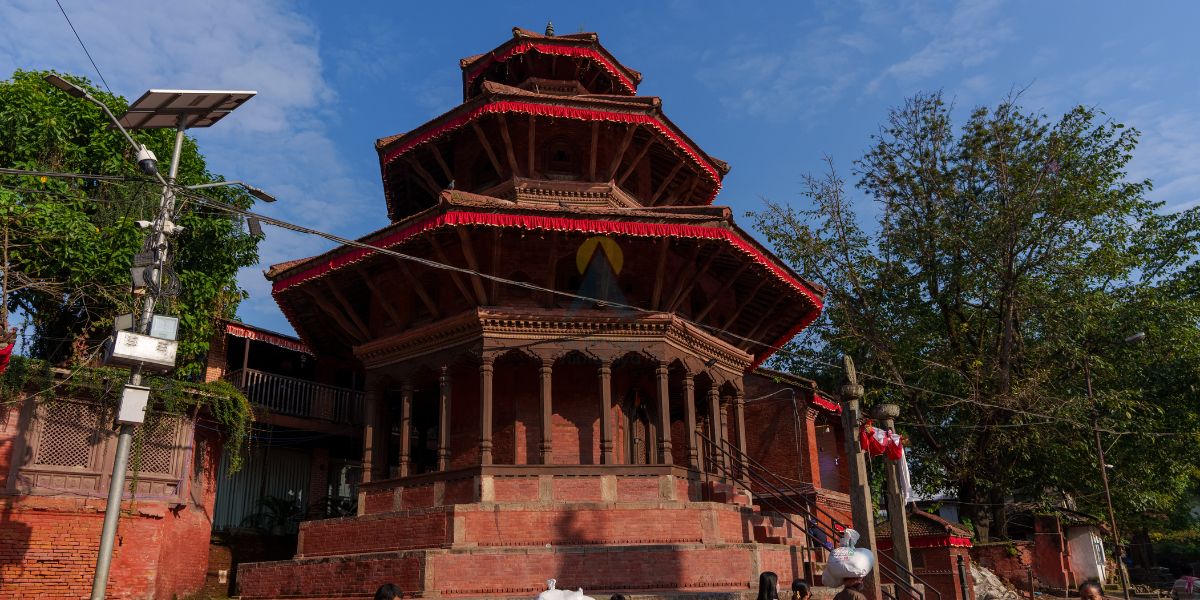
Likewise, this temple is considered to have been built by being inspired by love and affection rather than by religious enthusiasm.
Moving to the construction style of the temple, it stands on a raised platform of five stepped terraces (pancharatha pethi) and faces east. The temple is filled with internal as well as foreign visitors every day; you can see people sitting on the staircases of the temple.
Furthermore, hundreds of devotees come to worship, especially on Krishna Janmashtami (Krishna’s birthday).
Kandel Chowk Bhagwati Temple
This Bhagwati temple is located opposite the Big Bell and was built during the reign of King Jagajjaya Malla. It originally housed an idol of Lord Narayan, which was stolen in 1766 AD.
Later, King Prithvi Narayan Shah, who was a great devotee of Bhagwati and worshipped her regularly, installed the image of Mahishamardini Bhagwati here.
The courtyard of the building where this temple stands is known as Kandel (Kahenhol previously) Chowk; therefore, it is named the Kandel Chowk Bhagwati.
And since it was brought by King Prithvi Narayan Shah from Nuwakot, the idol is also known as Nuwakot Bhagwati. Interestingly, even today the goddess is taken in procession to Nuwakot every year.
According to a legend, the image of Mahisamardini was worshipped daily by the king; he even carried a small idol of her always during his travels, placing it in the palanquin (khat).
Today, Nepali festivals like Bada Dashain, Chaitra Dashain, Indra Jatra, Shrawan Sankranti, and Magh Sankranti, along with Asthami and Chaturdasi every month, are associated with this temple.
Swet Bhairav Temple
Near the tall Degu Taleju Temple, there resides a big statue of Swet Bhairav. Swet Bhairav is considered the most dangerous representation of Lord Shiva.
On a regular day, this statue can only be seen from Akhi Jhyal (eye window). But if you are interested in a better view of Swet Bhairav, then please visit during the Indra Jatra festival because the window is removed only during this time and can be seen easily!
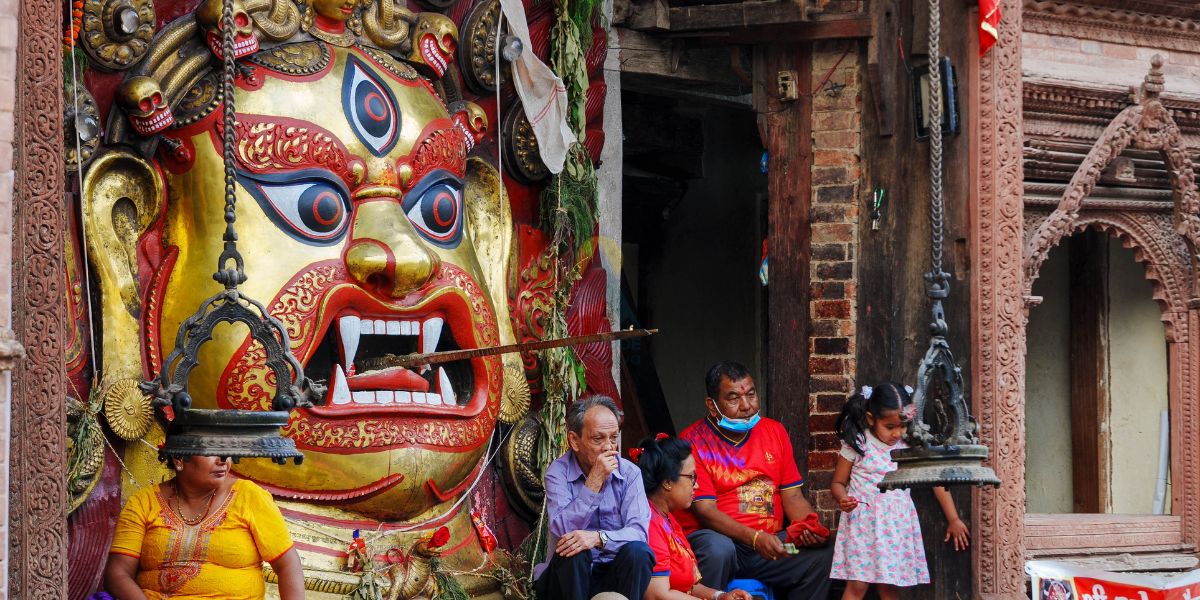
The statue was made and installed in 1852 BS, Bhadra, by the King Rana Bahadur Shah (written in the inscription engraved on a golden plate attached to the neck of the statue).
If you wonder why the Swet Bhairav temple was built, here is the answer: It was constructed to enhance the grandeur of Indra Jatra and to throw out the dakinis, shakinis, ghosts, spirits, and pichas (malevolent supernatural beings). Likewise, during the Indra Jatra festival, local alcohol (Tho) is poured through the mouth of Swet Bhairab’s statue using a spout.
Thousands of people gather in the crowd to drink the alcohol because it is considered a holy religious offering (Prasad). Not only that, it is also believed that the prasad even cures several pains and wards off ghosts and troubles!
Kal Bhairav Shrine
There is a big statue located to the north of the Jagganath and Degu Taleju temples. This huge idol is of Kal Bhairava!
According to genealogy (Vashabamshali), this statue was unearthed by King Pratap Malla under the land in Raniban when constructing a drainage from Budhanilkantha area to fill the pond of Bhandarkhal. He then ordered the idol to be brought and kept it in front of the palace!
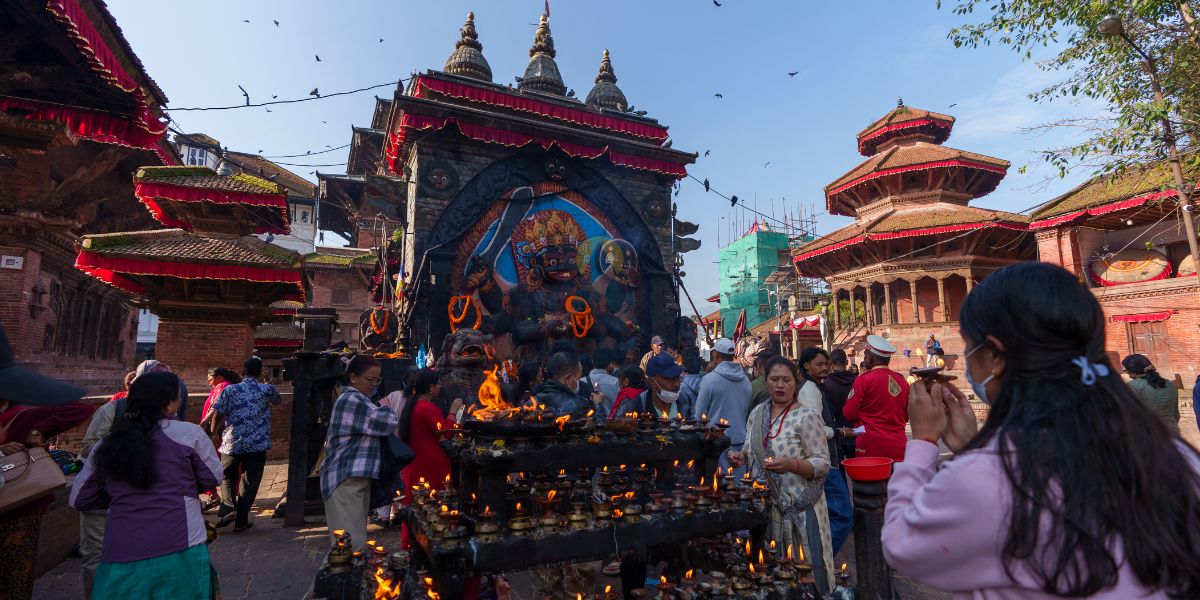
The idol looks scary because of its size and the posture of Kal Bhairav trampling a corpse (some even say he’s standing above Betal). It stands with a fierce yet smiling face (interestingly, the only smiling Kal Bhairav), wide eyes and fangs, a garland of skulls (mundamala), trident (trishul), skull bowl (kapala), and sword (tarbar) with serpent ornaments in the ears, wrists, and feet.
It is considered that worshipping here on Sunday helps to mitigate the Sani Dasha of people. Likewise, Kal Bhairav is associated with oath-taking and justice because people believed that he embodied divine justice and could see truth and punish the liars immediately!
Also, there is another legend that if someone speaks a lie in front of Kal Bhairav, they would vomit blood and lose their life on the spot.
Jagganath Temple
In front of the Krishna Temple, on the east, there is a big temple of Jagganath. At the east entrance, inside the temple, there is a statue of Jagganath, Suvadra, and Balaram on the wall.
Because of this, the temple’s name has remained Jagganath Dewal. Additionally, in the central part of this temple, there is a four-faced (chaturmukh) stone image of Vishnu that was installed by King Mahendra Malla (around 1560–1574 AD).
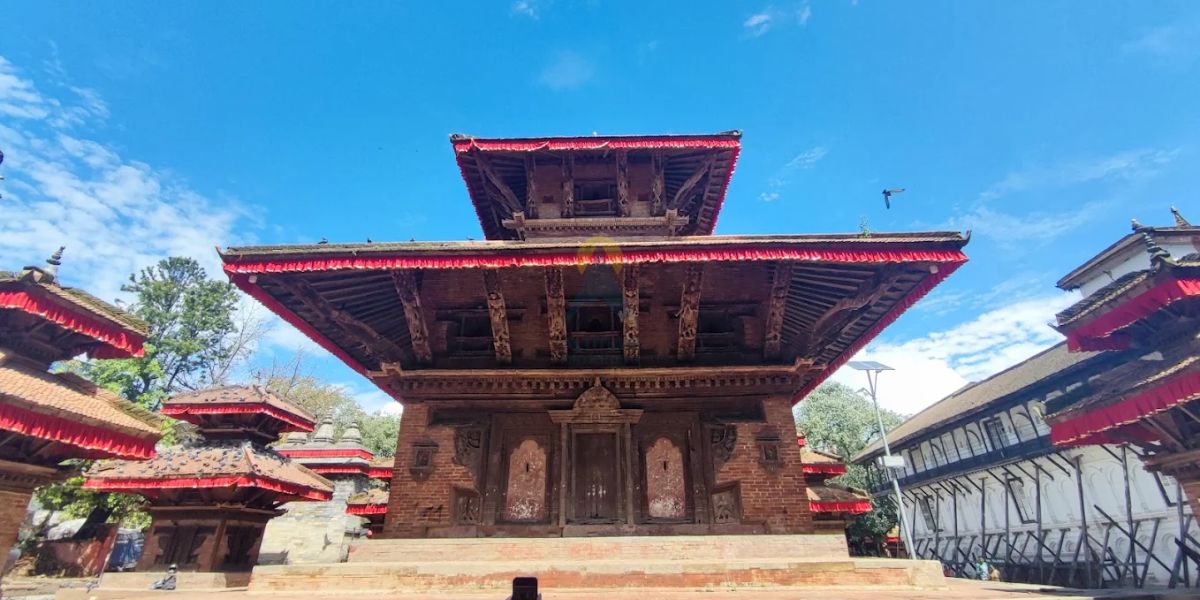
The biggest and most famous Jagannath Temple is located in Puri, Odisha, India, and inspired by the temple, a statue of Jagannath was added here. Going to India for the sacred sight (Darshan) of Lord Jagannath was not always possible, so it was made here!
Note: While there are claims that King Pratap Malla had established the temple, inscriptions dated it back to the reign of King Mahendra Malla.
Indrapur Temple
The temple is located near Kal Bhairav. In comparison to other temples of the Kathmandu Durbar Square, this one is quite simple, with only a single door, not even windows or torana; the struts are also very basic.
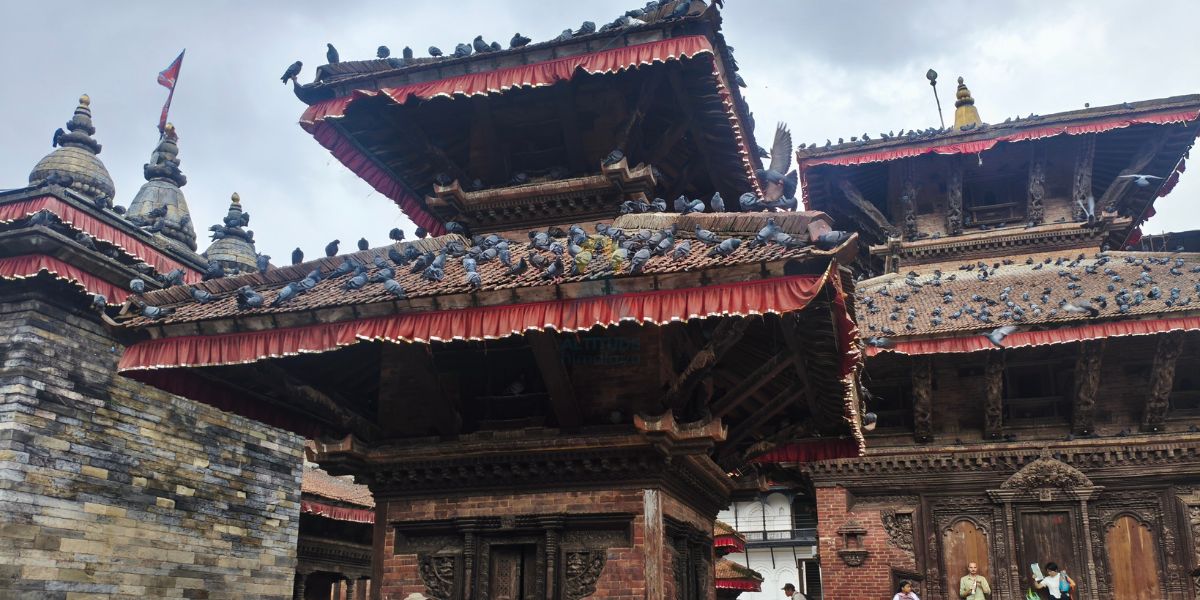
There is a small Shivalinga inside this temple, which is considered to be Indreshwor Mahadev and is a stand-in for the grander Indreshwor Mahadev of Panauti.
Some of them mentioned that, previously, during Indra Jatra, a statue of Indra used to be placed on the top floor here. However, this tradition has disappeared these days!
Kotilingeswor Mahadev Temple
The stone dewal (temple), located to the north of Kal Bhairav, is popularly known as Kotilingeswor Mahadev temple. According to genealogy, King Mahendra Malla was the one who built this temple. On the corner side of the temple, a stone ox (representing Nandi) can be seen being carved.
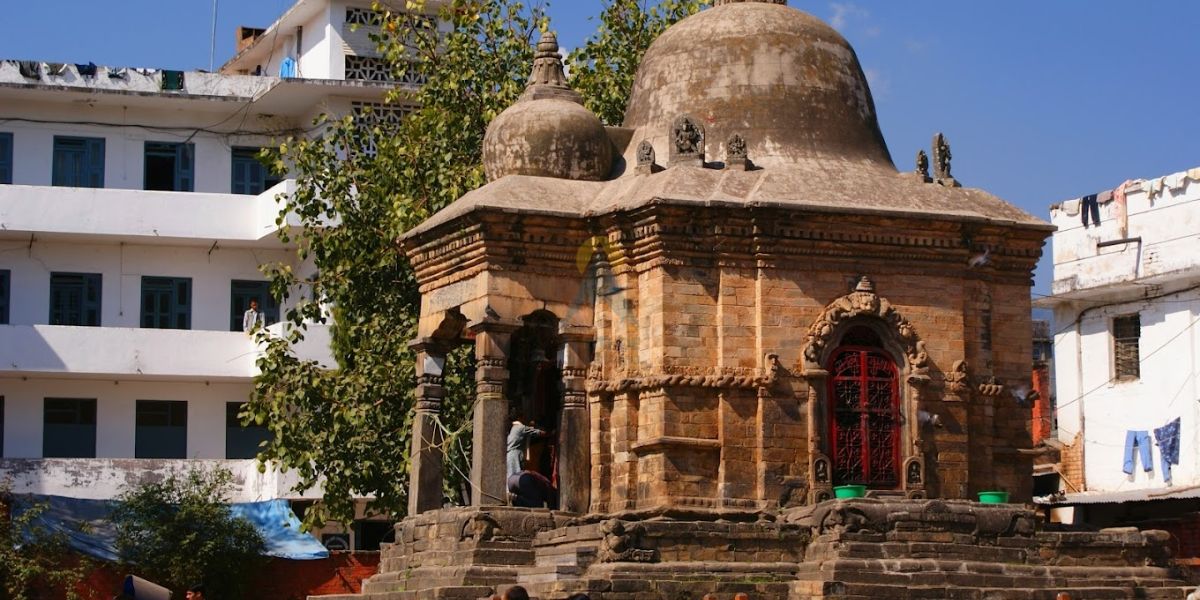
The main entrance of the temple faces south, and there is a copper pinnacle placed on the top! All toranas in the four doors of the temple are carved with Makar, Snake, and Garuda shapes.
Additionally, there are statues of Mahakal and Ganesh in the lower part of the temple’s door. Inside the temple, a four-faced (Chaturmukhi) Shivalinga is placed.
Maha Vishnu Temple
Located on the eastern side of the Kotilingeshwor Temple, across the road, there lies the Maha Vishnu Temple. The struts are simple, and so is its door!
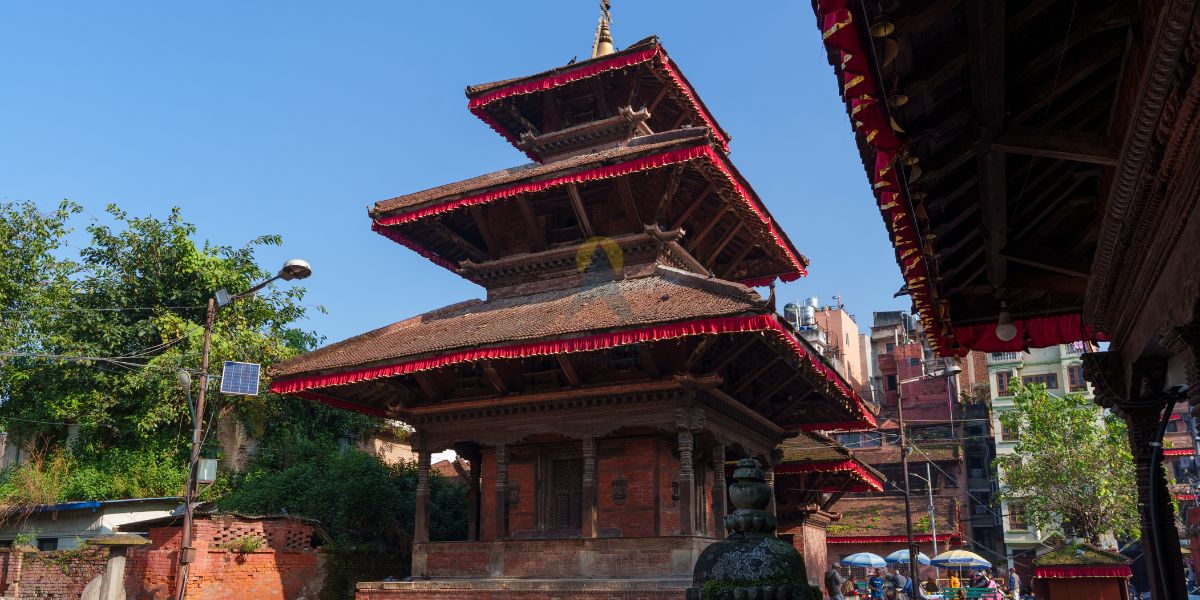
But the pinnacle of this temple is grand and is made of gold. There used to be a gold idol of Mahavishnu with Laxmi inside this temple, but after it was damaged by the 1934 AD earthquake, the idol was taken to Nasal Chowk, inside Hanuman Palace Museum, for safekeeping.
Similarly, it is believed that the temple was built by King Jaggajaya Malla around 300 years ago in remembrance of his eldest son Rajendra Malla, who died at an early age.
Mahendreshwor Mahadev Temple (Sano Pashupatinath)
Did you know there is Pashupatinath even within Kathmandu Durbar Square premises? Yes, there is, but don't get confused because it is just another name given to the Mahendreshwor Temple. It is located at the northern end of the square.
Mahendreshwor Mahadev Temple was built by King Mahendra Malla in 1618 BS. Since Kathmandu residents wanted a local replica of the great Pashupatinath Temple of Gaushala so they could make daily offerings without traveling outside the city walls.
This temple was damaged by the 1934 earthquake, and the present style and structure were built during the renovation in 1963 AD. Although there used to be a four-faced (Chatarmukhi) Shivalinga inside, the public was not allowed to enter the temple, but there was a Dharmaseela outside where people worshiped.
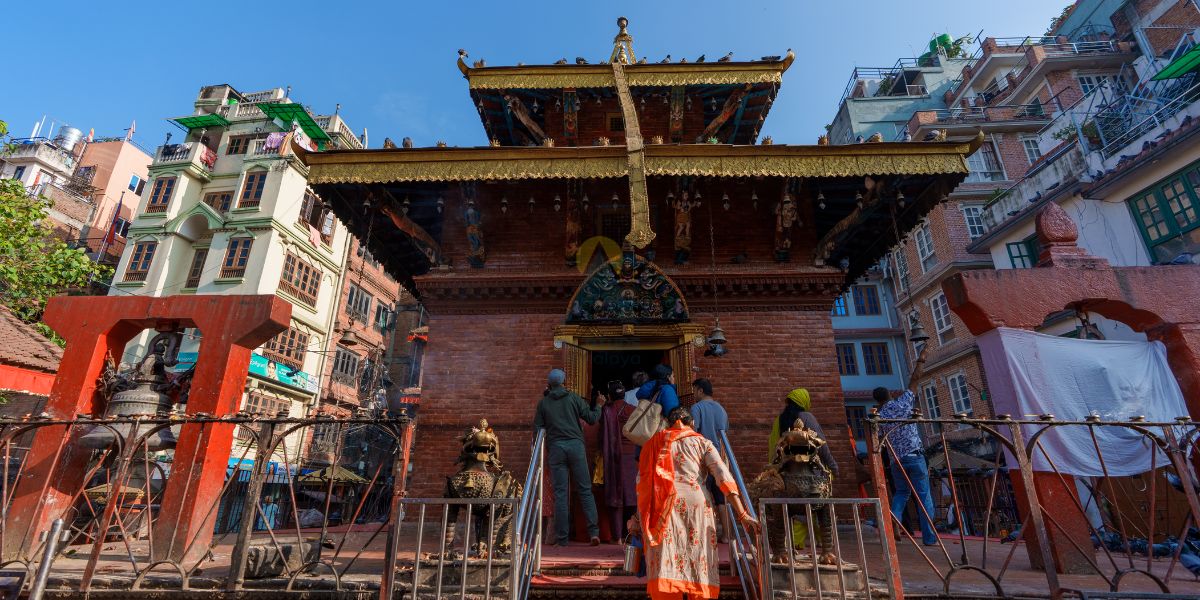
However, the temple is open to the general public now, so you can go inside for worship!
There are two bells on the left and right of the entrance and two lions in the entrance serving as guards. The struts of the temple are carved with deities related to Shiva/Mahadev.
On top of the entrance gate, you’ll find a statue of Lord Mahadev riding this sacred vehicle/mount (vahana), Nandi. Around the temple premises, there are small shrines of Bhairav, Ganesh, and other deities.
Behind the temple, there is the Guheyshwori shrine, and in front of it, there is a big entrance gate. Mahadev stands on the top of this gate carrying a Trishul, and it appears to be like he is observing the area.
The temple is usually crowded with Shiva devotees, especially in Shrawan, as this month is considered to be the month of showing devotion to Lord Shiva. Additionally, during Maha Shivaratri and the Teej festival, the temple is filled with hundreds of visitors!
Nil Barahi Temple
There is a small temple in the far northern corner dedicated to a fierce form of Durga (one of the Ashtamatrika mother goddesses).
It is believed that witches visit the temple during the Gathe Mangal (Pisach Chaturdashi) when tantric rituals are performed to ward off evil spirits.
Kageshwor/Kakeshwor Temple
Located to the south of Mahendreshwor, there is Kageshwor Temple, built in 1711 A.D. by Queen Bhuvana Laxmi, also known as Bhuvanalaksmesvara.
Later, people worshipped the temple as Kageshwor Mahadev. Every year on Bhadra Shukla Ashtami (the eighth day of the bright lunar fortnight in the month of Bhadra), the temple is filled with devotees as it is celebrated as Kage Ashtami.
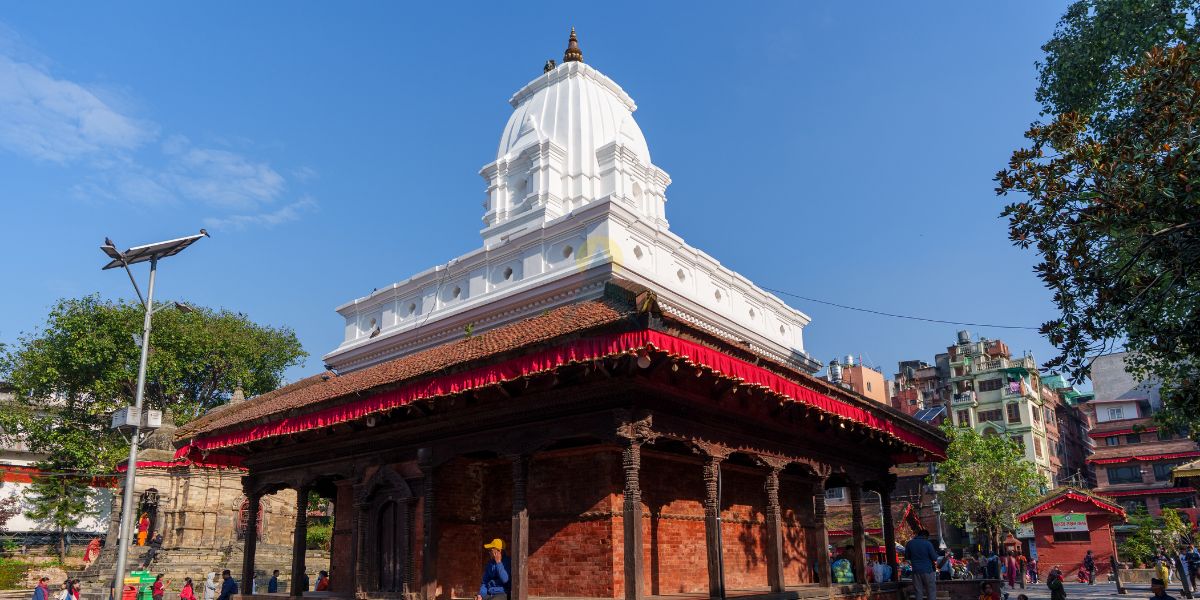
After the 1934 earthquake, this temple was damaged and later renovated with a perfect blend of the Shikhar with Nepali style. The upper, shikhara part is painted white in color, whereas the lower part reflects traditional Nepali architecture.
Shree Shree Shree Mahayogi Gorakhnath
There is a small hidden spot that people usually miss! Located near Kageshwor Mahadev, the small shrine is dedicated to Yogi-Saint Gorakhnath.
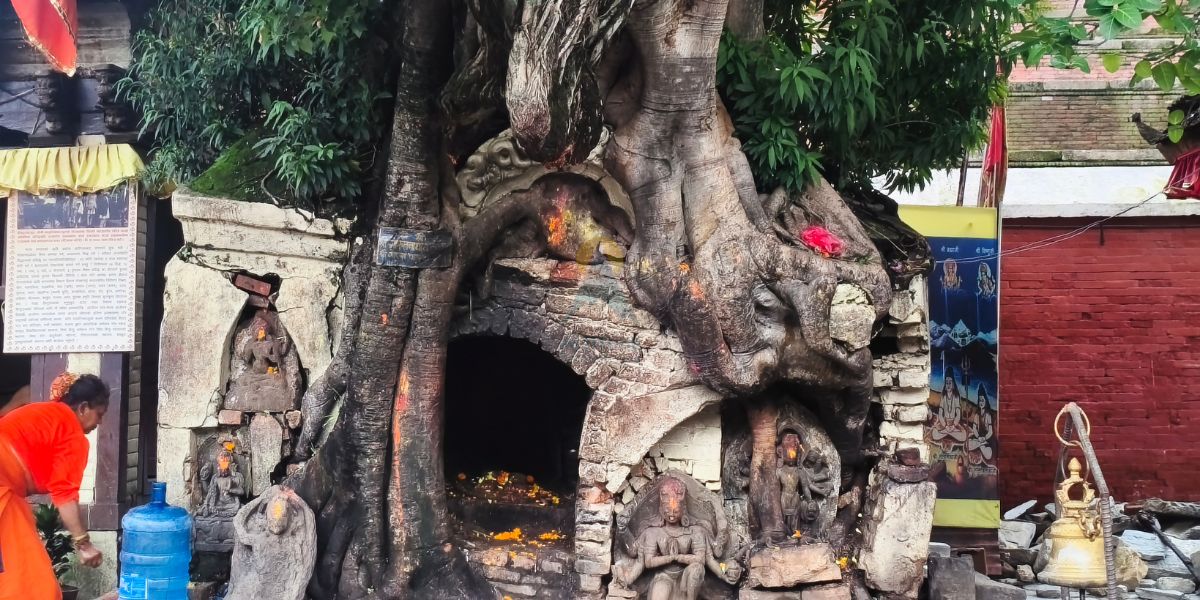
Above the temple, there is a big Peepal tree. At first glance, it looks like the tree is growing above the shrine and protecting it!
Beyond Temples: More Attractions
Besides the well-known pagoda temples, there are a few historic royal pavilions, public rest houses, and magnificent stone monuments in the Kathmandu Durbar Square.
Whether grand neoclassical halls or ancient wooden structures full of legends, the surrounding attractions show the rich architectural development and the vibrant daily life of the old royal court.
Gaddi Baithak
Gaddi Baithak was constructed by Chandra Shamsher Rana in 1908 AD. He was inspired by the European-style buildings during his visit to Europe and built them in a neo-classical style, especially to impress the foreign dignitaries.
This place, within the Hanuman Dhoka Palace, is a must-visit place, as it looks grand and really impressive.
Previously, the Gaddi Baithak was used for coronations and welcoming the heads of state from other countries. Now, it is just a museum and a place for observing the Kumari Chariot during the Indra Jatra festival with the presence of the Head of the State along with other important political figures.
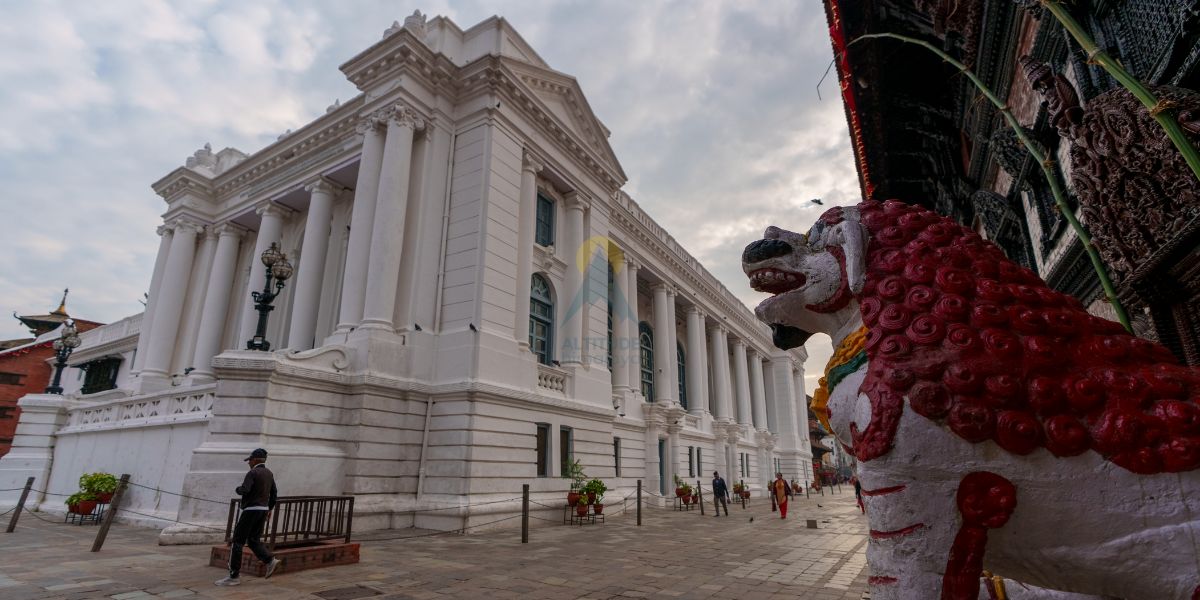
You will definitely be amazed by its arts and crafts inside and outside. Even I was surprised!
The architectural design inspired by Greek and Roman styles, the decorative patterns and wall panels, crystal chandeliers, Venetian mirrors, beautifully carved wooden decorations where kings and deities are carved, the space, the windows, and the color combination - each and every piece of this hall took my heart away.
Likewise, the big photo frames of several kings hanging on the wall look like they are speaking about history!
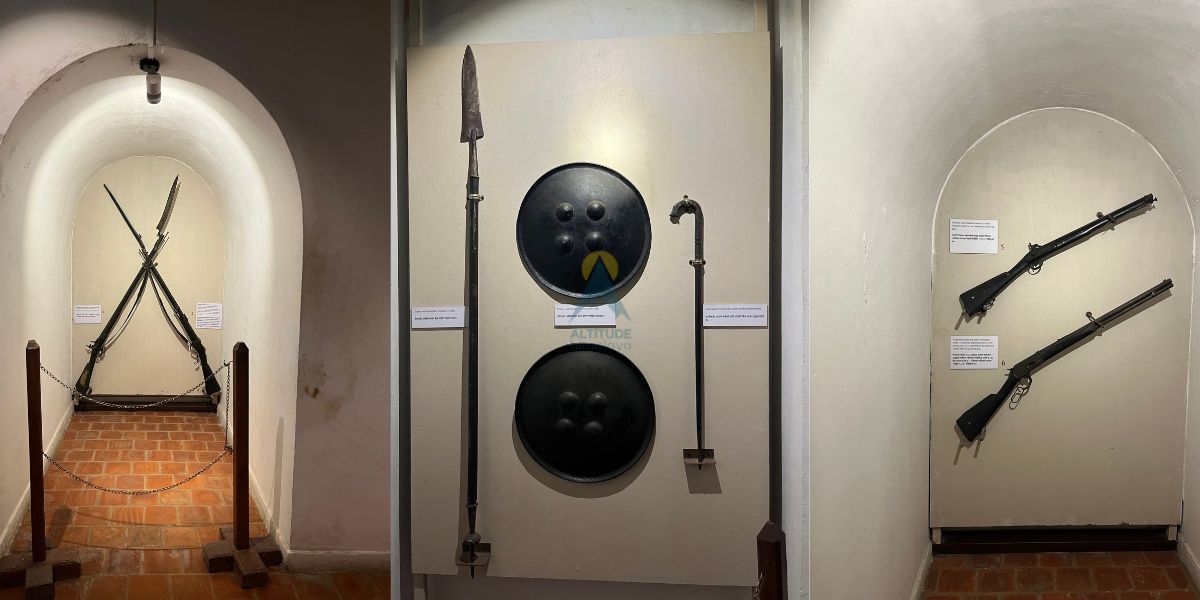
Another attraction of this monument is the gallery on the ground floor of the building. It includes various documents with photographs that depict the political and historical events, divided into Gallery One, Two, and Three.
You can see all the events from the very beginning: the Valley Unification Campaign launched by King Prithvi Narayan Shah to the Republic of Nepal. Also, there are weapons like a double-barrelled flintlock gun, a Winchester Model 1886 rifle, a spear, a shield, and a cane of wood with a sword hidden inside (used by Prithvi Narayan Shah).
Gaddi Baithak is located inside the Hanuman Dhoka Palace Museum complex, near Kumari Ghar. This ancient monument carries great political and historical significance.
Although it was damaged by the 2015 AD earthquake, it was renovated by the Nepal Government and the US Ambassador’s Fund and is now open for both internal and international visitors!
Kasthamandap/Maru Sattal
Maru Sattal, or the Kasthamandap, is the large three-storeyed building situated at the west of the square. It holds a unique place in the history of Nepal and is also regarded as the principal landmark of Kathmandu.
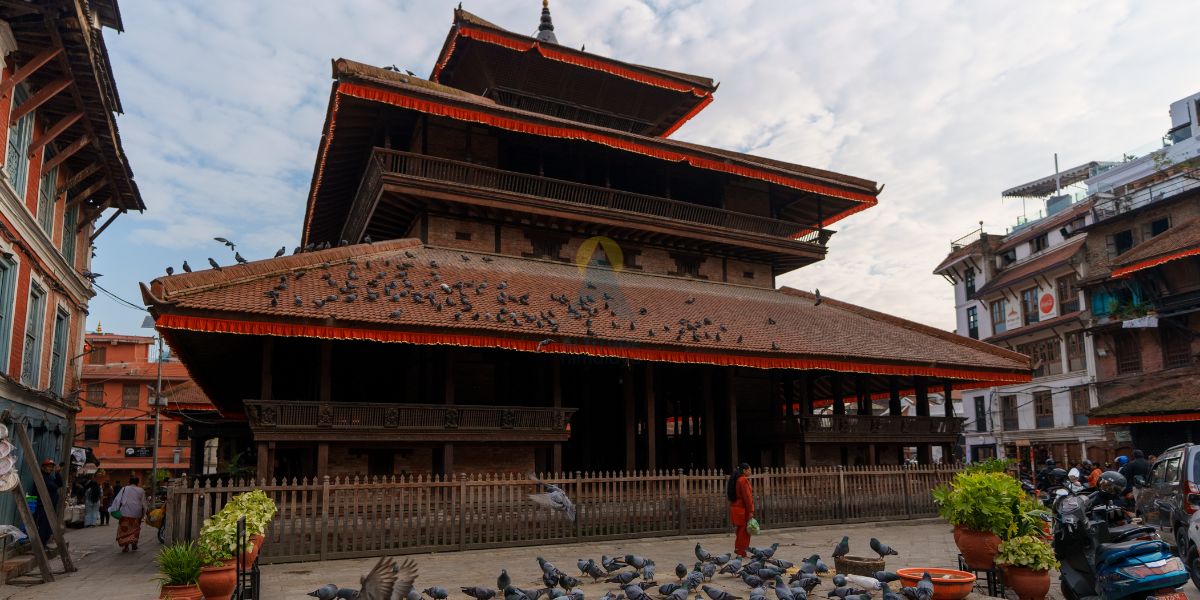
An interesting part is that the word "Kathmandu" was derived from this very building!
There is an ancient legend associated with Kasthamandap. Here is the one: Kalpa Brikshya (wish-fulfilling tree) had come in human form on the Lagan Jatra day of Rato Machhindranath Jatra to witness the event.
One of the priests of Machhindranath recognized and caught him. The priest then made him promise to build a Sattal (resting place) from a single tree. Then, after four days, Kalpa Brikshya sent a Sal tree, and the priest asked permission from the king to cut it down build a sattal.
After the completion, he named it Maru Sattal. Additionally, it was named Kasthmandap because it was made from wood of a single tree.
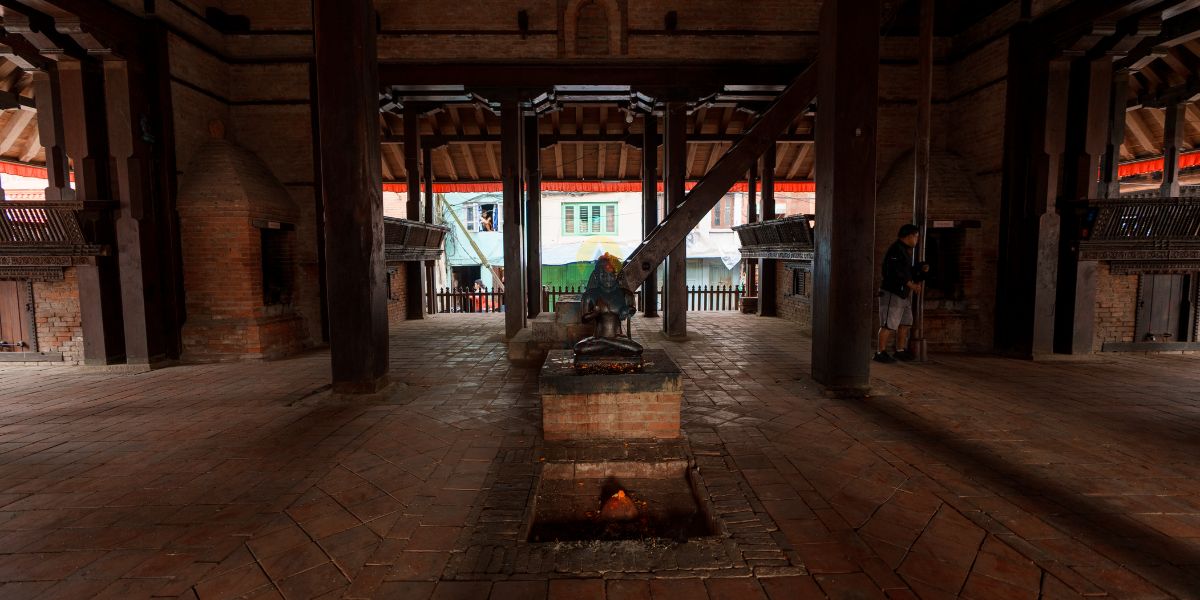
You can enter the sattal and explore the statue of Gorakhnath at the center and the different Ganesh statues at the four corners of the temple on the ground floor of the building.
Following Kasthamandap’s tragic collapse in the 2015 earthquake, the Department of Archaeology and the University of Durham conducted deep excavations of the foundation. Carbon-14 and OSL lab testing proved the foundation dates all the way back to the 7th-century Licchavi Era (approx. 700 CE).
After you visit Kasthamandap, you won’t believe that Sattal was destroyed by the 2015 AD earthquake. Yes, because it is already renovated with the same original appearance and doesn't look like it was damaged!
Singha Sattal / Silya Sattal
Nearby Maru Sattal, on the south, there is a three-storeyed building with four lions on the four edges. This building is well known as Singha Sattal, but the date of establishment of the temple is unknown due to lack of evidence.
According to a popular legend, this Sattal was built from the remaining woods of Maru Sattal. Hence, in Newari it is also called Silya Sattal (Sattal made from wood remains).
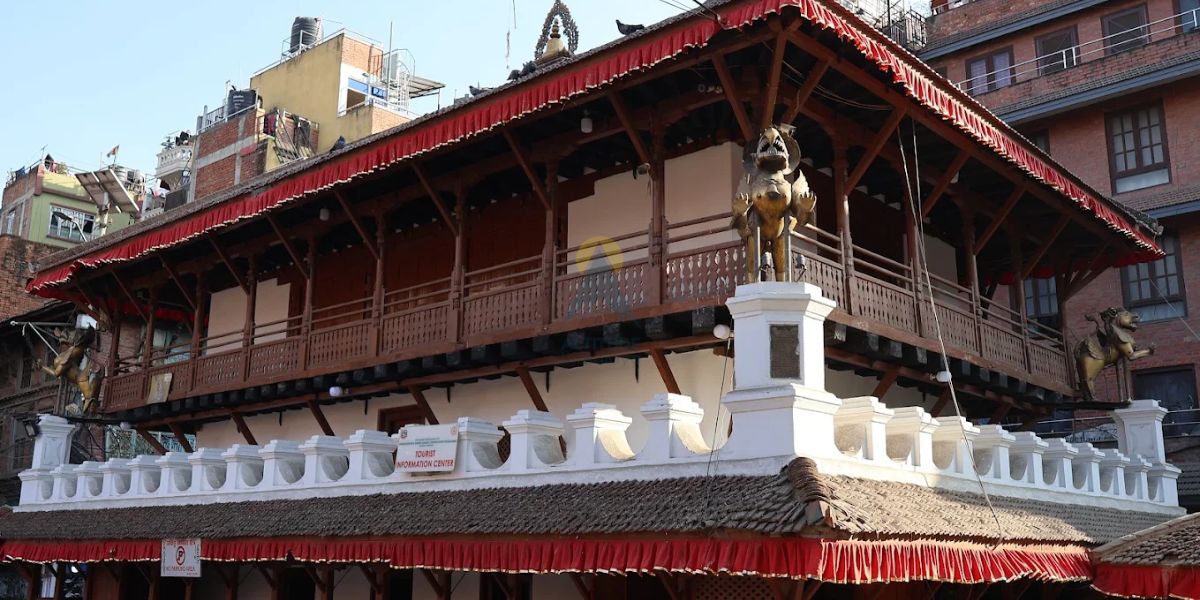
Singha Sattal is large in size and has been constructed in the traditional multi-tiered style.
There is an image of Garudavahana Narayana (Vishnu riding Garuda) on the upper floor. This image was found when a new house was being built (of Subba Dharmanarayan Salmia) after the old one was destroyed.
There are carved pillars on every side on the ground floor, and there is a porch where you can rest. The place is under private ownership, and it is not possible to obtain permission and go inside to watch.
Big Bell/Tago Gan Bell
Behind the Shiva Parvati Temple, there is a Big Bell. It was constructed by King Rana Bahadur Shah to impress the gods in 1797 AD, Asadh. Similarly, it is believed that the Big Bell throws out negativity and evil spirits.
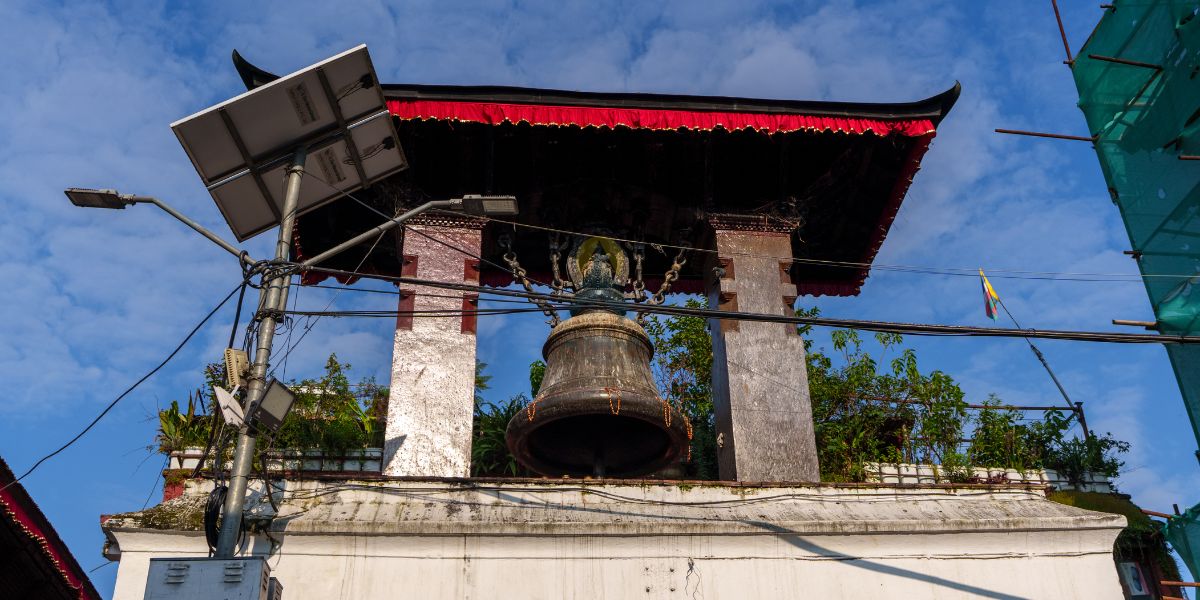
This bell is huge, and you will definitely be surprised by its size! I’d say it has helped in improving the grandeur of the durbar area.
Moreover, this bell is rung when worshipping Degu Taleju. Like this Big Bell of Kathmandu Durbar Square, the squares of Bhaktapur and Patan also have their own bells.
Big Drums / Nagaras
There is a Pati (like a public rest house, called Nagara Ghar) near the Krishna Temple where two big drums (called nagaras) are kept. When worshipping the Degu Taleju, the big bell along with these drums is also played.
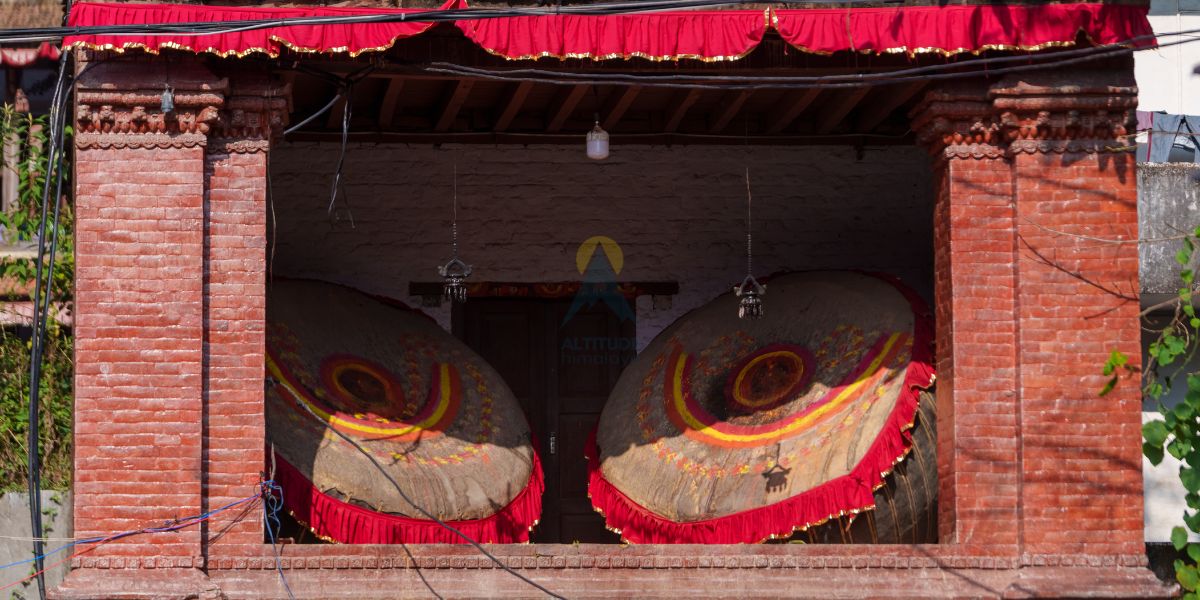
These drums were built in 1807 AD during the reign of King Girvan Yuddha Bikram Shah in the month of Shrawan. This information was provided by the person who made these drums from a copper plate inscription.
Additionally, on the same inscription, it is also written that in the Bada Dashain and the Chaitra Dashain, the drums were worshipped and provided with the offerings of he-buffaloes and he-goats.
Pratap Dhwoja (The Royal Pillar)
There is a raised platform (Dabali) in between the Jagannath Temple and the Krishna Temple.
There stands a tall stone pillar called Pratap Dhowja, where you can see the gilded statues of King Pratap Malla together with his family: two queens, Ananta Priya Devi and Pravati Devi, and five princes, Bhupendra Malla, Chakravartendra Malla, Nripendra Malla, Mahipatendra Malla, and Parthivendra Malla.
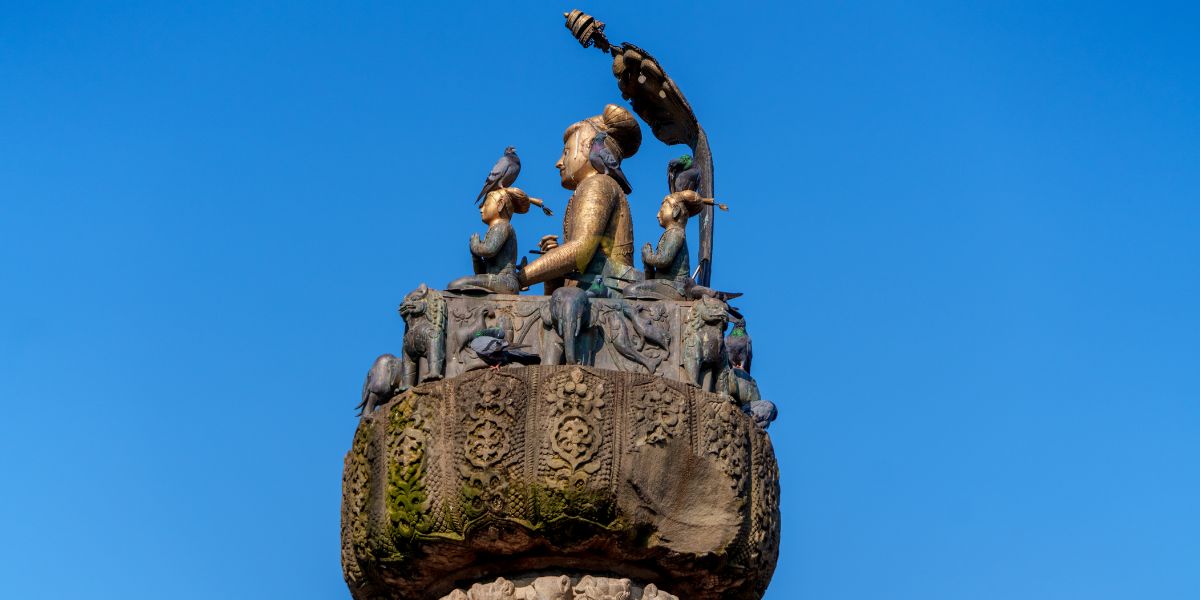
It was erected by Pratap Malla in 1727 BS in Bhadra, and an inscription is also displayed on the pillar, which refers to this as “Pratap Dhwaja”.
The pillar is about 3 storeys tall, and when judging by its height, it looks like two-thirds of the pillar is buried beneath the ground. This statue demonstrates the strength, determination, technical knowledge, and craftsmanship of our ancestors because it is massive, and constructing such monuments requires extraordinary engineering!
Hanuman Shrine
In the Lichhavi period, there was a tradition of placing a Garuda statue on the top of the stone pillar. One example is the Garuda statue of Changu Narayan Temple. On the other hand, the tradition of placing a statue of a human came during the Malla period.
So, before entering the Hanuman Dhoka Palace Museum, on the left side of the entrance, there is a big Hanuman shrine, which gave the place its name, “Hanuman Dhoka”. The statue was established in 1672 AD by Pratap Malla.
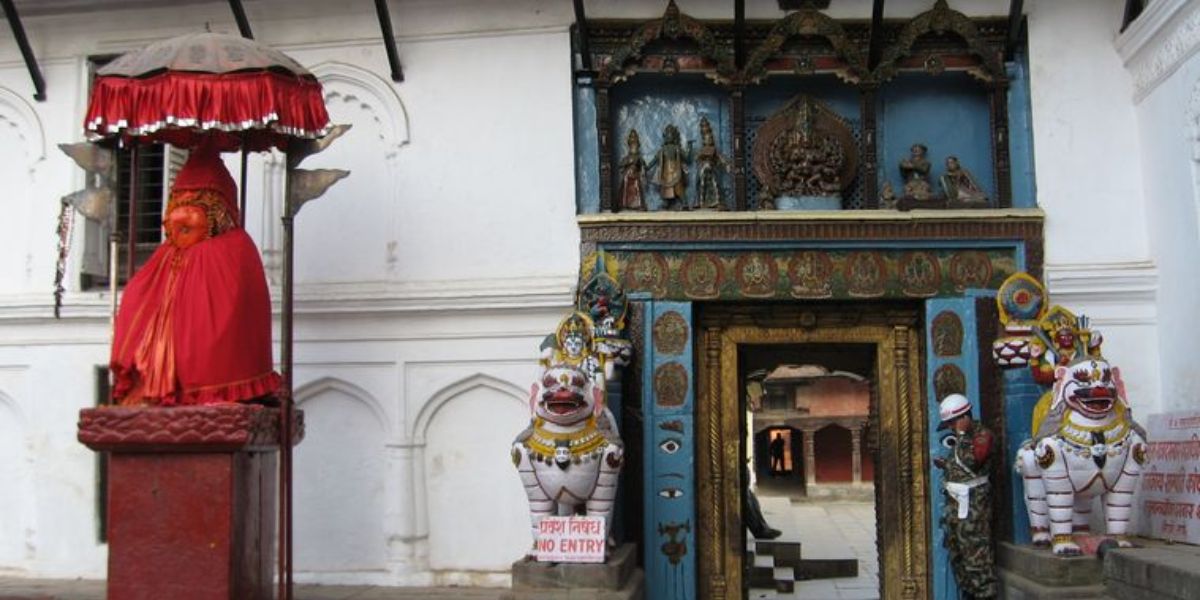
The statue stands on the top of a four-sided pillar where a mountain is depicted in the upper part, and the pedestal of the statue is also mountain-shaped.
On top of the pedestal, there stands a red statue of Hanuman, usually with red clothes covered with a red umbrella. In case you don’t know, Hanuman is famously known as the “monkey deity”.
Panchamukhi Hanuman Temple
On the eastern side of Nasal Chowk, there is a temple of five-faced Hanuman (Panchamukhi Hanuman) that is five-storeyed. The temple was built by King Pratap Malla again, in a unique circular shape.
However, we can only admire its beauty from outside because we are not permitted inside.
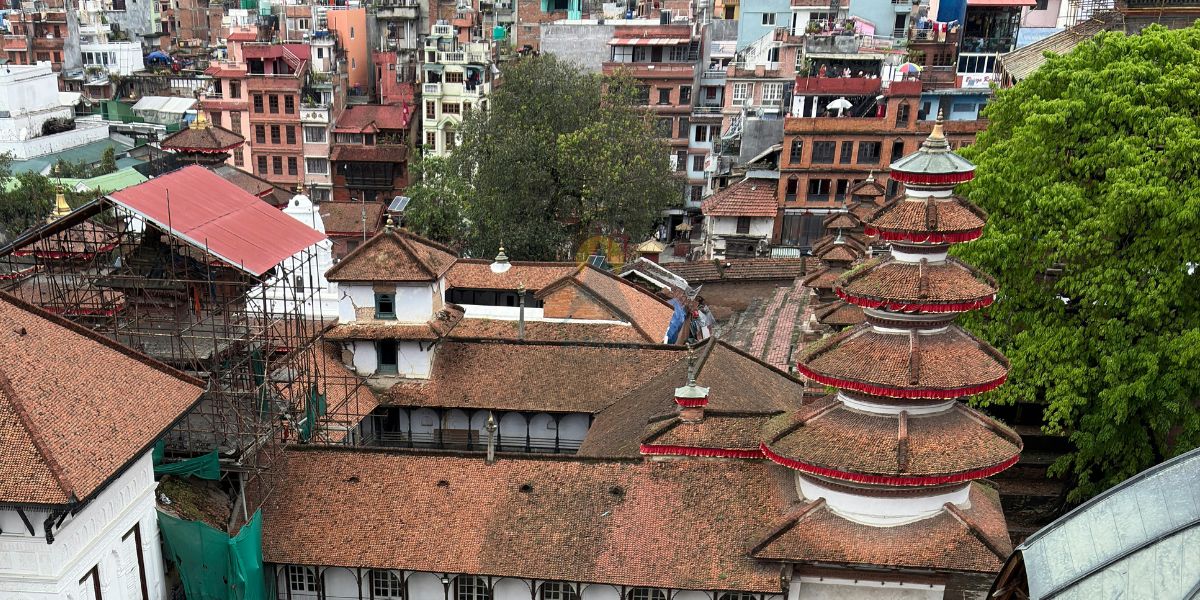
Moreover, the idol of five-faced Hanuman (Panchamukhi Hanuman) is inside the temple. But daily worship is conducted by secret rituals by the Karmacharya priests.
This temple is also called the umbrella-shaped temple and even looks like that when observing it from closer.
Dashain Ghar
Dashain Ghar, aka Dashain House, is located on the eastern side of Mul Chowk and is prohibited for the entry of the general public.
There is a small bell offered by the Queen Suvarna Prava Devi in 1802 AD inside this building. It is named Dashain Ghar because huge celebrations and worship are performed here during the Dashain festival.
Nag Pokhari
Nearby the Butterfly Garden (Putali Bagaicha), there is a pond called Nag Pokhari. It is attractive, and its color is what attracts most visitors!
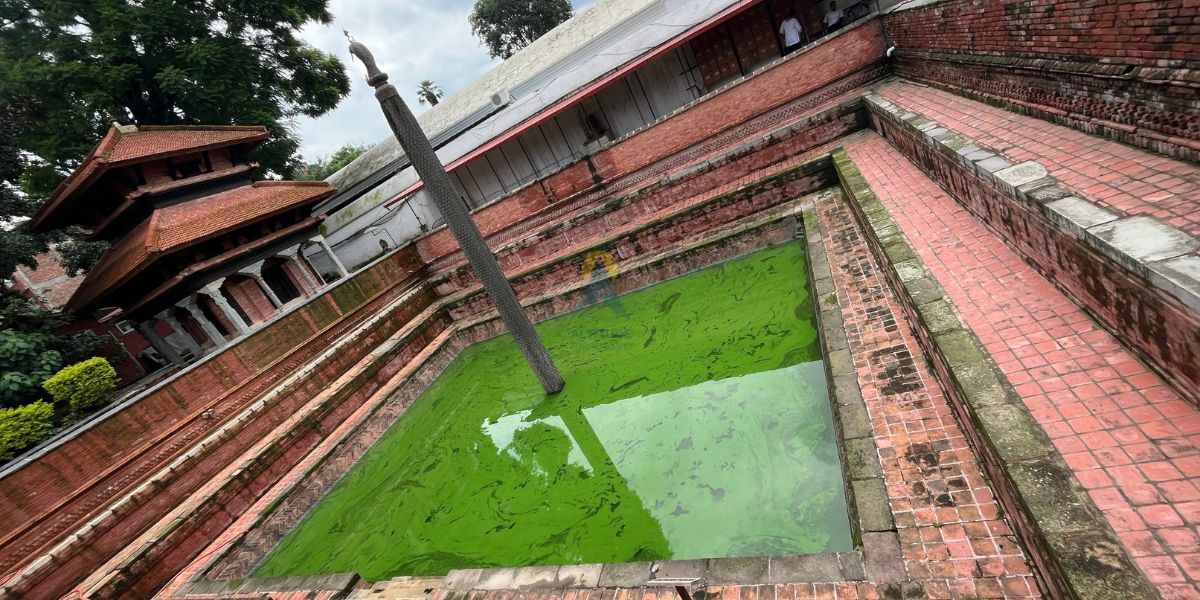
However, you are not allowed to step inside and watch it from above only. There is a tall pillar inside the pond, and on top of it, you can see a serpent with its pointed tongue.
This pillar was bought by King Pratap Malla from Tawa Pokhari, Bhaktapur, after defeating Bhaktapur and was placed inside this pond in Kathmandu Durbar Square.
Four Towers of Hanuman Dhoka Palace Museum
Hanuman Dhoka Palace, built back in the 15th century, is an incredible masterpiece of that time and still continues to impress with its grand courtyards, wide spaces, and history. I am now going to explain something important that many people miss!
They are the four towers built inside the Hanuman Dhoka Museum, and they are Kirtipur, Bhaktapur, Lalitpur (Patan), and Kathmandu (Basantapur) towers.
They were actually commissioned by King Prithvi Narayan Shah and his successor (Pratap Singh Shah) post-unification (after 1768 AD) to commemorate his victory over and unification of the valley's ancient principalities (Kathmandu, Patan, Bhaktapur, and Kirtipur).
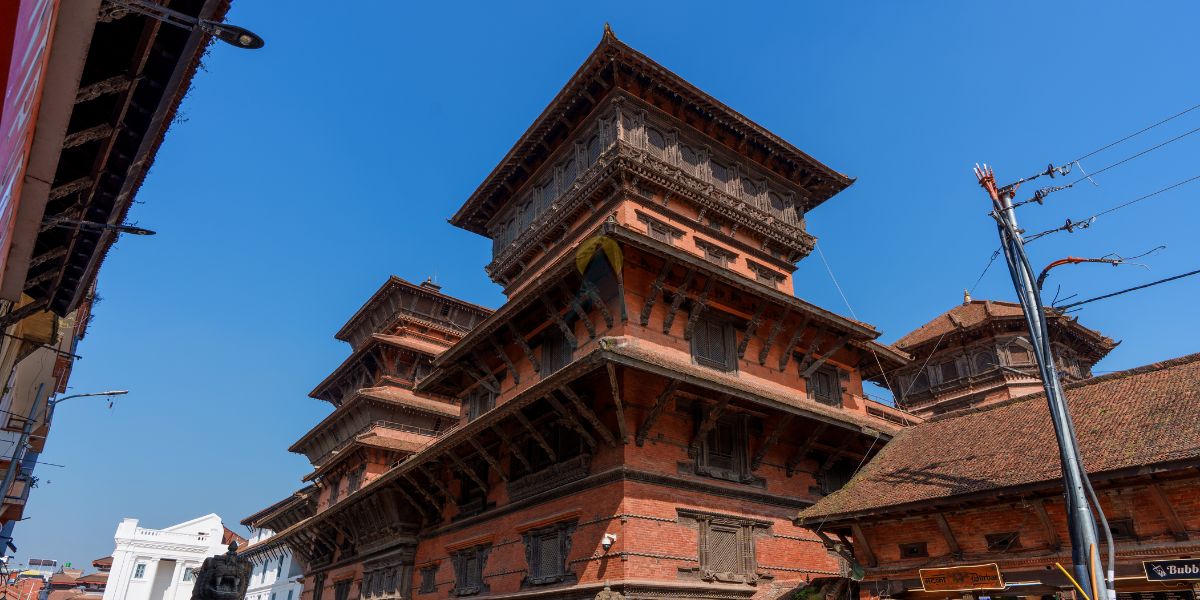
Their access varies based on post-earthquake restoration work. Basantapur Tower has historically been the primary tower open to public climbing, while the smaller corner towers remain restricted or part of gallery views only.
Oh! Please mind your head when climbing the staircase of this tallest tower, also famously known as Nau Talle, built by Prithvi Narayan Shah in 1770.
As in the name, the tower is nine-storeyed, and from here you can even witness the Monkey Temple, Swayambhunath Stupa from the ninth floor. Likewise, Freak Street, nearby areas, and other towers can also be seen.
It is believed that the king used to watch the homes and the families of general citizens from the top floor to find out whether they had cooked their meal or not. If not, the food and cooking ingredients were sent to the respective house.
Courtyards and Chowks
The interior of the Hanuman Dhoka Palace complex is organized around a series of historic courtyards, or chowks. Each courtyard served a unique purpose, ranging from royal residential quarters and administrative halls to sacred ritual grounds.
Nasal Chowk
As soon as you enter the Hanuman Dhoka Palace, you will be on the ground of Nasal Chowk, which is the biggest one.
Hold your breath and control your emotions because the beauty of this courtyard will totally surprise you! You will be surrounded by the artistic buildings that were built and developed by Malla Kings and Shah Kings in their era.
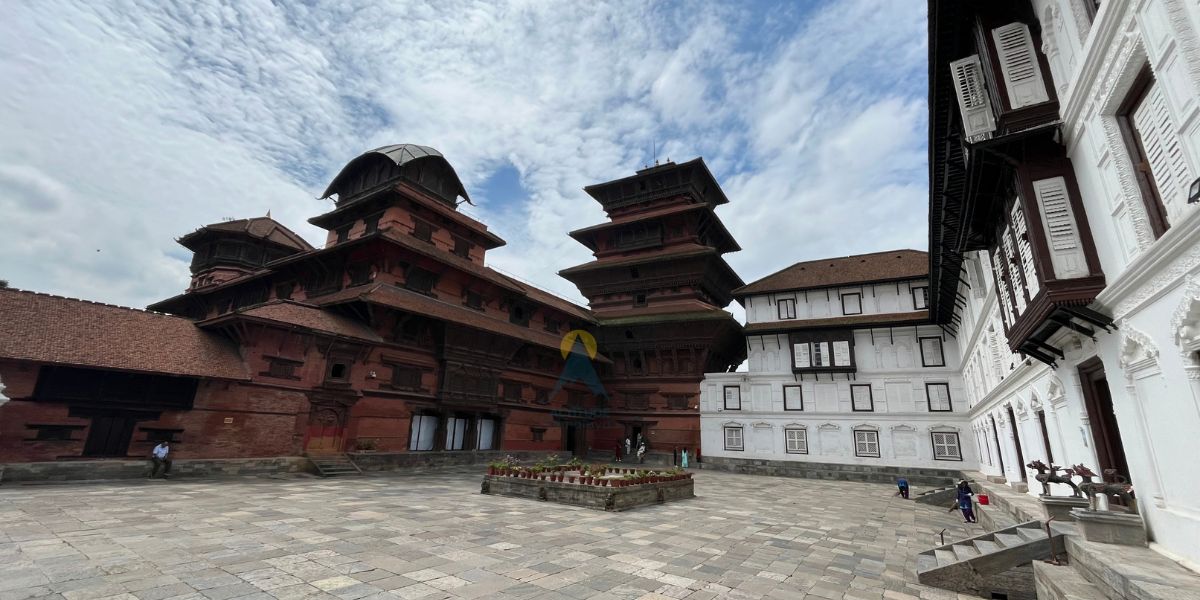
There is a small shrine of Natyeshwor (also called Nasal Devta) on the eastern side here. Consequently, this courtyard is named after the same deity, Nasal Chowk.
During the Malla period, dance performances, both training and the dance presented in the royal palace, used to be held here!
You can still see a Dabali in the centre of this chowk. In the Malla period, this Dabali was symbolized as the throne of Indra. However, later in the Shah era, this was used to crown the Shah kings. Also, in the past, a gold idol of Indra was brought here and kept in the Dabali.
The chowk is visible as soon as entering from the entrance, so it used to be a greeting and meeting place for the king with the citizens.
It was during the Shah period that the chowk became extra special and received more importance because the crowning ceremonies of the Shah kings started being held here in the Nasal Chowk!
Additionally, there is a huge statue of Narasimha, Vishnu’s form of half-lion and half-human, established by King Pratap Malla in 1673 AD. And there are two small statues of King Pratap Malla and Hiranya Kashyap on either side of the main statue.
The major attractions of this chowk are the royal bier/palanquin (Myana) used specifically for carrying deceased royals, the marriage palanquin used during the 1970 royal wedding of Prince Birendra and Princess Aishwarya, and an idol of Maha Vishnu.
Wait! Don’t forget to take a glimpse of Sun Dial (Saurya Ghadi), a traditional watch for telling time, gifted by a foreign pastor.
And don’t be confused with the door that has eyes carved in it; that is the religious room (Nishan Ghar) where religious deities of the Shardul Jung Gulma are kept. And a small wooden pillar in front of this was used for sacrificing animals in Bada Dashain and Chaite Dashain.
Dakh Chowk
It is located on the western side of Nasal Chowk. All the arts and crafts of this chowk were made during the Shah dynasty.
Likewise, this courtyard was well known till the reign of King Prithvi Bir Bikram Shah. Additionally, the name Dakh Chowk also came from the remembrance of Dakh (a tropical variety of Bengali grapes) that was grown here!
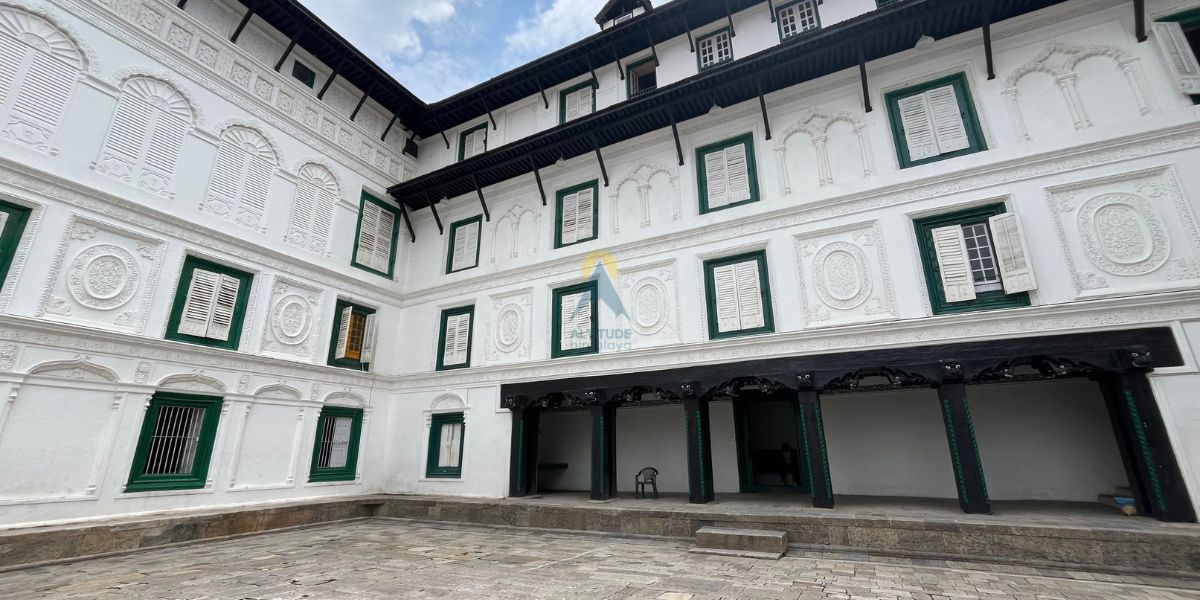
Three sides of this courtyard are surrounded by big buildings, and there is only a big wall on the western side. You can see a cannon (top) that was snatched by the brave Nepalese during the Nepal-Tibet war from the Tibetans.
Lohan Chowk/Basantapur Chowk
This courtyard is located to the south-east of Nasal Chowk. Sometime in the past, there was a Tejarath Adda in this chowk, so it is also called Lohan Chowk or Tejarath Chowk.
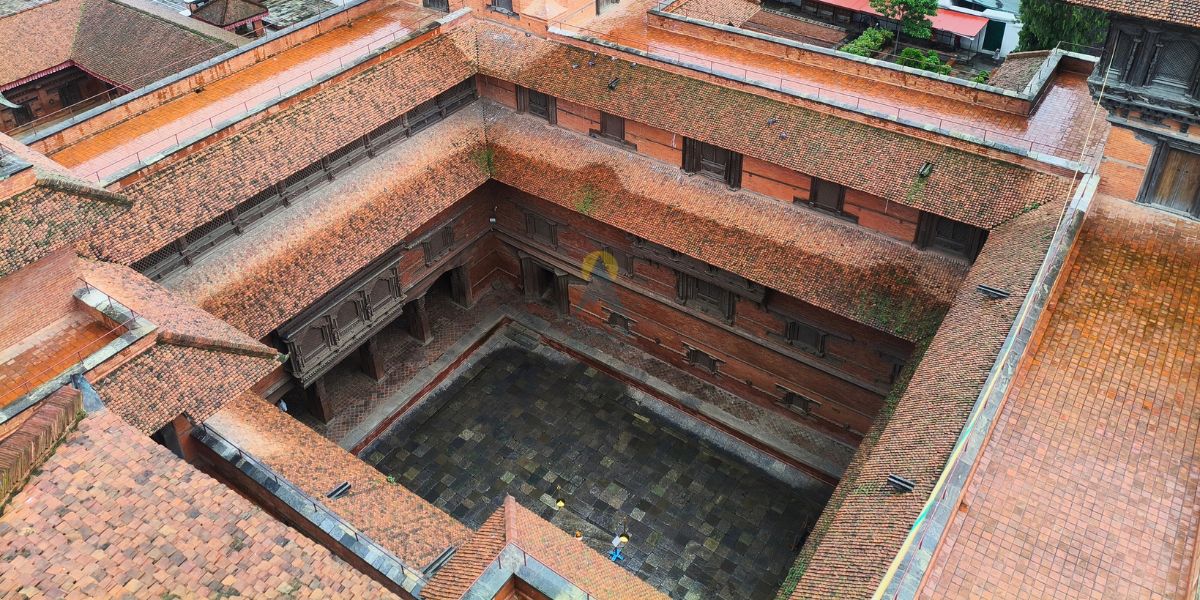
According to an old document of the Shah dynasty, this chowk is written as Basantapur Chowk too. Additionally, some historians mention that the first Nepal Bank was established here.
There is some debris of a Shiva statue on the eastern porch of this chowk. It is still unknown where this debris came from!
Other Chowks That Are Restricted to Public
Beyond the main accessible areas, certain inner courtyards of Hanuman Dhoka remain closed to general visitors. These restricted chowks are reserved for high-level priests, maintaining their sacred and private functions to this day.
- Masan Chowk: It is believed that during the Malla and Shah dynasties, this chowk was used for performing the last rituals (Antim Sanskar) when any of the royal family members died. At that time, there was fear of being attacked by other parties, so the royalties wouldn’t go far for such rituals and thus performed near the royal palace.
- Mul Chowk: This chowk is only accessible to the priests and the personnel of Sardul Jung Gulma. 54 he-goats and 54 he-buffaloes are sacrificed here on the day of Maha Asthami (eighth day of Dashain) to offer to the Taleju Bhawani. Additionally, on the day of Maha Nawami, the Taleju Bhawani here is given access to the general public.
- Nhulachhen Chowk: This chowk is the first chowk where King Prithvi Narayan Shah stepped into after attacking Kathmandu. It is also known as the seat of Kausi Toshakhana and is not as well known as other chowks of the square. It is also believed that the king stayed his first few nights in this place during the attack. The original construction date of this chowk is unknown, but it was reconstructed many times during the Rana era.
- Vayu Chowk: It is a lesser known chowk, which remains prohibited for the public to visit. There is a temple here that is only dedicated to the god of wind and breath.
- Trisul Chowk: It was too easy to name the courtyards previously because it is visible from this chowk. There is a huge Trisul kept here, and the courtyard became Trisul Chowk.
- Sundari Chowk: This chowk is a beautiful courtyard built by King Pratap Malla for his queens. It is the smallest courtyard yet one of the most pleasing. The main attraction of this chowk is the sculpture of Lord Krishna subduing the poisonous Kaliya Naag of the Yamuna River.
- Mohankali Chowk: It is also one of the beautiful creations of King Pratap Malla, where there is the finest golden water spout. Another attraction here is the image of a man (believed to be Bhagirath) who brought Ganga down to earth from heaven and a monolithic image of Astamatrika (eight mother goddesses).
Festivals Celebrated in Kathmandu Durbar Square
Kathmandu Durbar Square comes alive through its vibrant cultural celebrations, where ancient traditions transform the historic plaza into a stage for living heritage.
From grand chariot processions to masked dances, these annual Kathmandu Valley festivals showcase the deep spiritual devotion and timeless communal spirit of the place.
Indra Jatra/Kumari Jatra
Since the vedic period (Baidik Kaal), Lord Indra got special greetings and an honor as the king of deities, and Indra Jatra has been celebrated for centuries!
Although there are no Lichhavi inscriptions that mention Indra Jatra, there are a few things written about Indragosthi, and it seems like it was associated with the Indra Jatra and Kumari festival that’s celebrated today.

Indra Jatra is built around a local legend, and that legend has no single fixed version. It has been passed down in Kathmandu Valley for generations, so the details change depending on who tells it.
Even the name of Indra's mother changes (Dagin in Newari and Dakini, Basundhara, or Aditi in other tellings). In short,
- Lord Indra came to Kathmandu to pick Parijat (night-flowering jasmine) for his mother.
- He was mistaken for a thief and tied up by the locals.
- Later, he was released after his mother promised dew or mist for the crops and a way to heaven for the dead.
Well, King Gunakamadeva is believed to have started Indra Jatra in the 10th century in Kathmandu as a cultural and religious event to honour Indra and remember the dead.
The early festival included raising a wooden pole called the Yosin, worship of Indra, a masked Dagin searching for her son, masked dances of Pulukisi (Airawata), and Upaku Wonegu, where people honour the deceased.
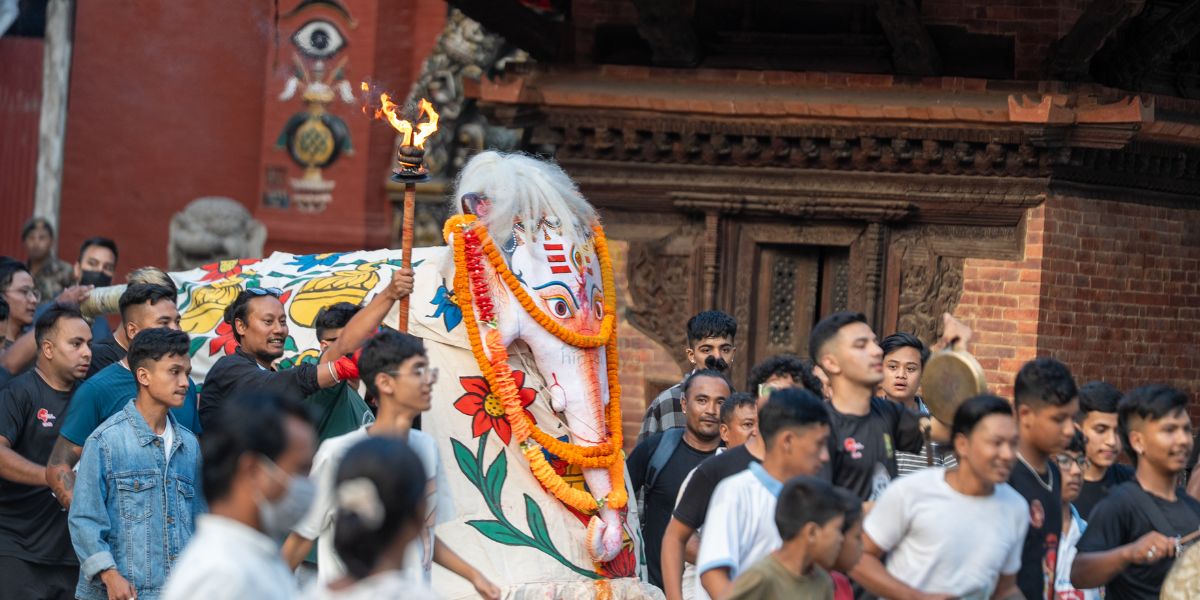
Also, there’s this: according to ancient chronicles, on the second day of the dark fortnight (waning phase of the moon) (Bhadra Krishna Dittiya), in 1436 BS, an important person, Dijja Raj, brought a torana from Pulchowk, Patan, and celebrated Indra Jatra in Kathmandu.
Most of what you see today was added in the 18th century, when King Jaya Prakash Malla ruled Kathmandu. He introduced the chariot procession of the living goddess Kumari, along with the Ganesh and Bhairav chariots and the Lakhey dance. The festival runs for 8 days and is still celebrated in much the same way.
During this time, Kathmandu Durbar Square comes alive with processions, chariots, and ceremonial rituals. It starts with the erection of a wooden pole from a Sal tree (Yosin) at Basantapur Durbar Square, and along with the chariot of Kumari, it is also taken out in the procession through the streets!
The processions last for three days and are celebrated in a grand way. Thousands of devotees gather in the courtyard in front of the Gaddi Baithak and Kumari Ghar. Even the President, Prime Minister, and other important figures visit the area and receive blessings from Kumari.
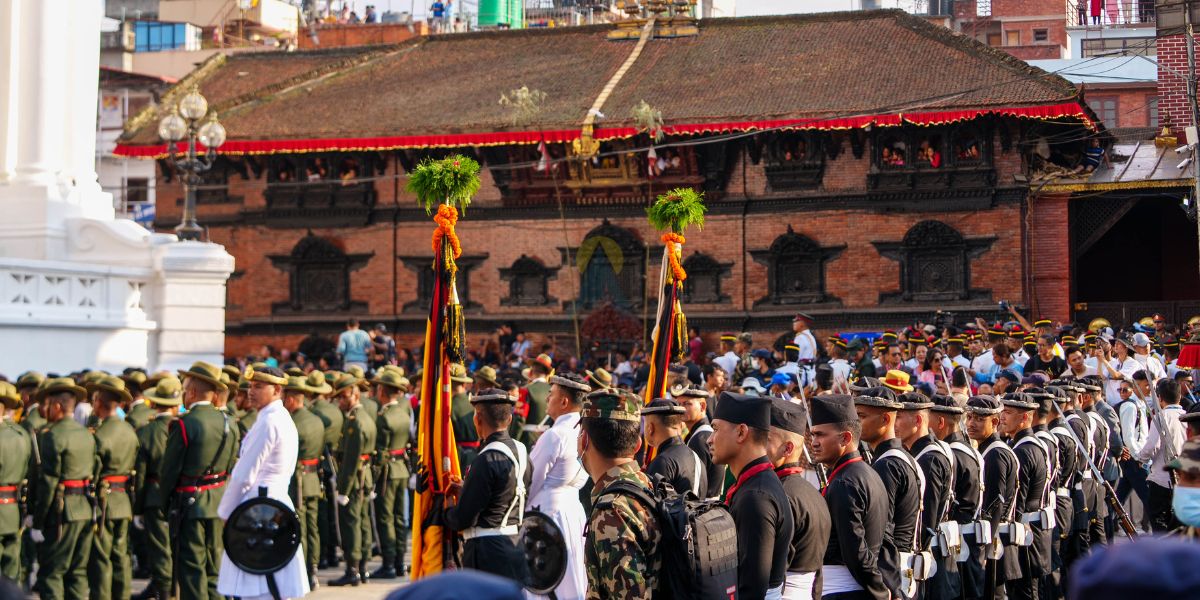
In 2026, President Ram Chandra Paudel attended the celebrations at Gaddi Baithak alongside Acting Prime Minister Swarnim Wagle (in the absence of Prime Minister Balen Shah), Vice President Ram Sahaya Prasad Yadav, Home Minister Sudan Gurung, and various government ministers/officials to observe the chariot procession and receive blessings from the Living Goddess Kumari.
The first route procession covers the lower city (known as Kwaneya) and takes place on the main day of Indra Jatra (Day 3). It starts from Basantapur and follows through Maru > Chikanmugal > Jaisidewal > Lagan > Brahma Marga > Wonde > Hyumata > Kohity > Bhimsensthan > Maru > Basantapur.
The second route covers the upper city (known as Thaneyaa) and takes place on Day 4. It starts from Basantapur and follows through Pyaphal > Nyata > Naradevi > Tengal > Nhyokha > Asan > Kel Tol > Indra Chowk > Makhan > Basantapur.
The third procession takes place on the final day (Day 8), which is known as Nanichaya. On this day, the procession starts from Basantapur and follows through Pyaphal > Nyata > Naradevi > Kilagal > Bhedasingh > Indra Chowk > Makhan > Basantapur.
During the first two procession days (Days 3 and 4), men pull the chariots of Goddess Kumari, Lord Ganesh, and Lord Bhairav, but on the final day (Day 8 / Nanichaya), the chariots are pulled by women devotees.
I am mentioning this again: if you want to see Kumari more closely and clearly, then participating in this festival is a great opportunity to see her.
In addition, Swet Bhairav is also displayed, and a Bhairav statue is also placed in front of Maju Dewal. Likewise, interesting depictions of Lord Vishnu related to Dashavatara (his ten incarnations) are displayed in Trailokyamohan Temple throughout Indra Jatra.
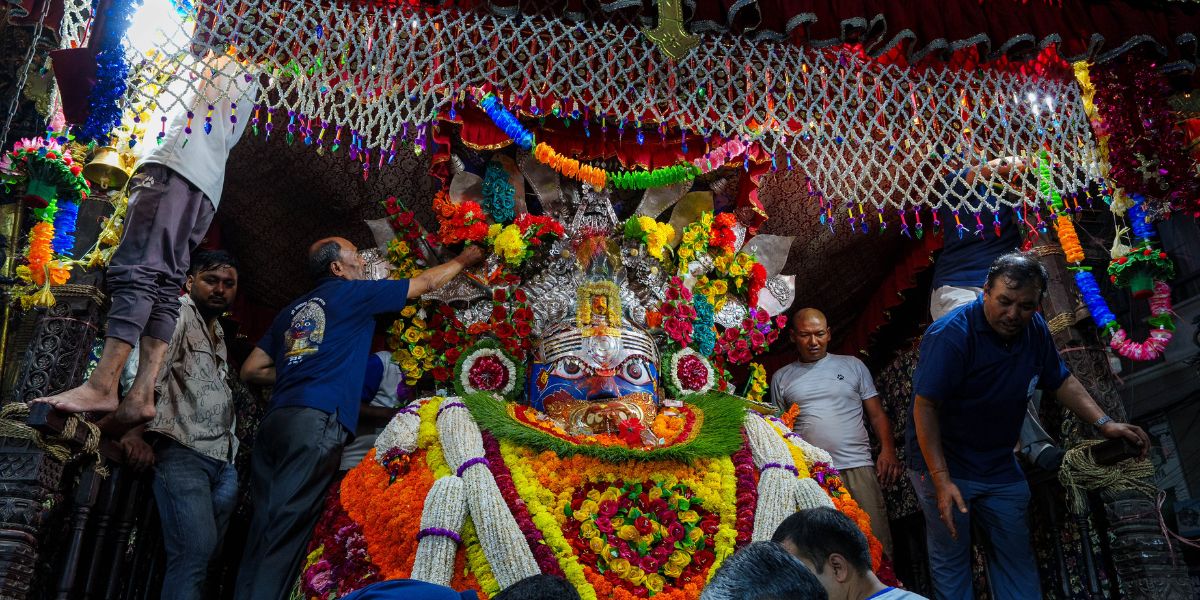
Akash Bhairab is displayed in Indra Chowk. Moreover, Indra isn’t just celebrated here in Kathmandu. Such statues of him are displayed in different places of Nepal during Indra Jatra.
Note: Indra Daha of Dahachowk is filled with devotees taking a holy bath during Indra Jatra festival.
Gai Jatra
In Newari, Gai Jatra is also called Sa-Yat. It is celebrated on the first day of the waning (darkening) moon during the month of Bhadra. It usually falls in late August or the first week of September in the Gregorian calendar.
The Gai Jatra Festival is celebrated in a grand way by the Newari community. It is celebrated in remembrance of the deceased, where a cow is paraded around the specific place. It is believed that the cow will help you cross the Vaitarani River that leads to heaven, so the cow has great importance in this festival!

Previously, in Hanuman Dhoka Square, if any member of the royal family was deceased, then the Gai Jatra was processed from Singh Dhoka to Hanuman Dhoka, then went through Trisul Dabali, Mul Chowk, and Nasal Chowk, and returned from Subarna Dwar (golden gate). The royal family distributed fruits and sweets for them.
But now, the traditions have changed in Kathmandu in the past three decades. It is also known as Saparu in Nepal Bhasa (alternative name of Sa-Yat).
According to an ancient manuscript, it was during the time of Jayasthiti Malla that it was named ‘Saa yaat’ and was already an ancient Newar festival celebrated all over the Nepal Mandala long before. Pratap Malla (who is often known to be the one who started it) was actually only the one to add humor to it!
Even today, the Gai Jatra procession passes by the Hanuman Dhoka Durbar Square. People gather around the Basantapur early in the morning; young boys can be seen with their painted faces, dressing like an animal.
Families who lost their members take part in the procession, and they offer beaten rice (baji), fruits, or money as an offering to the participants in the procession.
Dashain
Dashain is one of the major festivals of Nepal that is celebrated with great fanfare. This festival is a celebration of victory over misfortune, and Goddess Bhawani is worshipped during this festival.
In this festival, the Dashain Ghar of Hanuman Dhoka seems busy. As mentioned earlier about the connection of Dashain and Dashain Ghar, it was a place where barley shoots (Jamara) were kept inside for the royal families.
Another interesting fact is that there is still the tradition of bringing Fulpati (an assortment of auspicious flowers, leaves, and plants) on the seventh day of the Dashain festival from the Kalika temple of Gorkha Durbar. It is brought to Hanuman Dhoka Durbar, and it is kept there.
This Fulpati offering tradition at Gorkha Durbar was started by King Drabya Shah in 1616 BS, and the tradition of sending Fulpati from Gorkha to Hanuman Dhoka was started by Prithvi Narayan Shah after he conquered the Kathmandu Valley.
Likewise, on the eighth day (Astami), Taleju Bhawani is brought to Mul Chowk from the Taleju temple and is worshipped by the priests with great reverence. And on the same night, huge worship is also performed in a secret way for the whole night.
Now, on the ninth day (Navami), 54 he-goats and 54 he-buffaloes are sacrificed in the Mul Chowk. Additionally, on this day, the Taleju Bhawani Temple is open to the public. Yes, if you’re a Hindu and want to visit the temple, then you may plan your visit! There is a huge line to worship the god and seek blessings.
Again, on the 10th day (Bijaya Dashami), different worships are performed in the Dashain Ghar and Mul Chowk for several hours.
In the past, Khadga Jatra was also celebrated on this day, which started around 10 or 11 PM at night; even kings used to participate in this festival. But these days it is becoming extinct and is being celebrated only in some places.
Changu Narayan Kalash Jatra
Changu Narayan Temple is one of the major attractions of Bhaktapur district, and Kalash Jatra is one of the grand festivals here.
It is celebrated on the 12th lunar day (Shrawan Shukla Dwadashi) in the month of Shrawan/Bhadra and Poush Shukla Purnima in the month of Poush, twice a year!
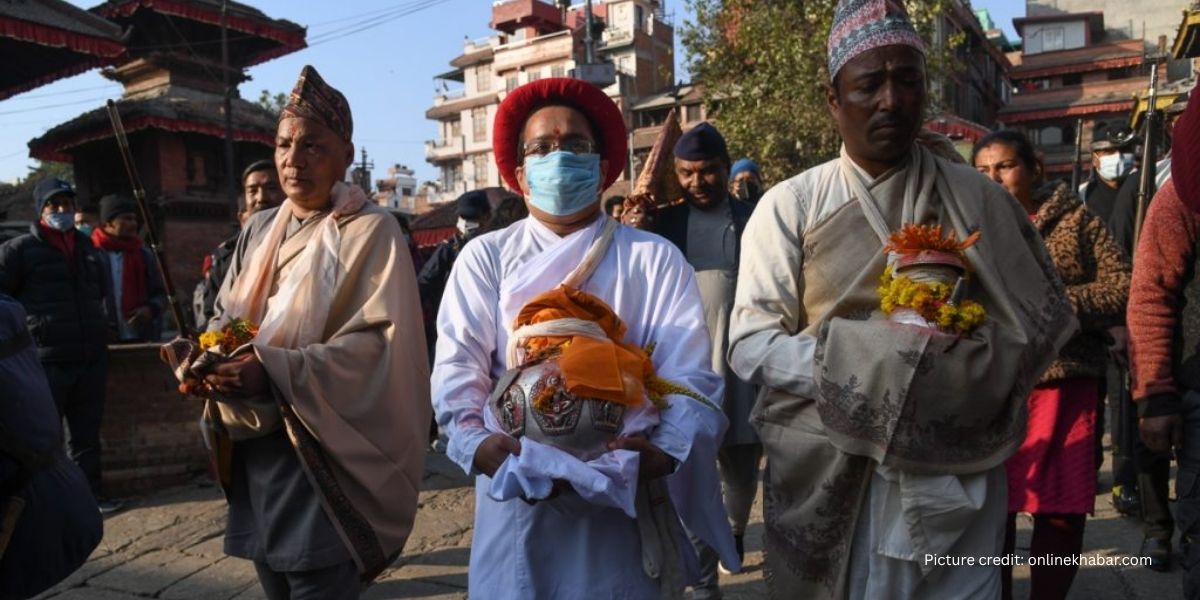
On both of these days, three sacred silver kalash symbolizing Laxmi, Saraswoti, and Lord Changu Narayan are brought to Hanuman Dhoka.
The ceremony starts from the western door of Changu Narayan via Sankha Daha, Boudhha, Chabahil, Sano Gaucharan, Naxal Bhagwati, Nag Pokhari, Kamaladi, Jamal, Rani Pokhari, Asan, and Indra Chowk, Makkhan, and it is brought to Kathmandu Durbar Square.
This procession is carried with Gurju Paltan (or Guruju ko Paltan), along with musical instruments. Living Goddess Kumari is also brought, and religious rituals are performed at the Taleju Temple!
Holi Festival
The Basantapur square is also a great gathering place to celebrate the Holi festival. On this day, the area is filled with color; a perfect blend of canvas and joy is depicted on this day.
Holi is celebrated as the victory of good over evil. It is the story of Prahlad, whose devotion to Lord Vishnu saved him from the fire and killed Holika. So, it is also a festival to celebrate the victory of Lord Vishnu over the demoness.

On this day, people of every age gather together in Kathmandu Durbar Square premises to celebrate the festival of colors. Putting color to each other’s face (and sometimes splashing water) is what is done!
Moreover, some organizations or groups/communities even organize different programs filled with fun and entertainment around the area. It also marks the start of spring, so it’s one of the best times to visit Kathmandu.
Kathmandu Durbar Square, one of the seven monument zones of the Kathmandu Valley UNESCO World Heritage Site, continues to preserve the centuries-old temples, museums, and courtyards and portrays the historic story from centuries ago.
So, it is essential to visit the site with careful planning and awareness. Here are some tips:
- Hire a Professional Tour Guide: It will be a great idea to hire a guide during your visit to Kathmandu Durbar Square, as you can receive valuable insights about the museums, temples, and other attractions of the square in detail. Also, the guide will help you deal with language problems.
- Buy the Entrance Ticket: The Durbar Square is free for Nepalese citizens, but other nationals should get a ticket or entrance pass from nearby ticket counters to enter the Durbar Square complex. This pass/ticket will allow you to visit the whole Durbar Square, including museums of the complex.
Ticket Information: The ticket counter of the square is open every day, from 09:00 AM to 05:00 PM.
Price: NPR 500 for SAARC/BIMSTEC nationals and NPR 1000 for all other foreign tourists.
- Take a Daypack: Don’t forget to take your necessities (water bottle, sunglasses, sunscreen, hat, and the ticket you bought).
- Request Before Photos and Videos: General photography and video recording are permitted in most areas. But no film, no capture in the museum areas, temples, and gallery zones. Additionally, check the notice or ask for permission before taking photos. Most importantly, photographing the Living Goddess Kumari is strictly forbidden when she appears at the window of the Kumari Ghar.
- Put on Your Comfortable Footwear: Yes, please put on comfortable shoes at Kathmandu Durbar Square as you are exploring for an hour here on foot! There are many temples and museums you will visit, and the complex is also too big.
- Respect the Culture and Heritage: You can wear clothes of your choice, but keep in mind that the square is surrounded by many temples; please dress in a plain manner, take off your shoes before entering, ask for consent from people before filming, and do not litter!
- Best Time to Visit: Early morning is quite peaceful and ideal for visitors who prefer fewer crowds. Otherwise, you can visit either in the daytime or evening according to your preferences and schedule. Afternoon is ideal for photos, food, and drinks, whereas evening is best for softer lights and vibrant weather. Most importantly, if you want to witness or participate in the festivals, then do visit during Indra Jatra (usually September). Our Indra Jatra Festival Tour should be ideal for you!
- Try Authentic Newari Food: You will find many small local shops that prepare local Newari food early in the morning. However, many restaurants and cafes also sell a variety of Newari food throughout the day. Some of them you shouldn’t miss are Bara, Samay Baji, Gwaramari, Yomari, Choila, Chatamari, etc.
- Try the famous Indrachowk Lassi: It’s mixed with dry nuts and khuwa. So, if you’re thirsty or want a refreshing drink, this would be a really good option!
Kathmandu Durbar Square Nearby Attractions
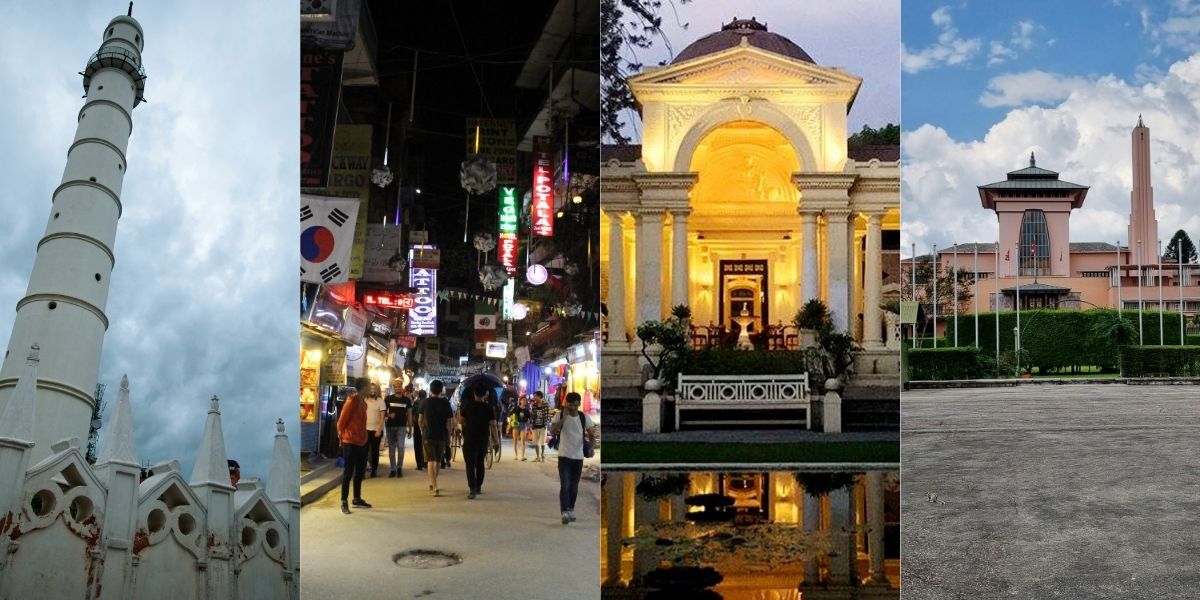
During your visit to Kathmandu Durbar Square, you can also explore nearby attractions. Some of them are:
- Dharahara: An iconic tower, previously known as Bhimsen Tower and now as the White Tower, is only a 10-minute walk from the Durbar Square. You can see a broad view of the Kathmandu district from here.
- Ason Chowk: It is a market area (Bazar) where you can buy affordable clothes, shoes, slippers, ornaments, and many more essential things. It is less than a 10 minute walk from the square. Additionally, there are many small shrines and temples like Balkumari Temple, Annapurna Temple, etc. in Ason, where you can make a visit.
- Itumbaha Museum: It is just a 5-minute walk from the square premises. If you are already around Gaddi Baithak or on the grounds of Hanuman Dhoka Palace, then head southwards toward the Mahendreshwor Mahadev, then take a left towards the Makha Mahadev Galli. Itumbaha Museum, also known as Kichanda Bahal (Keschandra Parawatta Mahavihar), is inside a courtyard that is filled with many small chaityas. You can visit Sunday to Friday from 11 AM to 5 PM with an entrance ticket of NPR 100 if you are Nepalese, NPR 200 if SAARC nationals, and NPR 500 if foreigners. For Nepalese students, it is 50% off!
- Thamel: If you have completed your exploration of the square, you can walk for 20 minutes and reach the vibrant tourist hub. Try different cuisines, and shop for souvenirs, Nepali caps, and weapons. Additionally, if you have a plan for trekking, then you have lots of options for purchasing your trekking gear and equipment here. Also, Thamel serves as the best nightlife place in Kathmandu.
- Garden of Dreams: Want to rest and spend time in quiet and peaceful surroundings? Then walk about 20 minutes from the Durbar Square and arrive at the Garden of Dreams. The place is really worth visiting and a perfect destination to escape the hustle and bustle of busy streets!
- Narayanhiti Palace Museum: It is another former royal palace that turned into a museum in 2009, after the monarchy era ended. Within a 30 minute walk from the Durbar Square area, you will be at the complex of Narayanhiti Palace. Buy a ticket and get inside to see the complex and its major attractions like the Gold State Coach, the Royal Crown “Sripech”, Shree Sadan, the museum garden, and many more!
Final Thoughts
Overall, the Kathmandu Durbar Square, or the Hanuman Dhoka Durbar Square is amongst the must-visit tourist places in Nepal. Each temple, museum, courtyard, tradition, statue, and monument portrays the rich history of Nepal.
The Durbar Square, a historical site and monument zone of a UNESCO World Heritage Site is also a cultural site that carries religious, spiritual, cultural, and traditional significance.
From the wood-carved Kasthamandap and the Hanuman Dhoka Palace to the Living Goddess Kumari, everything offers a glimpse of history and makes your trip worthy!
So, if you are on a trip to Kathmandu, then don’t miss Kathmandu Durbar Square. Explore the museums, beautiful architecture, courtyards, fascinating royal collections, art galleries, gardens, ponds, and much more!


 Garima Bhandari