Bhaktapur Durbar Square is the historic heart of Bhaktapur district and Nepal’s living heritage! It is home to four main squares: Durbar Square, Taumadhi Square, Dattatreya Square, and Pottery Square.
Each square has its own character, story, and tradition. In this blog, we will be focusing mainly on the “Durbar Square” and briefly talking about other squares present here.
Well, the Durbar Square is not limited to the collection of magnificent monuments; instead, it is a living museum of history, art, religion, and culture! Every courtyard, temple, and alley depicts the story of the Malla Kings.
Whether you are an architecture enthusiast, simply planning to experience Nepal’s rich cultural heritage, or eager to witness the vibrant festivals, Bhaktapur Durbar Square promises all of these with an unforgettable experience.
The Four Main Squares of Bhaktapur
Although Bhaktapur is considered a small district, it is famous for numerous squares, museums, temples, and much more. Each monument has its own history and identity.
As mentioned earlier, this blog will be more focused on “Durbar Square”. But before we deep dive into it, let’s understand all four squares in brief.
Note: We’ve already covered every single square in detail in separate guides. So, if you want to learn more about them, follow the links provided below.
Durbar Square
Starting off with Durbar Square, it is an open-air museum consisting of historical palaces, courtyards, ancient temples, and traditional monuments.
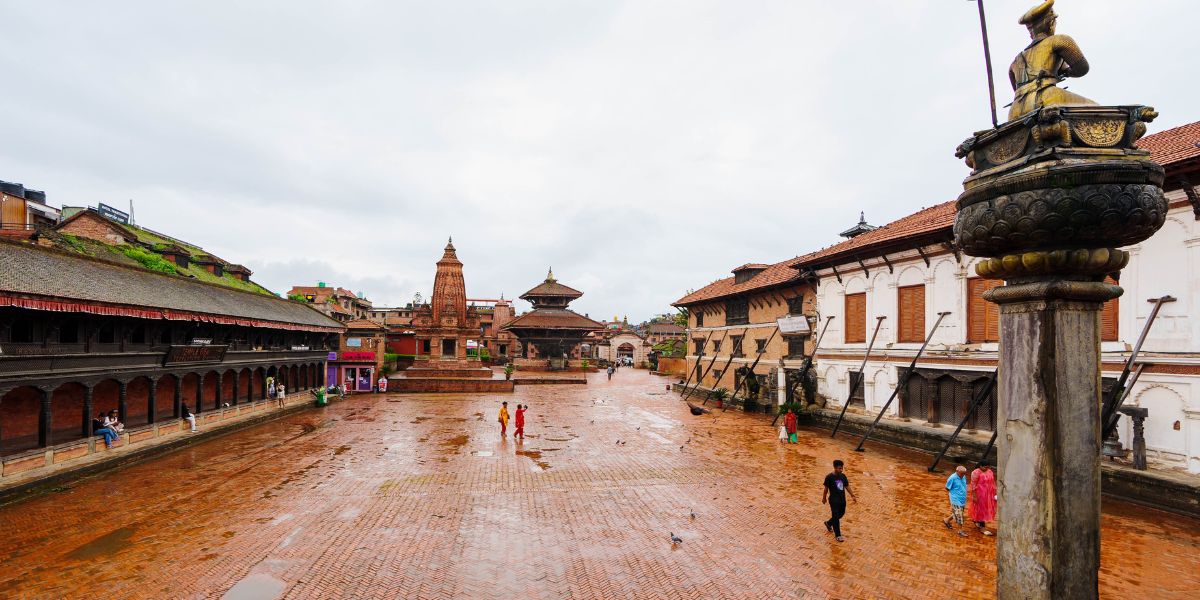
The Durbar Square of Bhaktapur is believed to have been primarily built during the reign of Ananda Deva, a Thakuri-dynasty king. However, it was mainly expanded by the Malla kings from the 15th to the 18th century. More on this later!
Main Attractions: Golden Gate (Sun Dhoka), 55-Windows Palace, Vatsala Temple, Taleju Complex, statue of King Bhupatindra Malla, National Art Museum, Chardham (Jaganath, Badrinath, Rameshwor, and Kedarnath temples), Siddhi Laxmi Temple, Yaksheshwor Mahadev Temple, open courtyards, and traditional architecture.
Taumadhi Square
This is another important square serving as a religious, commercial, and community gathering center since the Malla period. It is located southeast of Durbar Square and can be reached within a 3-5 minute walk.
Taumadhi Square is a fascinating landmark featuring Nepal’s tallest pagoda temple, Nyatapola, along with Bhairavnath Temple, Betal Bhairav, and Til Madhav Narayan Temple.
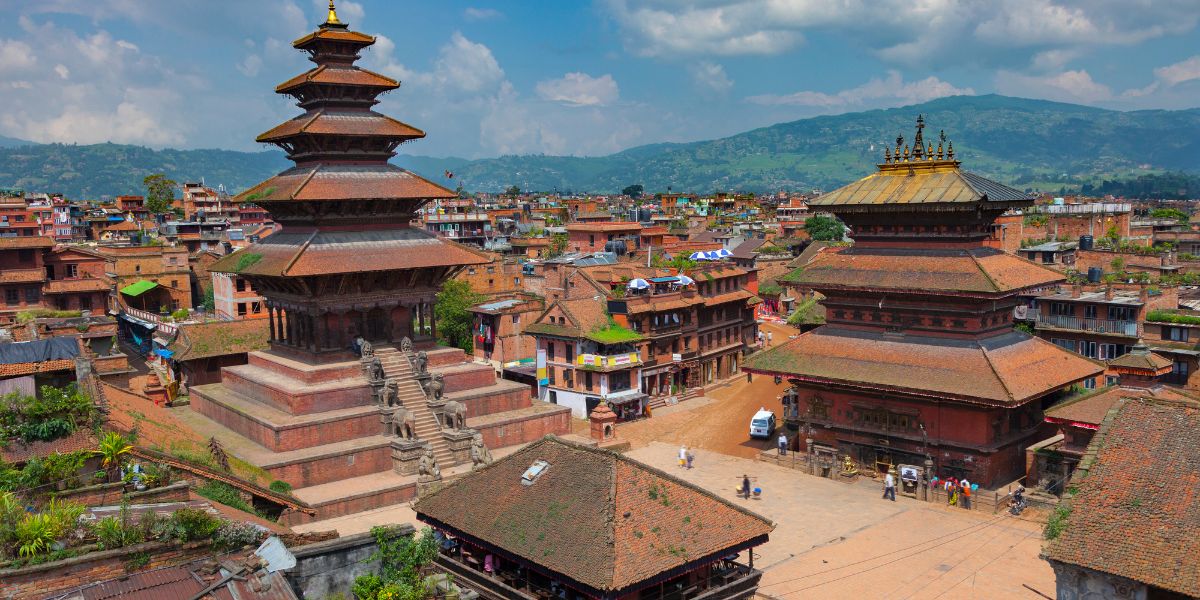
The Til Madhav Temple is believed to have been built in the early medieval period. In fact, it is one of the oldest here.
Also, the name of this square evolved through the years, beginning with the word “Tilmadhav”. Gradually, it was altered to Tilam-de, then to Talamande, and finally to Taumadhi, which remains today.
Taumadhi Square is a vibrant public space where centuries-old festivals are celebrated, and religious rituals are practiced. Festivals like Bisket Jatra, Gai Jatra, Indra Jatra, etc., are celebrated here with great devotion and faith.
Other Attractions: Tileshwor Mahadev Temple, Jor Ganesh Temple, Golden Spout with Navagraha (Nine Planets), etc.
Pottery Square
This square is full of pottery works from the indigenous Newar community, where you can watch the traditional craftsmanship.
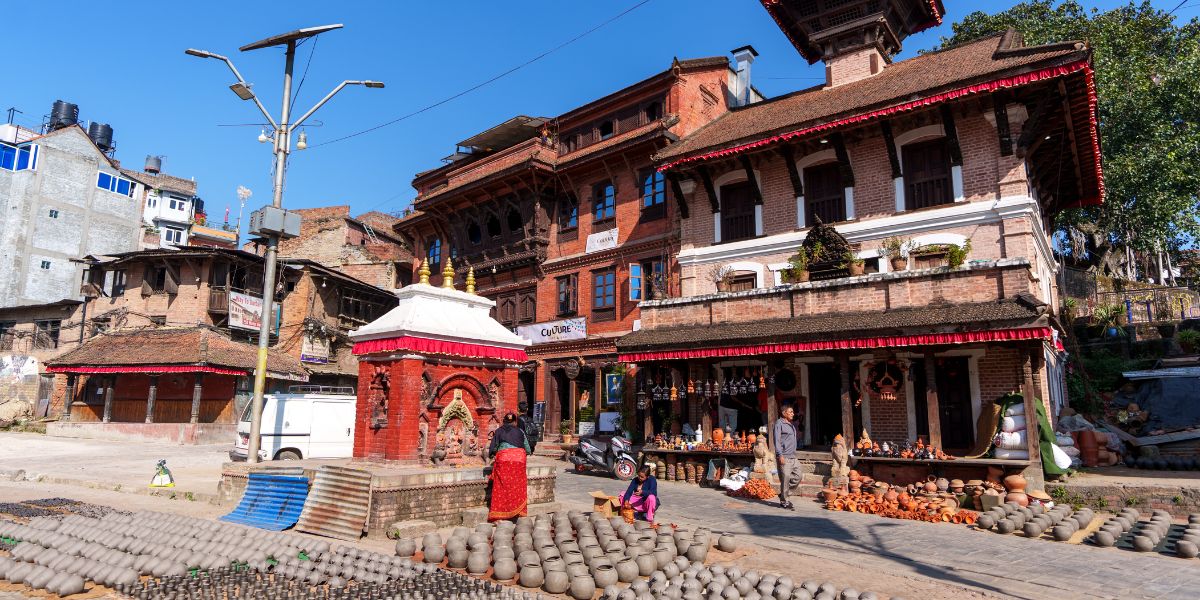
Pottery Square is a worthwhile spot to visit while you are exploring Bhaktapur. Yes, because here you can find several handmade souvenirs perfect for gifting to your loved ones.
Pottery Square has two particular localities:
- Talako Tole: From everyday essentials like cups, kettles, and trays to decorative flower vases, money pots (khutrukke), statues of gods, clay lamps, plant wares, and many more, you can find everything here.
- Suryamadhi Tole: It is also known as Mathiko Pottery Square and is less crowded in comparison to Talako Tole. Suryamadhi Tole is more famous for buying pottery items in bulk.
The most interesting part of this square is that there are many pottery shops where you can experience pottery on your own. Yes, try making a useful item from a lump of clay and take home the final product!
Other Attractions: Jetha Ganesh Temple, Gorakh Nath Temple, and Thangka Painting Schools/Galleries.
Dattatreya Square
Dattatreya Square is located to the east of Bhaktapur Durbar Square, in Tachupal Tole. It is considered one of the oldest squares of Bhaktapur.
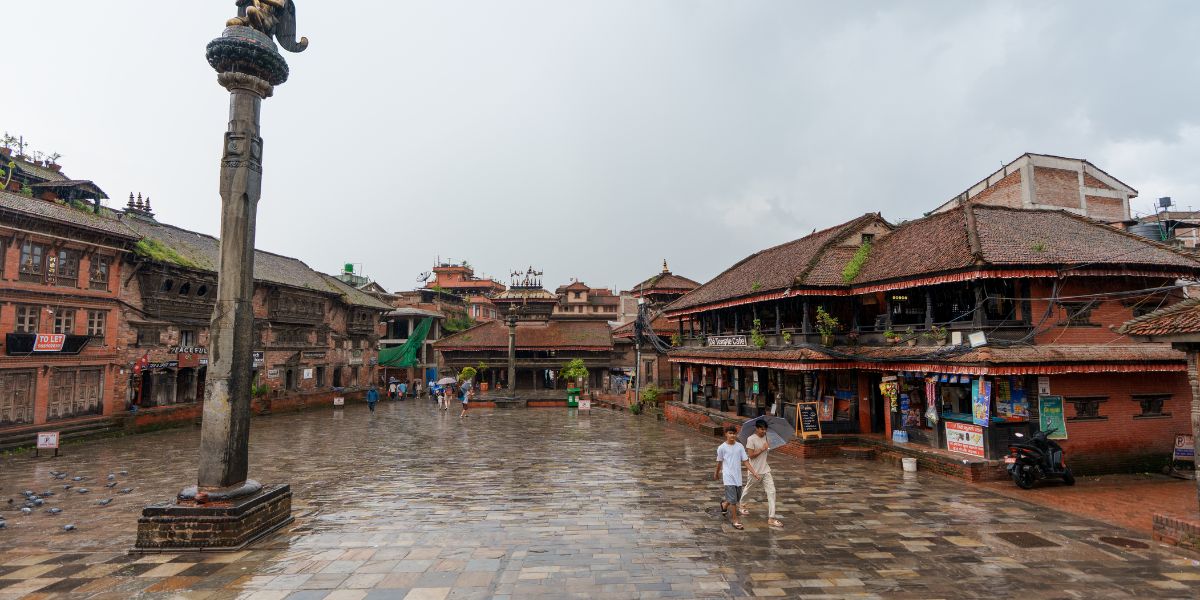
Moreover, this square is home to museums, like the Wood Carving Museum (Pujari Math previously), the Brass and Bronze Museum, and Peacock Shop and Paper Factory (where there’s a privately owned museum featuring woods and pots from the 17th and 18th centuries).
Other Attractions: Dattatreya Temple, Bhimsen Temple, Brass and Bronze Museum, Peacock Window, the Peacock Shop, Sithu Math, Godawari Math, Bardali Math, Phulanchotha Math, open courtyards, statue of Garuda, etc., are the main attractions of Dattatreya Square.
Beyond the Four Squares
There are a few other local squares besides the above-mentioned squares in Bhaktapur Municipality. They are:
- Nasamana Square: It is located northwest of the Bhaktapur Pottery Square and was severely damaged by the 1934 earthquake. The square couldn’t be fully recovered after that, but there is a large Garuda statue remaining.
- Bhelukhel Square (Yoshin Khel): This square is home to the Bhadrakali Temple and is named after the Yoshin Dyo, a tall and famous wooden linga pole that is erected during the 9-day Biska Jatra festival.
Quick Facts on Durbar Square of Bhaktapur
|
Location
|
Bhaktapur Municipality, Bhaktapur District, Bagmati Province
|
|
Listed as a UNESCO World Heritage Site
|
1979 AD
|
|
Historical Importance
|
A royal palace of the late Thakuri King and Malla Kings, and the main center of Bhaktapur, with centuries-old temples.
|
|
Entry Fee
(Covers permit for all squares)
|
- Foreign Nationals: USD 18
- SAARC Nationals: NPR 500
- Chinese Nationals: NPR 500
- Nepalese: Free
|
|
Temples
|
- Vatsala Temple
- Taleju Temple
- Pashupatinath of Bhaktapur
- Siddhi Laxmi Temple
- Nrtya Vatsala Temple
- Char Dham (Jagannath, Badrinath, Rameshwar, and Kedarnath temples), etc.
|
|
Museums
|
National Art Museum (requires separate entry fee)
|
|
Local Specialities
|
- Juju Dhau (King of Curd)
- Newari Cuisine
- Wood Carving
- Handmade Souvenirs
|
How to Reach Bhaktapur Durbar Square?
Reaching Bhaktapur Durbar Square is easy whether you are traveling from Kathmandu or you are already in other squares of Bhaktapur. I will explain in detail:
From Thamel
Whether you are staying in Thamel or nearby areas of Kathmandu, you can reach Bhaktapur Durbar Square in two ways:
By Public Vehicle
Regular buses to Bhaktapur leave from Ratnapark, Bagbazar area; you can go there and get on a bus (45 min - 1 hour, depending on traffic).
The buses travel via two routes: the Kamalbinayak route and the Suryabinayak route.
If you get on the bus that goes on the Kamalbinayak route, then get off at Dudhpati (near Siddha Pokhari). From here, you can reach Bhaktapur Durbar Square with a 10-15 minute walk.
In case you get on a bus that travels on the Suryabinayak route, get off at Suryabinayak Chowk; it is also a 10-15 minute walk from there.
By Private Taxi or Motorcycle
If you plan to travel without any hassle, then you can book a taxi or a motorcycle from any reliable ride-sharing app.
Within 30-60 minutes (depending on your location), you can directly reach Bhaktapur Durbar Square.
From Other Squares
Already on the ground of other squares? Don’t worry, I will guide you to reach Bhaktapur Durbar Square from other squares too:
- Pottery Square: Simply walk 300-350 meters north along the street near the Kedarnath Temple. Within 5 minutes, you will reach the Durbar Square area.
- Taumadhi Square: You can reach Bhaktapur Durbar Square by walking for 2 minutes northwest from here, which is approximately 200 meters.
- Dattatreya Square: You need to head west through the lanes and pass through Taumadhi Square (longer route) and continue your walk moving northwest. As you pass, you will reach the Durbar Square within 12-15 minutes, approximately. For the shorter route, walk east from Dattareya and take a left at Sukuldhoka; you will reach it within 10-12 minutes.
Entry Fees and Opening Hours
Bhaktapur Durbar Square area is open 24 hours for Nepalese, but for other nationals, you need a ticket to enter the Durbar Square. The ticket counter operates only at a specific time, from 6 AM to 7:30 PM, so you have to manage your time accordingly.
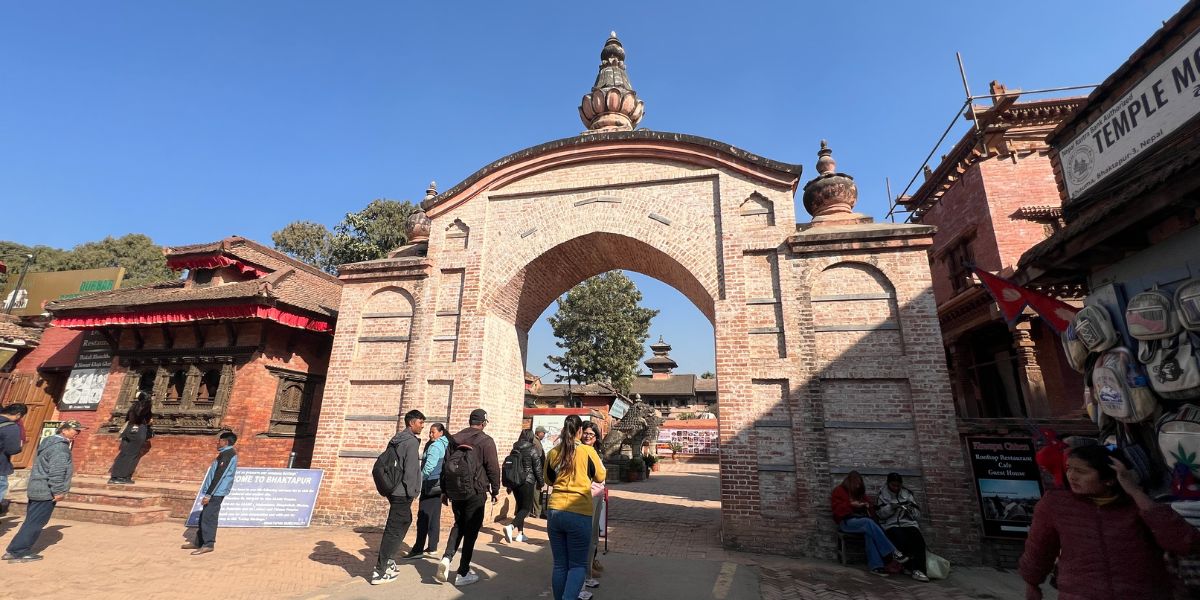
Here are the details on entry fees if you plan a visit to this heritage site in the Kathmandu Valley:
|
Visitor Category
|
Entry Fee (per person)
|
|
Foreign Nationals
|
USD 18
|
|
SAARC Nationals
|
NPR 500
|
|
Chinese Nationals
|
NPR 500
|
|
Nepalese
|
Free
|
Notes:
- Children under 10 years can access free entry.
- This ticket covers all the squares of Bhaktapur: Durbar Square, Pottery Square, Taumadhi Square, and Dattatreya Square.
- However, you need to pay a separate entry fee for museums (more details below).
History of Bhaktapur Durbar Square
We all know that Bhaktapur Durbar Square is popular and has many attractions, including museums and ancient temples. But there is a lot of confusion about when and how it was established, as well as other in-depth information.
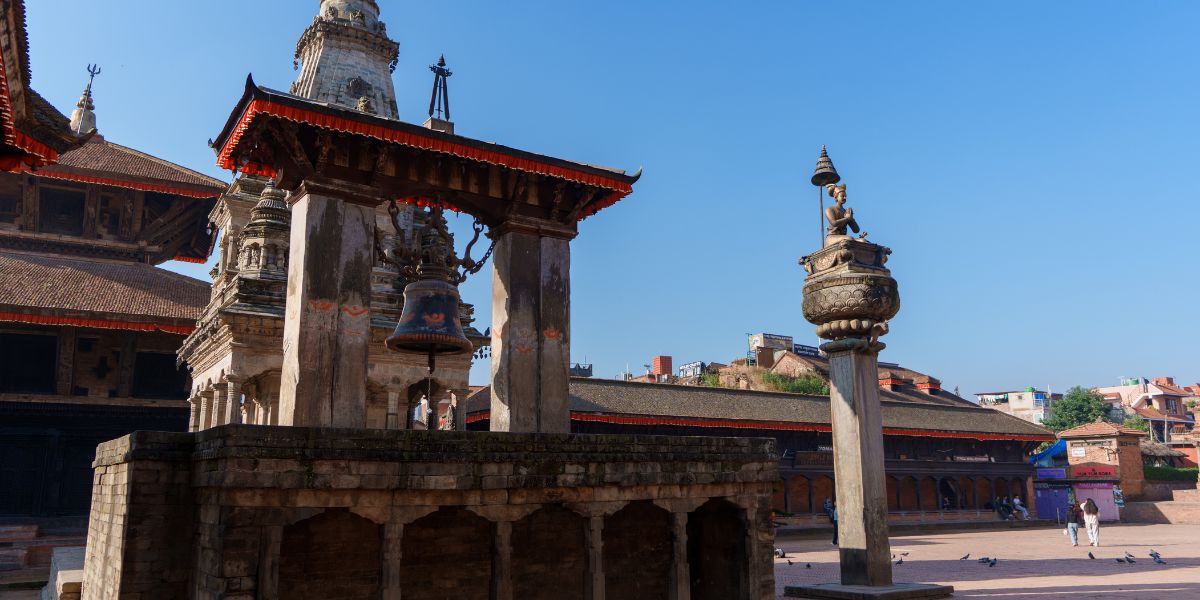
So, our team made a personal visit to learn significant history and other possible details about Bhaktapur Durbar Square. Here is what we found:
Historical Timeline and Architectural Contributions
In this section, you will learn about the historical timeline and major contributions of the kings to the architectural beauty of the Durbar Square of Bhaktapur:
|
Ruler
|
Time Period
|
Major Constructions and Events
|
|
Ananda Deva
|
1147 - 1167 AD |
- Shifted the capital of Nepal Mandala to Bhaktapur.
- Built Tripura Rajdarbar.
- Established deities like Astamatrika, Vishnu shrines, Bhairav, and other deities around the city.
|
|
Jayasthiti Malla
|
1382 - 1395 AD
|
Built Yuthuniman Rajkula.
|
|
Yaksha Malla
|
1428 - 1482 AD
|
- Expanded the kingdom and the royal palace.
- Also was the one who finalized the division of the valley into separate kingdoms (starting after his death).
- During his reign, the foundations of the main royal palace compound began (which was later remodeled into the 55-Window Palace).
|
|
Raya Malla
|
1482 - 1505 AD
|
- First king of Bhadgaon (Bhaktapur).
- Extended Bhaktapur up to Dudhkoshi.
|
|
Prana Malla
|
1519 - 1547 AD
|
During his reign, the Jagannath Temple was built.
|
|
Naresha Malla
|
1637 - 1643 AD
|
- Renovated Taleju Temple.
- Decorated Mul Chowk by adding a couple of windows.
|
|
Jagat Prakash Malla
|
1643 - 1672 AD
|
Built Siddhi Laxmi Temple.
|
|
Jitamitra Malla
|
1672 - 1696 AD
|
Extended the royal palace and built numerous Dharmasalas and temples.
|
|
Bhupatindra Malla
|
1696 - 1722 AD
|
Reconstructed the 55-Window Palace and started construction of the Golden Gate (Sun Dhoka).
|
|
Ranajit Malla
|
1722 - 1769 AD
|
Completed the construction of the Golden Gate in 1754 AD.
|
The 2015 Earthquake and Restoration
An earthquake of 7.8 magnitude struck Nepal on 25th April, 2015, and caused extensive damage to several UNESCO World Heritage Sites, including Bhaktapur Durbar Square:
- Vatsala Durga Temple: The temple was almost completely collapsed. Some of the stone platform and architectural elements remained, and the restoration work was started using original stone blocks, traditional construction techniques, and seismic strengthening.
- Fasidega/Phasi Dega Temple (Shilu Mahadev): This temple was also severely damaged in the 1934 and 2015 earthquakes. The temple is rebuilt and restored now.
- Taleju Temple Complex: There was moderate damage, with several cracks in masonry walls, damage to roofs, a weakened structure, and damage in the surrounding courtyards.
- 55 Windows Palace: There was no significant structural damage in the palace, except for the Lal Durbar wing, which was severely impacted.
- Golden Gate (Sun Dhoka): Only minor damage was seen.
Present-Day Bhaktapur Durbar Square
Bhaktapur Durbar Square, once a royal palace of the late Thakuri and several Malla kings, is now a religious, historical, and cultural center of the Bhaktapur district. Welcoming hundreds of visitors daily, it has been the heart of Bhaktapur!
You can enjoy several collections of distinct architectural structures from the Malla period here. Temples with different architectural styles like pagoda, shikhara, mandala, and Newari architecture are the major impressive features.
The Royal Palace Complex of Bhaktapur
As mentioned earlier, Durbar Square served as the Royal Palace and administrative center of the Thakuri (since Anandadeva) and succeeding Malla kings. The royal palace complex served as a political, religious, and ceremonial heart of Bhaktapur.
The kings used to hold royal assemblies, receive foreign envoys, and celebrate major festivals here. In the present day, the complex includes royal courtyards, statues, temples dedicated to the royal deity, gates, shrines, museums, and public spaces.
It depicts the finest examples of Newar royal architecture and the living heritage of Nepal.
Golden Gate (Sun Dhoka)
The construction of Golden Gate, also known as Sun Dhoka or Subarna Dwar, started during the reign of King Bhupatindra Malla. However, it was completed by Ranajit Malla in 1754 AD. The gate served as the entrance to the inner courtyard of the royal complex that led to the Taleju Temple and Sundhara.
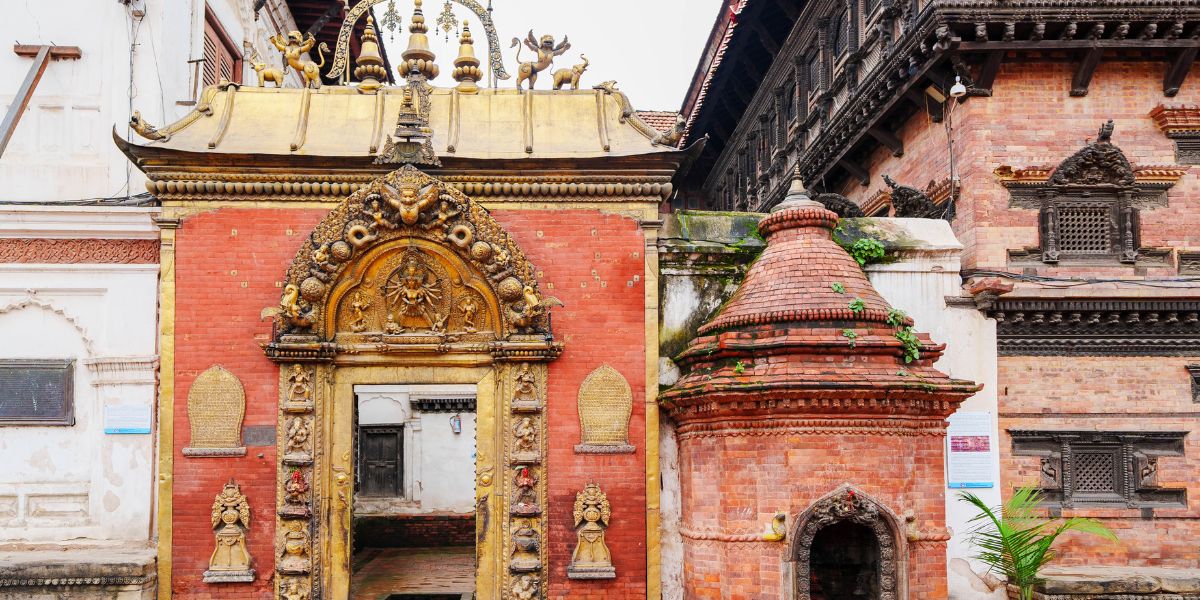
Similarly, the gate is one of the most photographed monuments in Durbar Square, as it is the finest example of metalwork. Also, it is the last masterpiece of the Malla period!
Likewise, the Golden Gate is made of gilded copper, roofed in the pagoda style, and stands facing south. This golden scripture is world-famous for its exceptional metal art.
Additionally, the upper part of the figurine shows a wonderful Garuda and serpents along with a four-headed and ten-armed figure of the goddess Taleju Bhawani (the family deity of the Malla kings).
55 Window Palace (Pachpanna Jhyale Durbar)
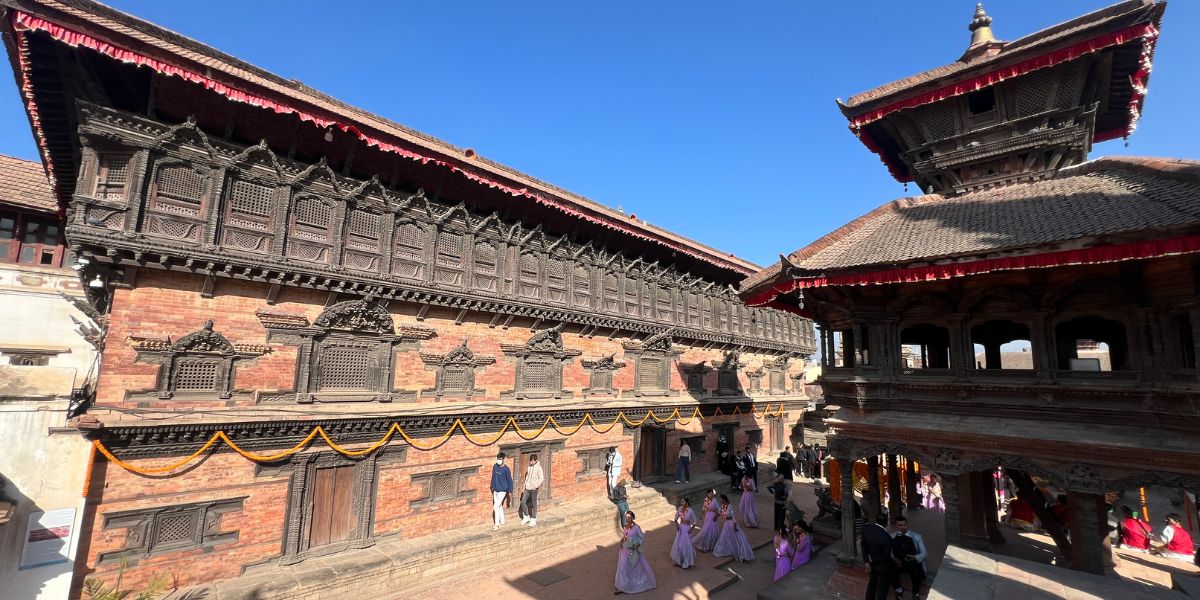
Another major attraction and the finest example of traditional Newari architecture in the complex is the 55 Window Palace (Pachpanna Jhyale Durbar). Located just beside the Golden Gate, the three-story window palace is intricately carved with wooden windows.
While early human settlements like Khopring existed in the area since the ancient Licchavi period, it was around the mid-12th century, during the reign of Anandadeva (1147-1167 AD), that Bhaktapur was founded.
Anandadeva organized the city of 12,000 houses by merging sixty small villages and seven towns in his territory, and officially named it Bhaktapur!
He also built a temple and a royal palace in Bhaktapur. In the Sanskrit language, the palace is called “Rajkula”.
Then, in 1382 AD, Jayasthithi Malla built Yuthuniman Rajkula, renovated the palace building, and also built and restored many temples throughout the valley. From then on, the Malla kings started ruling and expanding the palace with several development works.
It was Yaksha Malla (1428-1482) who expanded the palace and laid the foundation for the 55 Windows Palace. But the 55 windows were added later by King Bhupatindra Malla (in 1708 AD).
At present, the first floor of the palace consists of:
- Incredible mural painting that is based on the life of Lord Krishna.
- Painting of Bhupatindra Malla with his queen Vishwalaxmi in the form of Vishvarupa engaged in Tantric practice.
- Other paintings, like the one of King Bhupatindra Malla and his friend Maniksen (King of Makawanpur) chasing elephants and hunting wild animals using dogs.
Each of the 55 windows is a finely carved wooden lattice, with columns and arches of hardwood of Saal.
At that time, glass was rare in Nepal, so historic records mention that only one window had a single small pane of glass (a precious gift from the Indian plains) displayed as a mark of luxury and wonder.
Taleju Bhawani Temple of Bhaktapur
Taleju Temple served as the royal temple for the Malla kings of Bhaktapur. Goddess Taleju is the main deity of the temple, and she is also known as the family deity of the Malla Kings.
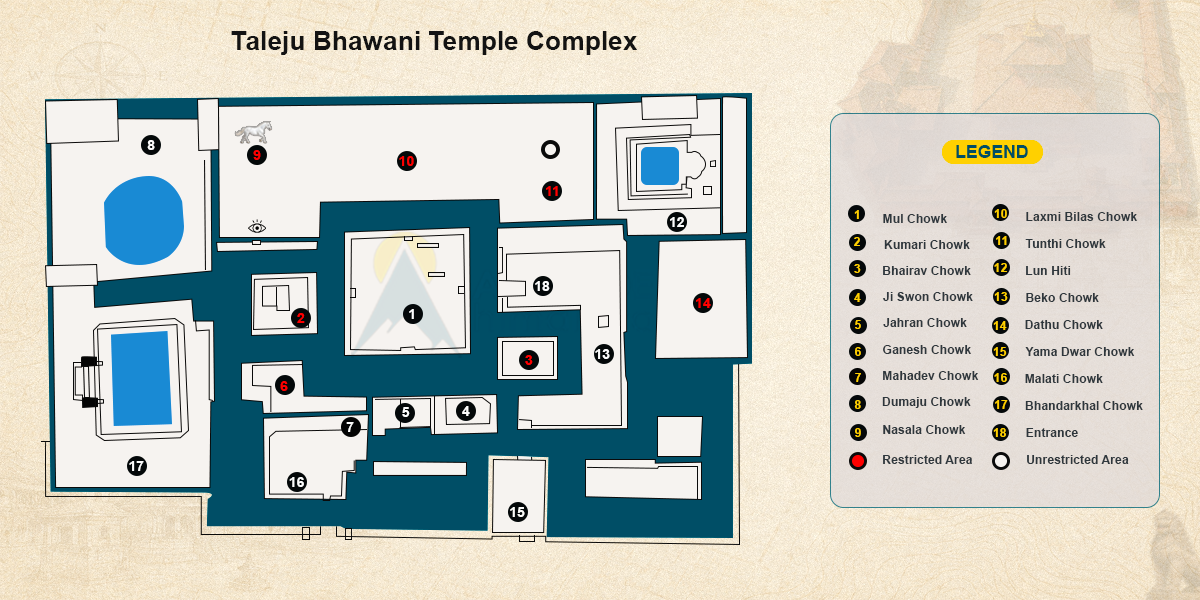
There are conflicting views regarding the installation of Taleju at Bhaktapur. One of them mentions and believes that the statue of Goddess Taleju was first brought by Harisimha Deva of the Karnata Kingdom of Tirhut in the 14th century.
Harisimha was driven out of his kingdom by Muslim armies, and he came to the valley and also brought the goddess Taleju and installed her in Bhaktapur; later, she became the house goddess of the Malla royal family (evidence: two Sanskrit texts, Talejvāgama and Tulyāgama).
On the other hand, some others believe that King Harisimha Deva unfortunately died on the way (somewhere near Tinpatan). And it was his widow, Devalakshmidevi, and their son, Jagatsinghadeva, who brought Taleju Bhawani to Bhaktapur and established the vessel of Taleju in the palace.
So, whoever brought the Taleju, the goddess remained the guardian deity for the Malla Kings in all three kingdoms of Kathmandu, Patan, and Bhaktapur.
Taleju Bhawani is taken out from her Main Ghar to the Dashain Ghar on the seventh day of the Dashain festival, and she will be taken back to the Main Ghar on the day of Vijaya Dashami.
Royal Courtyards (Chowks) in Bhaktapur
The royal courtyards of the Durbar Square showcase centuries of royal history and living traditions. There used to be 99 courtyards previously, but today, only around 17 remain:
|
Unrestricted Chowks
|
Restricted Chowks
|
- Mul Chowk (some parts are accessible)
- Jahran Chowk
- Dumaju Chowk
- Sundari Chowk
- Ji: Swan Chowk
- Yama Dwar Chowk
- Bhandarkhal Chowk (accessible only from the National Art Museum entrance)
- Mahadev Chowk
- Malati Chowk
|
- Mul Chowk (Important areas are restricted)
- Kumari Chowk
- Bhairava Chowk
- Nasal Chowk
- Laxmi Bilash Chowk
- Tunthi Chowk
- Ganesh Chowk
- Bekwo Chowk
- Dathu Chowk
|
Mul Chowk
Mul Chowk, or the main courtyard, is the earliest (12-13th century AD) courtyard of the Bhaktapur Durbar Square Complex. It was the primary and principal royal courtyard where different important religious and cultural celebrations used to be hosted.
Likewise, this main courtyard also served as the court to discuss important matters of the state related to the judiciary, administration, and politics. For these types of discussions, the ministers used to be present.
In the southern wing of this chowk, Taleju Bhawani resides, and it is the oldest Taleju temple of Nepal. King Bhupatindra Malla renovated it with a golden roof and 11 gold pinnacles in 1703 AD.
The walls of the main square are decorated with murals (some paintings dating back to the 14th century). Surprisingly, here you can still see the traces of bullets fired from the roofs when the Gorkhalis attacked in 1769 AD.
Kumari Chowk
Kumari Chowk is also known as Eta Chowk and is situated to the west of Mulchowk. This is a beautiful courtyard with an inscription of King Jitamitra Malla (1677 AD) placed in it.
Inside the courtyard, you can see the wood carvings, sculptures, and wall paintings (murals). The construction date of Kumari Chowk is unknown, but it was restored by Jitamitra Malla. It took him fifteen years to restore.
Likewise, a large stone pedestal can be seen in the center of the courtyard. Here, on the ninth day of the Dashain festival, Bhaktapur’s living goddess, Ekantakumari/Ganakumari, sits on this pedestal for worship.
On the eastern side of the courtyard, you can see the wall paintings of Yogini deities, including Chandi. If you look on the southern side, there are decorative faux doors and windows, whereas the western side is decorated with a fountain.
The fountain is carved with the statues of Kaliyadaman and Navarasa. Similarly, the northern side has stone statues of different deities like Chandi, Astamatrika, and Panchamukhi Hanuman.
Bhairava Chowk
Bhairava Chowk or Sadashiva Chowk dates back to the 16th century AD. The courtyard has eighteen beautiful wooden statues of Ashtadasha Bhairava deities. These deities reflect their tantric spirit. Therefore, the courtyard is called Bhairava Chowk.
The king of Kantipur, Sadashiva Malla, was chased away from his kingdom for mistreating women. He then fled to Bhaktapur and hid there, but the authorities of Bhaktapur caught and imprisoned him in this courtyard. It is also believed that King Sadashiva died here, so this courtyard is also known as Sadashiva Chowk.
This courtyard is filled with several artifacts. If you look to the east, you can see a three-bayed window with incredible carvings that depict a frog about to swallow an elephant, and jackals attacking a tiger from all sides.
Now, when you turn towards the east and north bays, you can see the human heads of uncommon expressions and shapes carved in the beams.
One of the most attractive parts of this courtyard is the painting on the wall of King Bhupatindra Malla, offering devotion to the goddess Durga.
Other major attractions of this courtyard are a small, beautiful well with a water tank in the west and a statue of the Varahi deity. In the water tank, you can see a record engraved mentioning that the work was commissioned by Bhupatindra Malla in 1711 AD.
Jahran Chowk
On the western side of the courtyard, there is a large spout (fountain) known as Jahran or Jaladhroni, constructed by King Jitamitra Malla in 1708 AD. It is because of this fountain that the courtyard is known as ‘Jahran Chowk’.
Additionally, there are three spouts in this fountain. Among these three, the central one is the most beautiful and artistic. There is a round stone structure at its back to fill it with water.
Dumaju Chowk
It is located on the northwestern side of Mul Chowk. It is named Dumaju Chowk because there is an open ground with a small pond, and there is a stone shrine in a corner, which is worshipped as the Goddess Dumaju.
It is believed that if any child takes a bath or a dip in this pond, it will cure the child's colic.
Nasal Chowk
Although the Nasal Chowk lost its beauty when it was once covered in debris, the northwest corner still has a shrine that has a hole in it. It is a symbol of Nrityanath, the dancing form of Lord Shiva.
Several performing artists, such as dancers, dramatists, musicians, and others, worship this deity, and every year, dances are performed during special occasions.
Currently, it is restricted to the general public. However, you can see a white horse standing in its stable at this chowk. You can see it from a window in the corridor while heading towards Dumaju Chowk.
You may ask, “What is this White horse?” Well, this white horse at Nasal Chowk is considered the conveyance (vahana) of Taleju Bhawani. It has great importance, and even White Horse (Seto Ghode) Jatra is celebrated in the Bhaktapur Durbar Square area during the Dashain festival.
Laxmi Bilash Chowk
In the medieval period, this area housed one of the preeminent courtyards of the Royal Palace. However, it is now just an open area.
There were bed chambers in this part of the palace complex of King Ranajit Malla and his favorite son, Abdhut Simha.
Sundari Chowk: Lun Hiti / Sundhara
The Golden Fountain in Sundari Chowk was built by King Jitamitra in 1688 AD, according to the inscription here. This fountain is also called Lun Hiti or Sundhara.
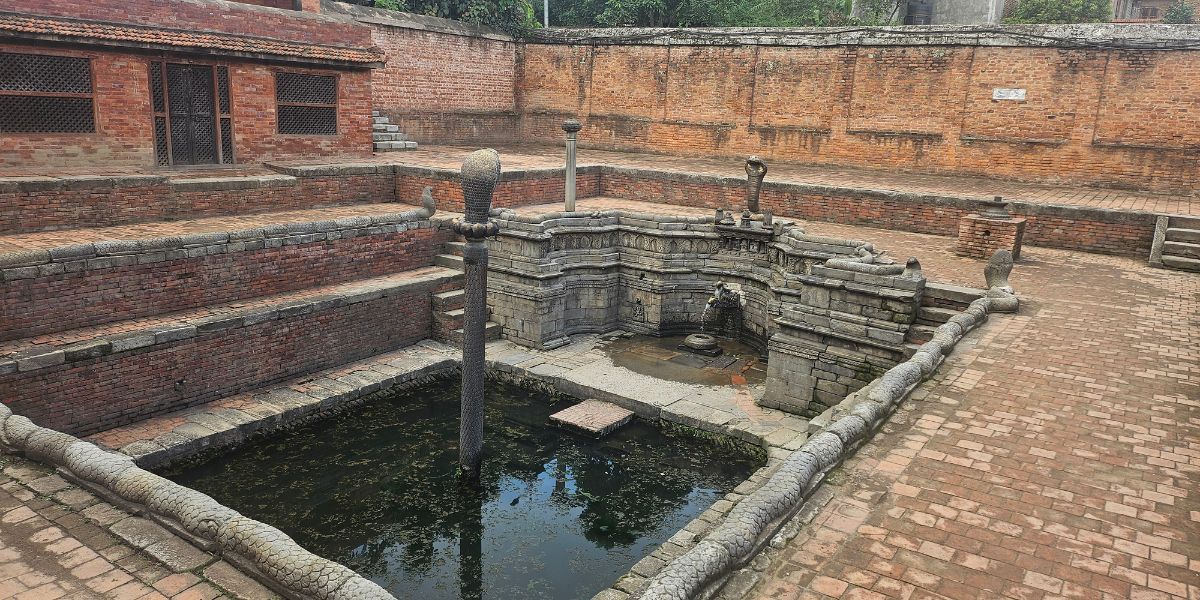
You can see the fountain with figures of different animals. In this golden fountain, the water falls from the goat’s head. It looks like “Makara” (a mythical creature) swallows the goat’s head, which is a special feature of this fountain. The holy water required when worshipping the Taleju deity is taken from here.
Other Chowks
Here are some other chowks in the Bhaktapur Durbar Square that carry history and traditions:
- Bekwo Chowk - Since this chowk is not straight in size, it was named Bekwo Chowk. Basically, Bekwo in the local Newari language means not straight.
- Mahadev Chowk - There is a Shivalinga (an iconic representation of Lord Shiva, also known as Mahadev). Hence, the place is known as the Mahadev Courtyard.
- Ji: Swan Chowk - The main attraction of this chowk is the plant of White Jasmine in the center. Ji Swan is the Newari term for white jasmine, so the courtyard is known as the Ji Swan Chowk.
- Ganesh Chowk - There is a stone sculpture of Lord Ganesha on the boundary wall of this courtyard that gives the name of this chowk. There is also a rest house that is decorated with artistic wooden blind windows.
- Tunthi Chowk - According to the local language, a well is called a Tunthi. As the name suggests, there is a big well in this area, and hence the courtyard is known as the Tunthi Chowk. Currently, the place is devoid of any buildings.
- Malati Chowk - Built by King Bhupatindra Malla, this is a part of the National Art Museum and the reason why the former palace here was named “Malati Chowk Durbar”.
- Yama Dwar Chowk - Often overlooked, this is the first courtyard you’ll pass after crossing the Golden Gate. Its name comes from the Hindu God of death and justice, “Yama”. It’s accessible to even non-Hindus.
- Bhandarkhal Chowk - Built by Bhaktapur King Jagajyoti Malla, this is the courtyard home to Bhandarkhal Pond. This is the chowk that you’ll pass when entering the second building of the National Art Museum.
- Dathu Chowk - This is one of the restricted areas of the Taleju Temple complex and was part of the Thanthu Durbar.
Statues and Monuments Within Durbar Square Premises
There are several statues and monuments scattered throughout the Bhaktapur Durbar Square complex. Each of them narrates the history, religious devotion, and artistic craftsmanship during the Malla dynasty.
Statue of Bhupatindra Malla
When exploring around the Durbar Square area, you will see a tall bronze statue opposite the Sundhoka/Golden Gate. The statue is of King Bhupatindra Malla and is one of the most beautiful examples of metalwork here.
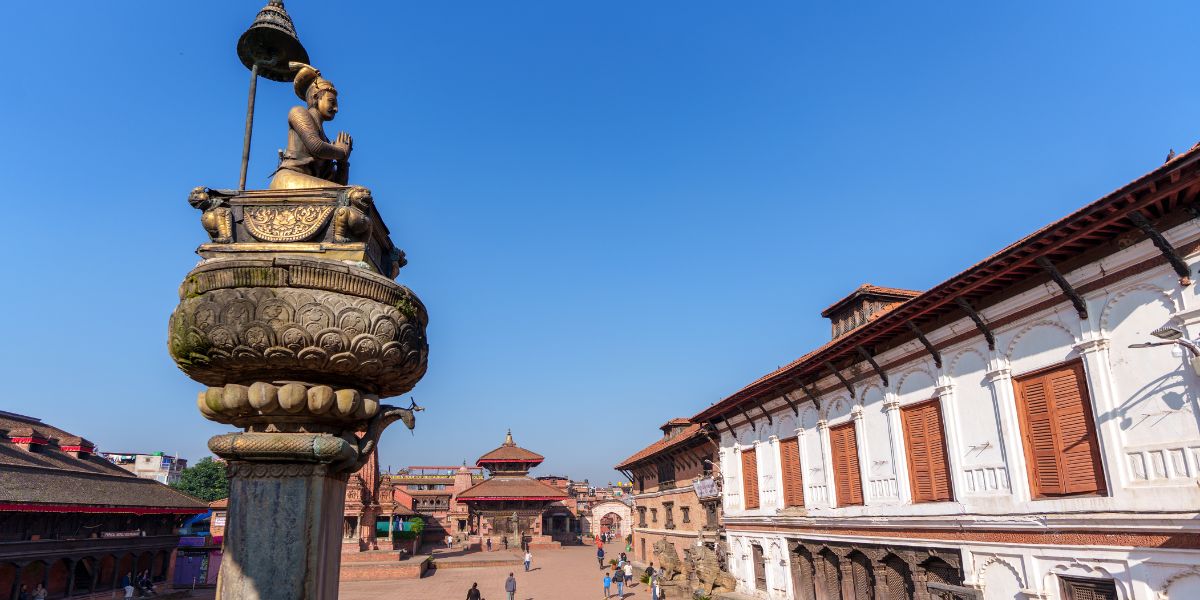
King Bhupatindra Malla is posed in a crossed-leg posture, bowing his head towards the Taleju complex. It is said that he is showing his devotion toward his guardian deity (Ista Devta). He is standing above the seats of a snake (Naagashan), a lotus (Padmaashan), and lions on the four corners (Simhaashan) of the pillar.
Statue of Ugrachandi and Ugra Bhairava
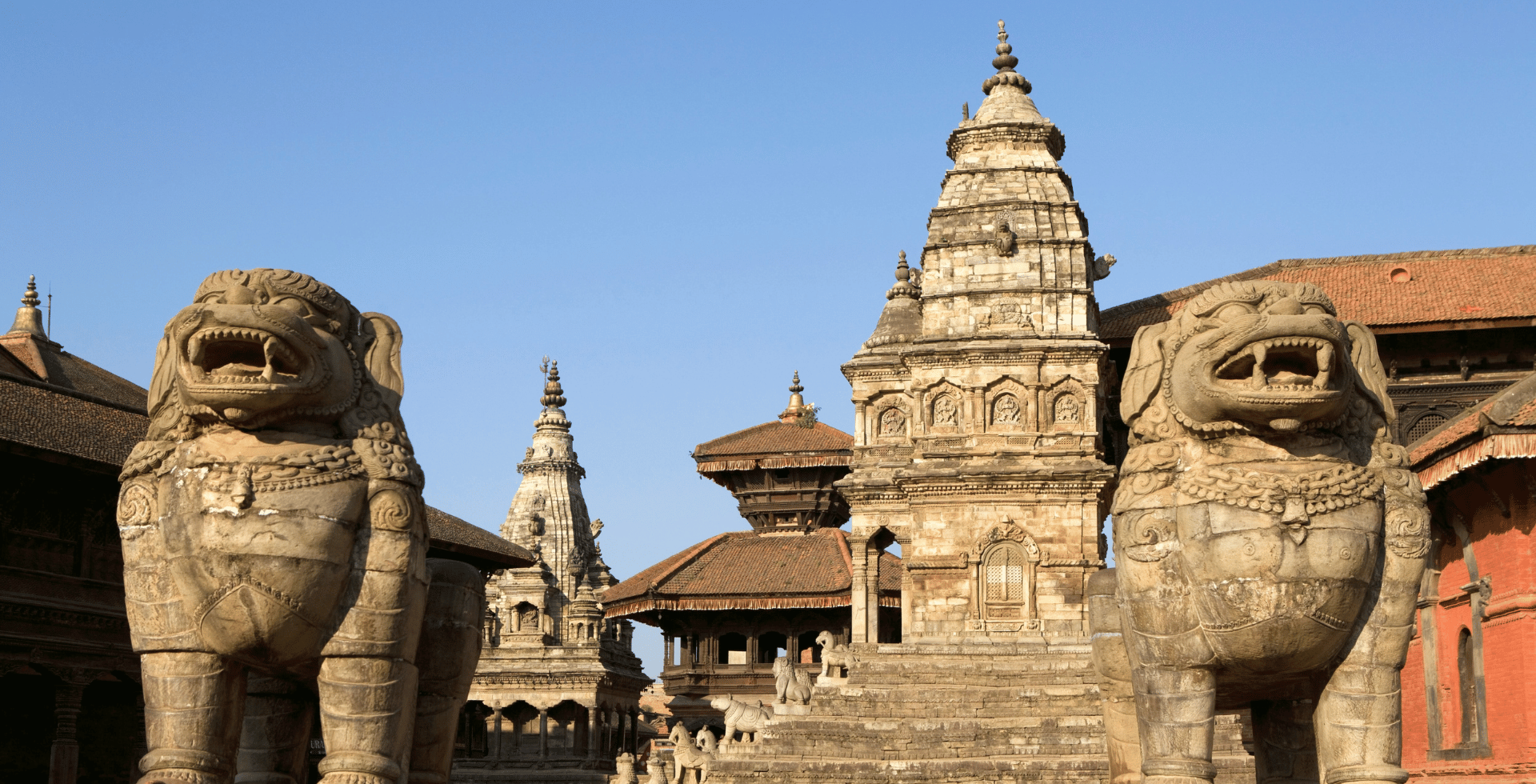
While entering through the western gate of the Durbar Square, on the left side, there is a gateway with two large stone lions.
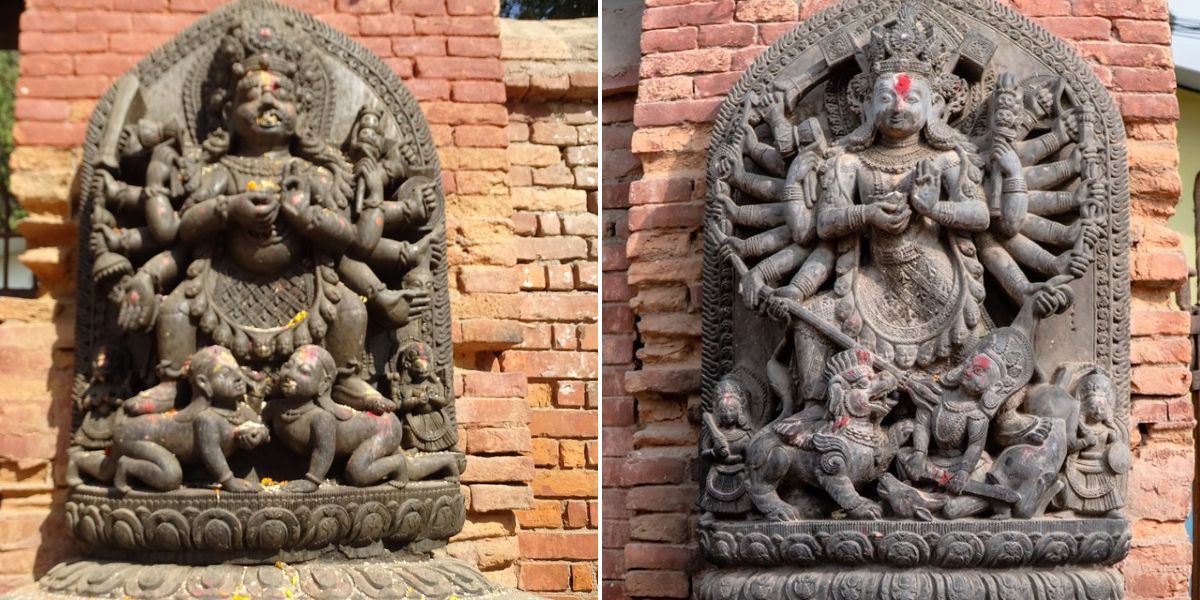
Positioned between them, there is a pair of statues on either side, one of Ugrachandi (with 18 arms) and the other of Ugra Bhairava (with 12 arms). These statues, erected by King Bhupatindra Malla in 1701, are a masterpiece, and they are really worth praising.
You will be shocked after hearing this legend, as I was: the artist who made this statue had his hands cut off, so he would not design such masterpieces again.
Taleju Bell and Barking Bell
Taleju Bell is also known as the Big Bell and is located near the Vatsala Durga Temple. It is really huge in size and was made to show devotion toward the goddess Taleju Bhawani.
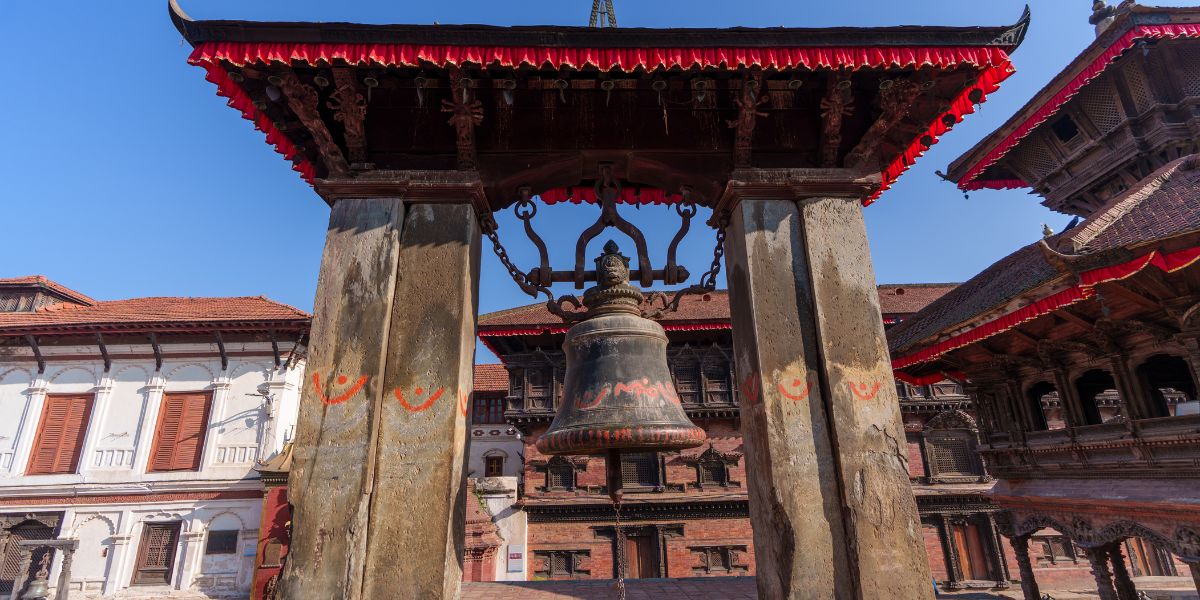
Besides this, it was also a medium to notify people about some important matters at that time. King Ranjit Malla is credited with making this bell. The bell is rung in the morning and evening daily.
Moving on, there is another small bell on the plinth of the Vatsala Durga Temple, and it is the Barking Bell. Wondering why it is named the Barking Bell?
Here is the story: whenever this bell used to be rung, the dogs in the nearby areas would start barking and howling continuously, which led to the name. This bell was erected by King Bhupatindra Malla.
Chyasilin Mandap
Locally known as Chyasing Mandap, this multi-tiered pavilion is one of the finest examples of traditional Newari architecture and craftsmanship in the Durbar Square area.
Constructed during the reign of King Bhupatindra Malla (1696-1722), it is located just opposite the 55 Windows Palace and near the famous Golden Gate.
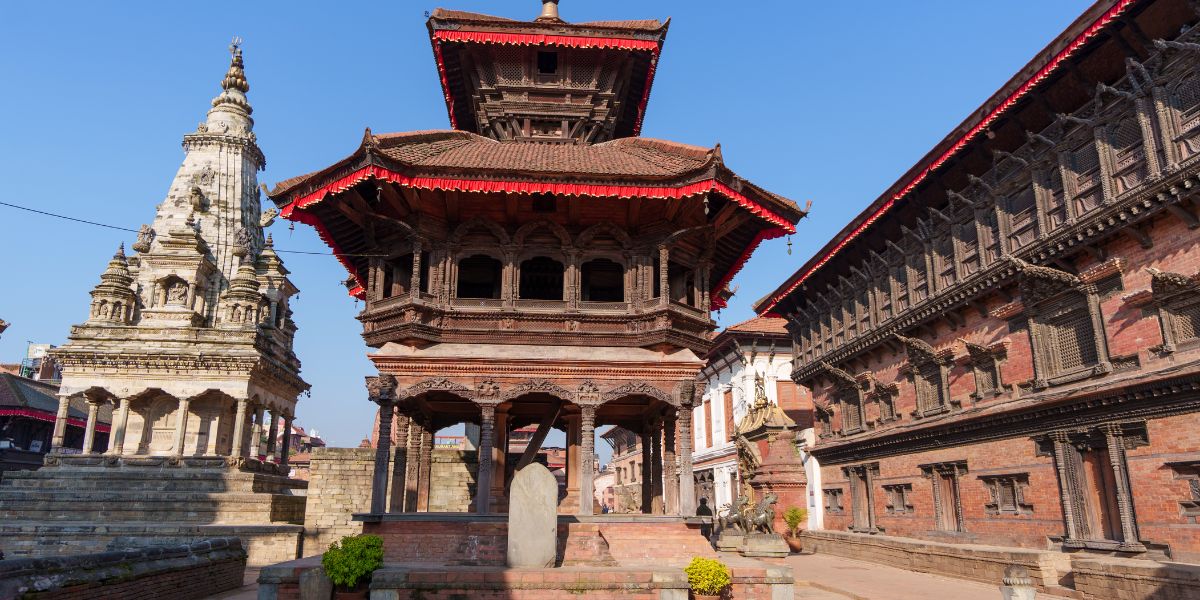
It is named Chyasilin because the word means “Eight Corners and Eight Sides”, and the structure is in an octagonal shape.
Chyasilin Mandap was built as a ceremonial and public gathering place. Malla Kings met with emissaries and dignitaries here. Previously, a poetry competition was also held between Bhupatindra Malla and the King of Bhaktapur in this Mandap.
But the Mandap wasn’t actually built to organize such a competition. As per local traditions, it was built as a barrier between his palace and a Shiva temple (Yaksheshwor Mahadev) to block the radiations believed to emanate from the temple’s yoni.
Lanpadegal/Nimha Singha
There are two monolithic lions standing a little ahead of Phasidegal. They are also called Lanpadegal in the local language.
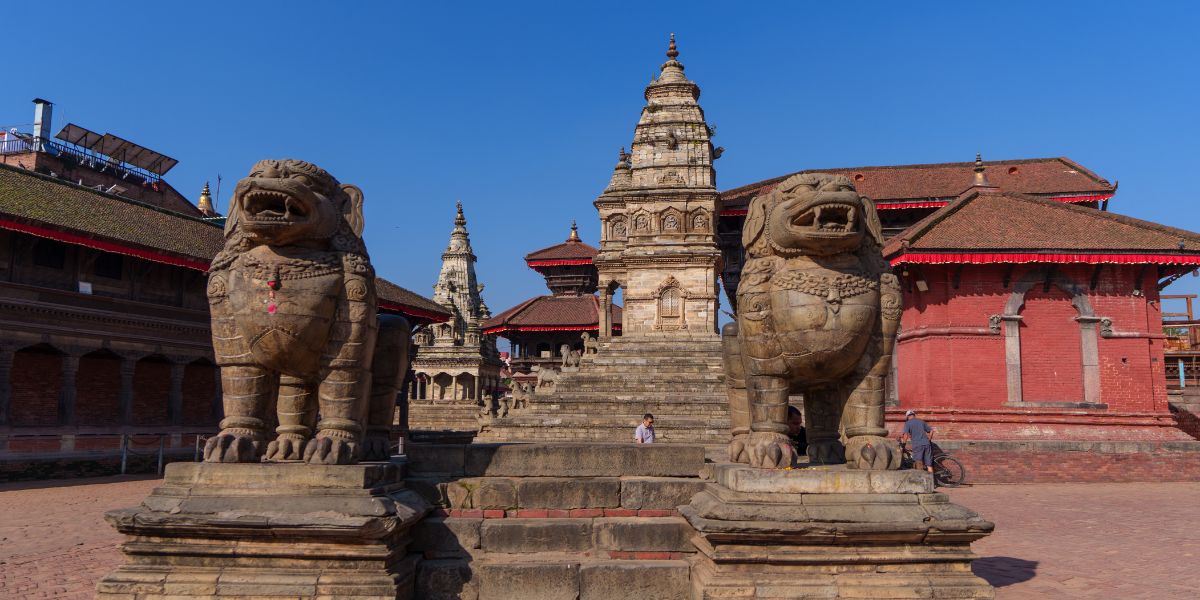
Lanpadegal is derived from Newari words Lan, Pa, and degal, where Lan refers to road, Pa refers to obstruction, and Dega (degal) refers to temple. The lions look like they are standing as an obstruction in the road, hence called Lanpadegal.
Before the 1934 earthquake, there was a pagoda-style temple with an artistic Harihar statue, and these lions were at the entrance of the temple. Sadly, the temple was completely destroyed and was never built again. However, the lions are the only ones left there!
Temples and Shrines in Durbar Square
The Durbar Square Complex is also home to the ancient temples that depict the remarkable Newari architecture. Among them, many of them still remain active as places of worship in the present day.
Pashupatinath of Bhaktapur (Yaksheshwor Mahadev Temple)
Yaksheshwor Mahadev Temple is also known as the “Pashupatinath Temple” of Bhaktapur and was built by Yakshya Malla in 1475 AD. This temple is located in Bhaktapur Durbar Square, to the north of Vatsala Durga Temple, and is dedicated to Lord Shiva as Pashupati (Lord of all beings).
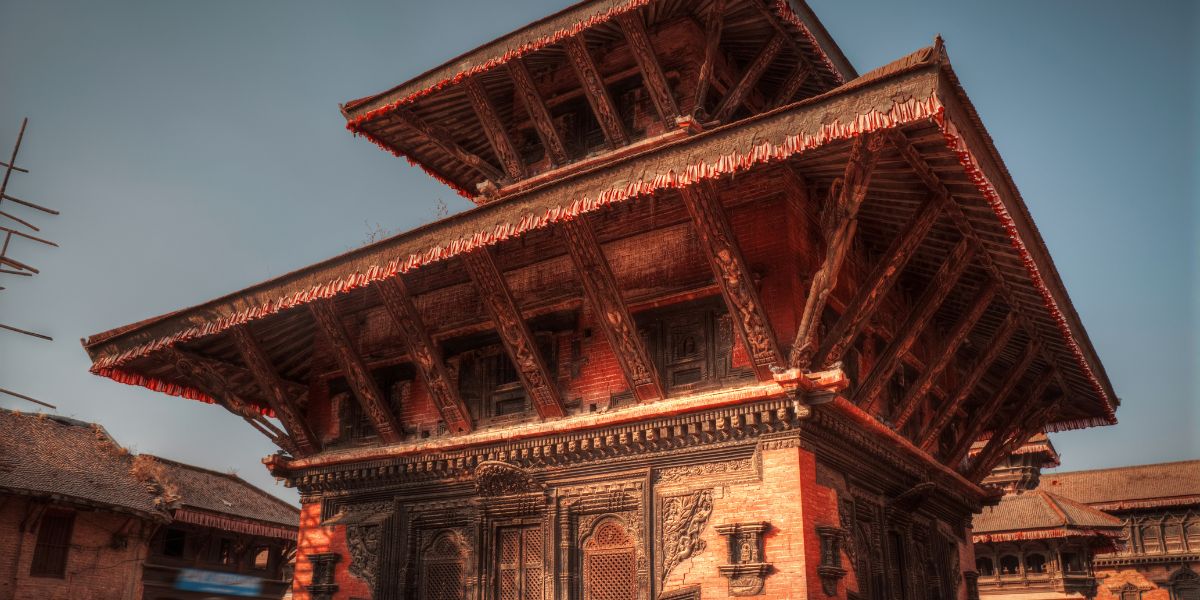
It is the oldest surviving monument of the 15th century in the area and is finely carved with wooden doors and woodwork.
Vatsala Durga or Nritya Vatsala Temple
On the eastern side of the Durbar Square, near the Pashupatinath of Bhaktapur, there is a temple dedicated to Vatsala Durga (Vatsala Devi), a manifestation of the female deity Durga.
This sikhara-style temple was the third Vatsala temple on the premises, built by King Jitamitra Malla in 1696 AD. However, it was reconstructed later in the late 17th or early 18th century by King Bhupatindra Malla.
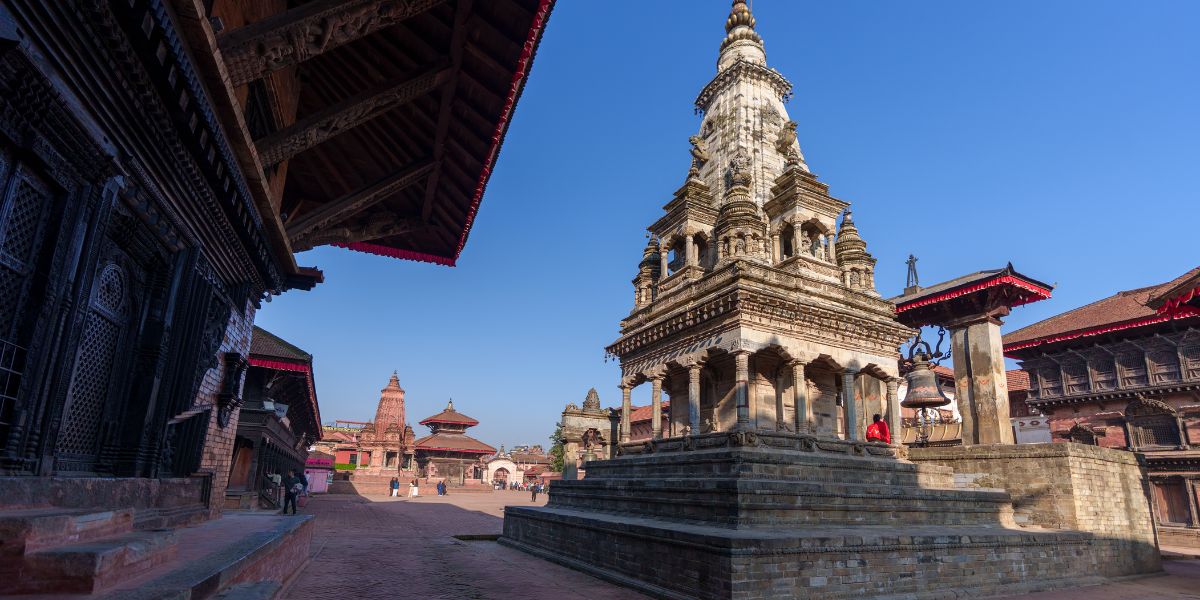
You can see the temple is richly decorated with 32 tantric images of Durga, Bhairava, Leaping lions (Sardula), and Asta Matrika (eight mother goddesses).
Inside the temple, there is a central sanctum, where Durga is symbolized by a Kalasha (sacred pot), and it is topped with a Sri Yantra. This represents fertility, creation, and divine power.
The first Vatsala temple is a miniature shrine constructed by King Jitamitra in 1693 and is located behind the Pashupatinath temple. Whereas the second temple was constructed in the year 1696 by the same King behind the Siddhi Laxmi temple.
Char Dham Temples
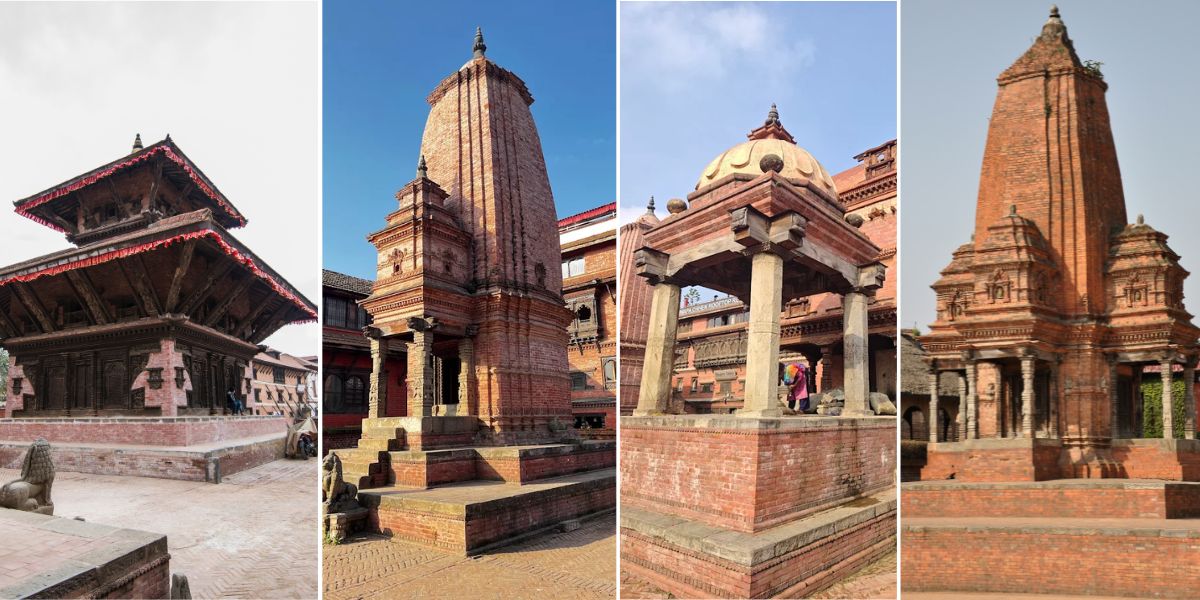
Located at the western end of the Durbar Square, there are four temples that make up Char Dham. They are:
- Jagannath/Gopinath Krishna Temple: This temple is two-roofed and features several incarnations of Vishnu on the ceiling struts. You will also be welcomed by the statue of Garuda on the pillar at the entrance.
- Badrinath Temple: One of the Char Dham temples, the shikhara-style Badrinath is dedicated to Lord Vishnu and was built in the early 18th century by King Bhupatindra Malla.
- Rameshwor Temple: This temple is a replica of the temple in South India and is dedicated to Lord Shiva. Unlike other temples, this is an open temple standing with four artistic stone pillars. There is a Shivalinga here, which is the main feature of the temple.
- Kedarnath Temple: The 17th-century, shikara-style Kedarnath Temple is dedicated to Shiva. It is named after the statue of Kedareshwor that is established in the temple. King Bhupatindra Malla is believed to be the founder of this temple.
All of these temples were built to offer spiritual benefits to the pilgrims who could not travel to the Char Dham temples. It was believed that visiting the Char Dham temples helps to achieve moksha (salvation), but due to limited resources for traveling, it was not possible to go to India. Therefore, King Bhupatindra Malla built the Char Dham inside the royal complex area.
Siddhi Laxmi Temple or Siddhi Vatsala Temple
This temple is located to the southeast of the 55-Window Palace, with the entrance facing south. Built in the shikhara style, the Siddhi Laxmi or the Siddhi Vatsala Temple honors Siddhi Laxmi, a patron deity of the Malla Kings.
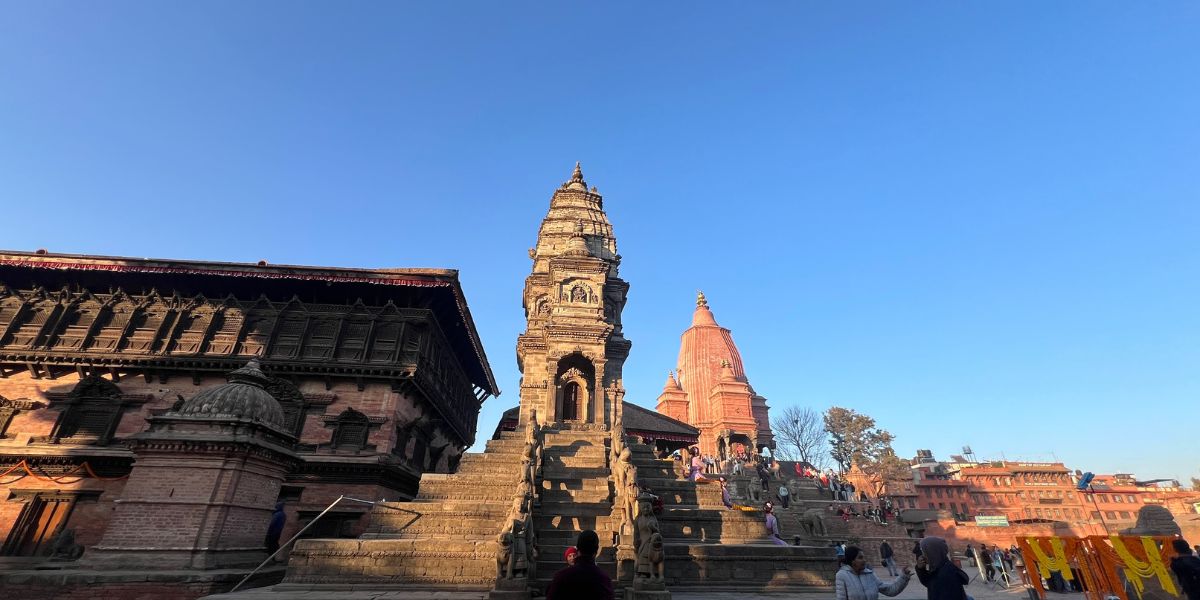
The temple represents one of the manifestations of the wrathful goddess Durga, so many bas-reliefs of Durga are mounted above the temple’s entrance and also on the sides.
Additionally, the goddess Siddhi Laxmi is believed to have the power to drive away evil spirits and negative forces and serve as a protector.
Phasi Dega Temple
This temple is also known as Phasi Degal or Shilu Mahadev Temple. It was built by King Jitamitra Malla (1672 - 1696) during his reign.
Gosai Kunda (Silu or Shilu) is a famous pilgrimage site since the Malla period, but the majority of the people were not able to reach the site. So, the king established the Shilu Mahadev Temple in Bhaktapur, near the palace.
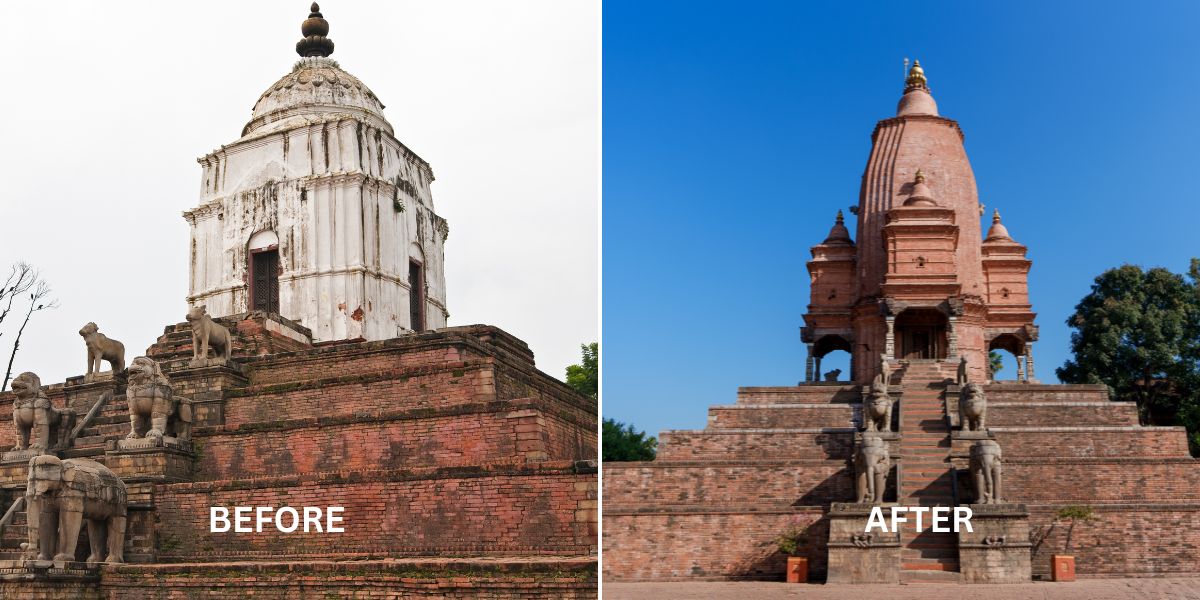
The shikara-style temple is dedicated to Lord Shiva and was completely destroyed by the 1934 earthquake and was rebuilt in a small, painted white dome. Later, again in the 2015 earthquake, the temple was destroyed, and reconstruction was done. Now, it is ready, and visitors are allowed.
The National Art Museum of Nepal
If you want an answer to how Bhaktapur became one of Nepal’s greatest art and architecture hubs, then you can visit the National Art Museum inside the Durbar Square Complex and other museums of Bhaktapur.
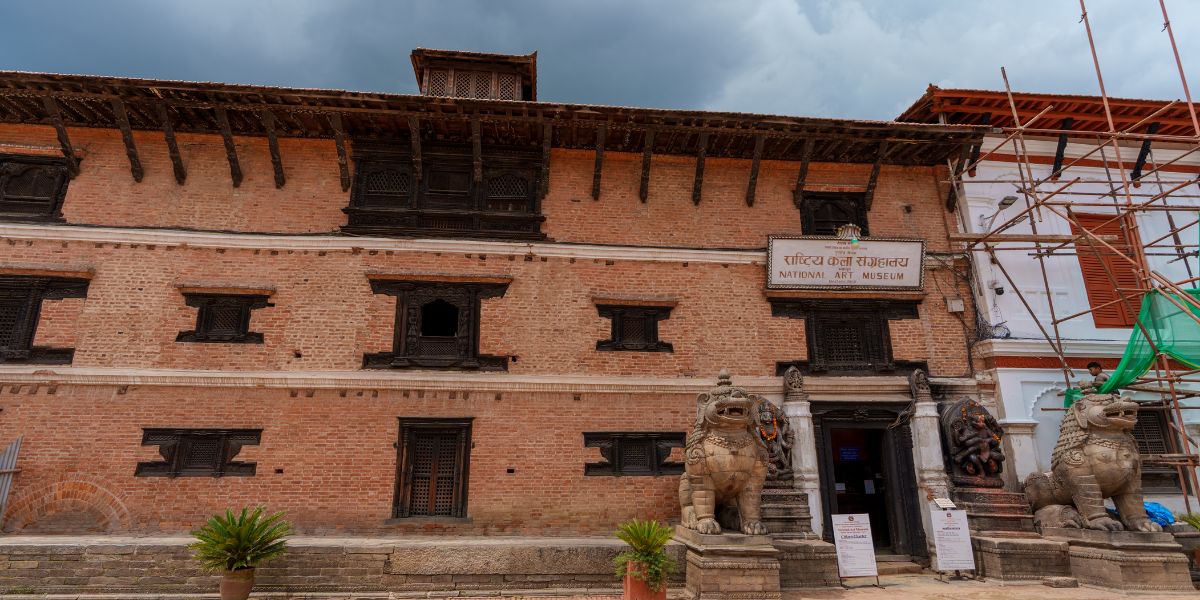
The museum, previously called Simhadhwaka Durbar and also referred to as Malati Chowk Durbar, is one of the best acquisition hubs of Nepalese medieval art and crafts. King Bhupatindra Malla erected this former palace in 1698 AD.
However, the government of Nepal and the Department of Archaeology set it up as the National Art Gallery in 1960 to preserve and exhibit ancient Nepalese art and craftsmanship.
There are two other museums (wood carving and brass and bronze museums) under the National Art Museum, which are outside the Durbar Square (more about them later).
Although there is a limited painting collection, all the art from paubhas, manuscripts, and Mithila paintings here is significantly old and priceless. The remaining collections include ancient stone sculptures and woodcrafts.
You will be welcomed by the grand statue of lions at the gate, and a stone sculpture of Hanuman-Bhairav and Narsimha will show the way towards the museum!
Currently, two buildings serve as part of the National Art Museum that showcases its rich art collections.
First Building
The first building of the National Art Museum can be considered the entrance because here you will find the ticket counter. You need to buy entry tickets first and only then start exploring the museum’s collections.
Ground Floor: Stone Arts
The ground floor of the museum is the stone art section, also called the arcade section or Chhindi Gallery. Here, you will get to see the stone inscriptions and sculptures from different periods.
Some of the inscriptions even date to the reign of Lichhavi King Shivadeva I, and others belong to the Malla period, including the Yaksha Malla in the 15th century.
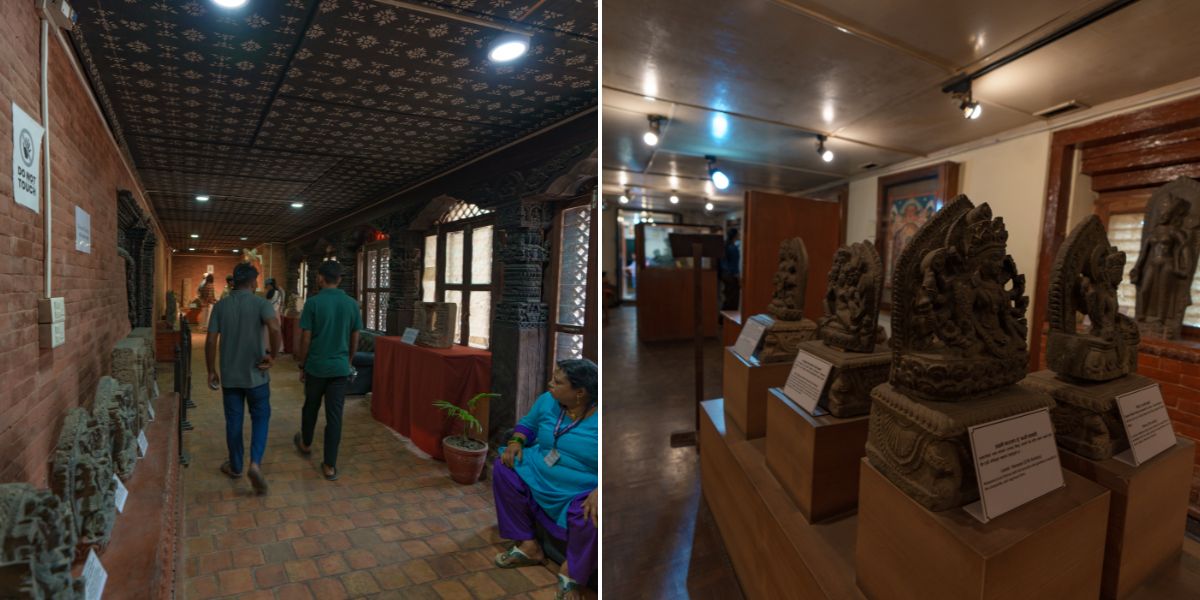
Additionally, there are some magnificent stone sculptures; some of the sculptures on display are mostly from Bhaktapur, and they depict Nepal’s early medieval to medieval stone art.
Don’t miss the four-faced Shivalinga. Sculptures of Harihar, Surya, Chandrama, Vishnu, Tara, Ardhanariswar, and other architectural fragments are also present in the section.
Likewise, there are stone inscriptions from the medieval period, architectural components from ancient temples, and an intriguing stone idol of Harishanker here. This sculpture was recovered from the rubbles of a temple that was destroyed by the 1934 Nepal–Bihar earthquake.
It is not only limited to the stone art, but you will also see some paintings and masks of Navaratri hanging on the wall.
First Floor: Paintings and Manuscripts
Now, let's climb up to the first floor, where there are paubha paintings from several religions and cultures, along with manuscripts displayed. The most important ones are the Vasundhara Mandala, Ganesh with Shakti, Mahisa Sambhara, Vajra Yogini, and Shiva Viswarupa.
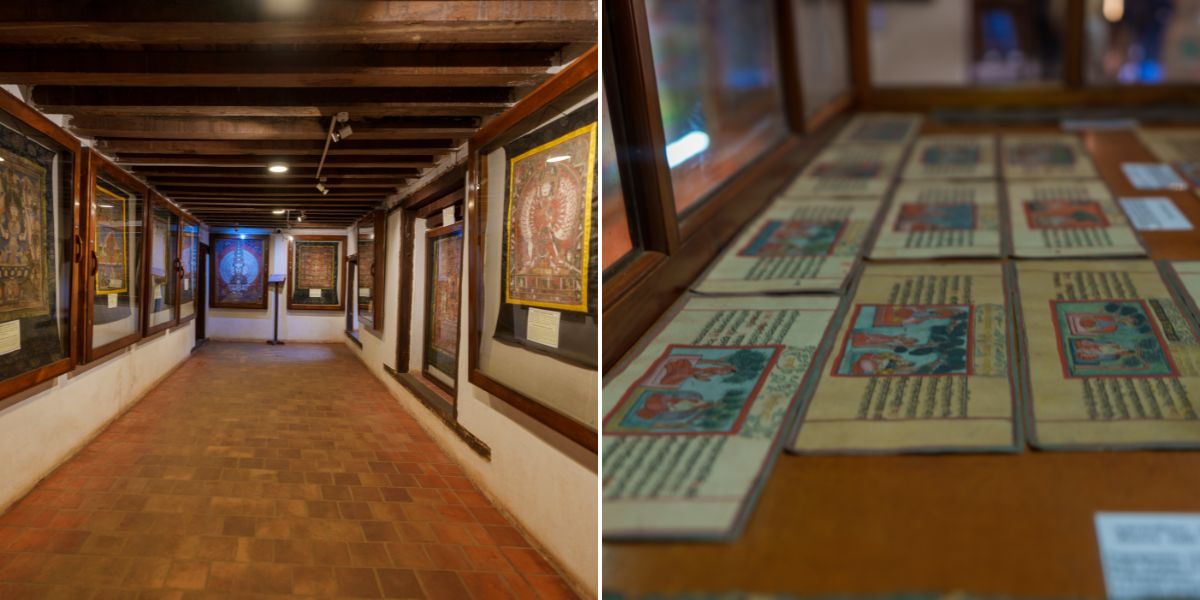
There is a main exhibition hall where five showcases are in the middle of the room, and it contains some extremely valuable ancient illustrated manuscripts and covers dating to the 18th century. One of them illustrates the pilgrimage tour of King Pratap Malla.
Other significant artifacts are a Treatise painting (Granthachitra) of Vishnu Dasavatara from the 11th century and a manuscript cover of Shiva Dharma Purana from the 13th century.
You will also see a rectangular room that resembles a corridor. On the northern wall, there are rows of paintings depicting Shiva Vishwarupa (multi-armed and multi-headed), facing south.
In addition, there are some of the best examples of Nepalese medieval folk art in the long corridors. They are watercolors of the aquatic world, mythical creatures, various birds, bulls, and other wildlife.
Also, you get to learn about the kings from the Shah dynasty from the photos hanging on the wall.
Top Floor: Wood Carvings
The collection doesn’t end here. Let’s climb to the top (second) floor, which is filled with another unique collection of Nepalese art. This floor is filled with sculptures, statues, and decorative pieces that are beautifully wood-carved.
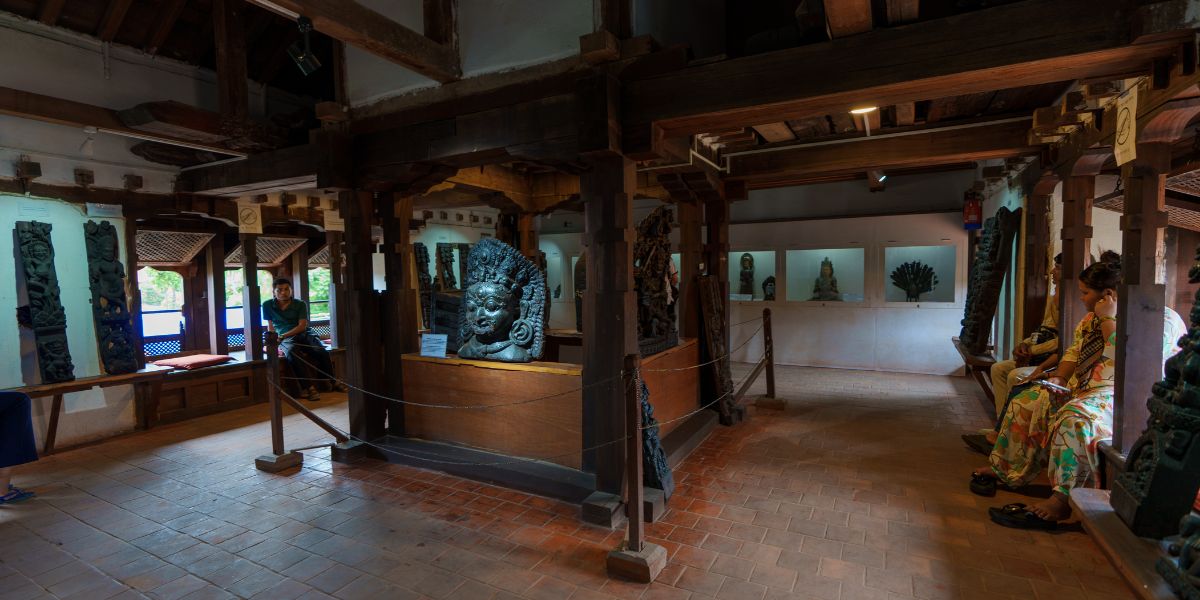
Showcasing the exceptional local Newar artisans, here you can see the wood carvings of several deities, religious figures, and mythical creatures. A huge head of Bhairav that dates back to the 16/17th century and Bhairab with Tympanum (18/19th century) are the major attractions.
Second Building
The National Art Museum has another building too! Although it was damaged by the devastating earthquake in 2015 AD, it has been restored and is open to visitors.
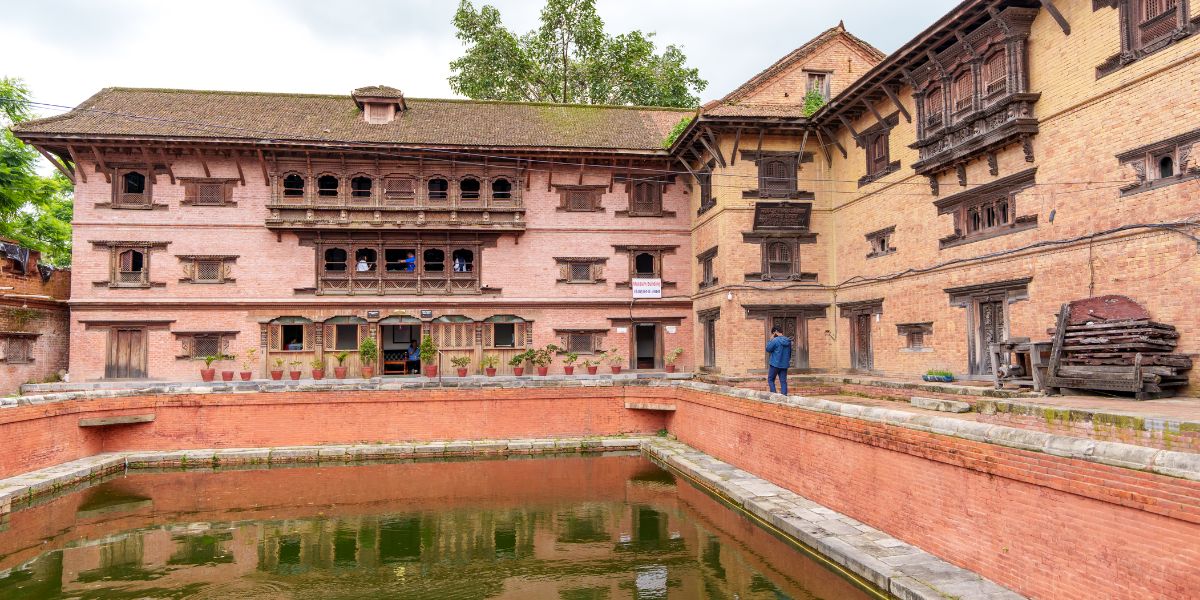
There is no different entrance; you will enter via the first building and pass through a corridor to reach an open space (chowk) with an artificial pond called Bhandar Pokhari (in Bhandarkhal Chowk, part of Taleju Temple Complex).
Take some time to observe the pond before entering the building. But please be aware that you are not allowed to click pictures of certain areas of this chowk, as the police department also uses this space!
This building is also filled with a diverse collection of Nepalese art and paintings that are from centuries ago.
You will directly climb to the first floor because the area of the ground floor is not accessible!
First Floor: Paubha Paintings
Just like the first building, you will reach the world of paubha paintings here as well.
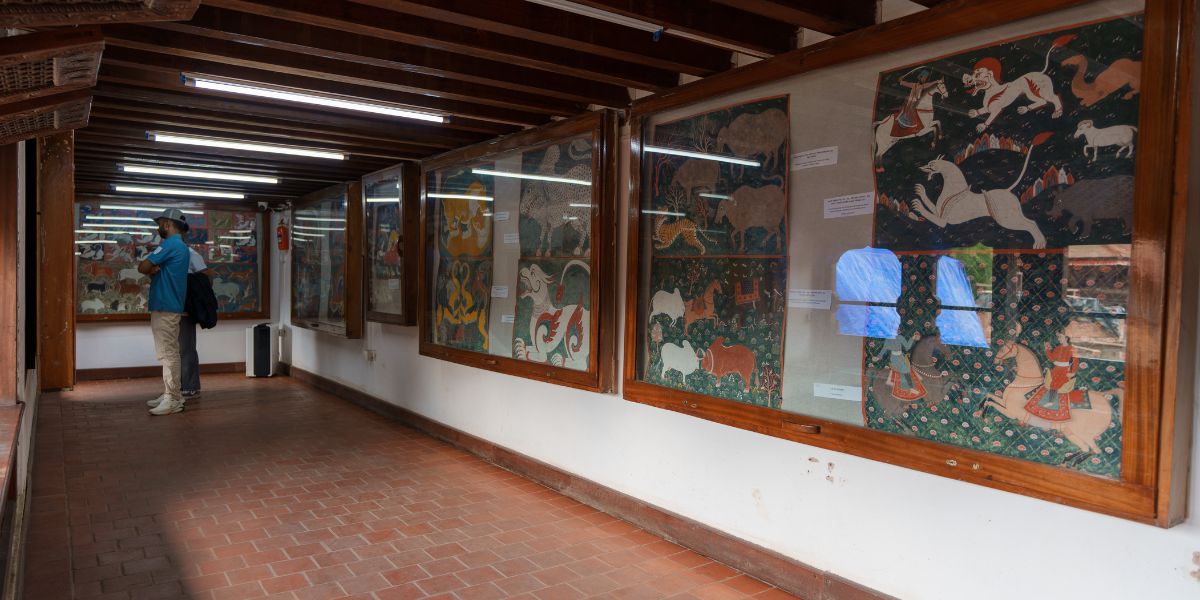
Paubha paintings are one of Nepal’s most unique traditional art forms. This floor is filled with intricate paintings of Buddhist and Hindu deities, mythical creatures, religious stories, and so on.
Take your time and observe every figure; each of them tells you a unique story and has a specific spiritual meaning.
Second Floor: Mithila Paintings
Welcome to the colorful world of Mithila paintings!
Mithila paintings are not only a form of painting, it is a traditional art of the Mithila region that displays cultural symbolism in a distinct style with vibrant colors and intricate patterns.
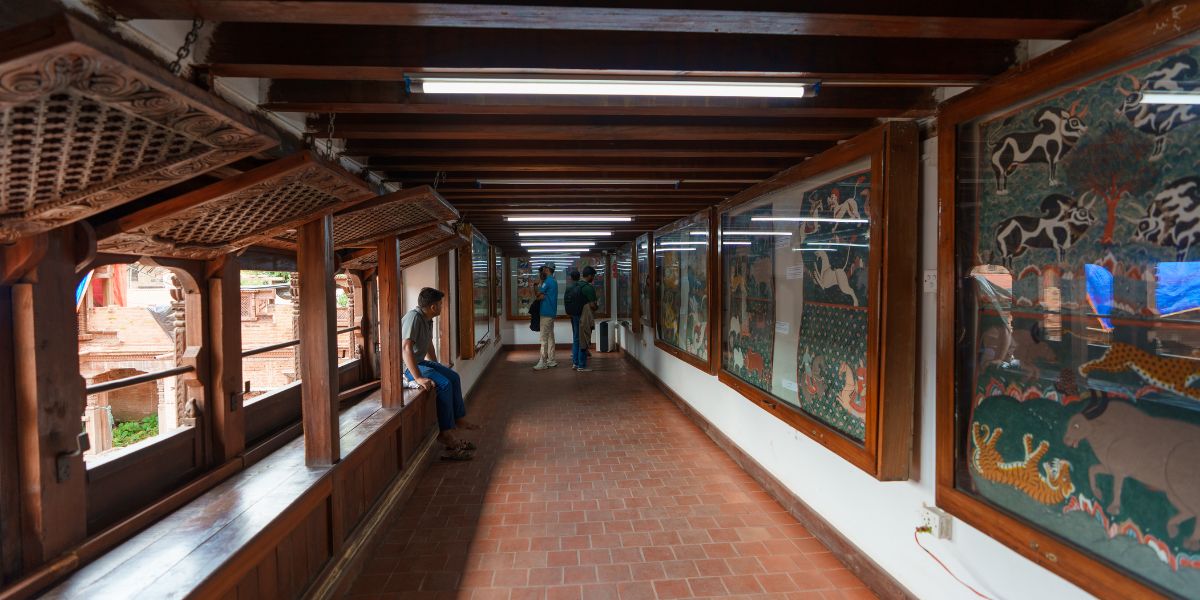
On this floor, you will see the Mithila artworks that feature several Hindu deities, mythological stories, nature, animals, and daily life scenes. These arts are deeply connected with religious beliefs, festivals, and rituals.
Have you heard about Krishna Leela? If not, you will get an opportunity to learn about it here!
The art portrays all the stories and incidents from Lord Krishna’s life: childhood in Gokul and Vrindavan, interactions with Gopis, relationship with Radha, encountering demons, and many more.
Entry Fee and Opening Hours
Are you excited to visit the National Art Museum? Here are the details regarding entry fees and opening hours of the museum.
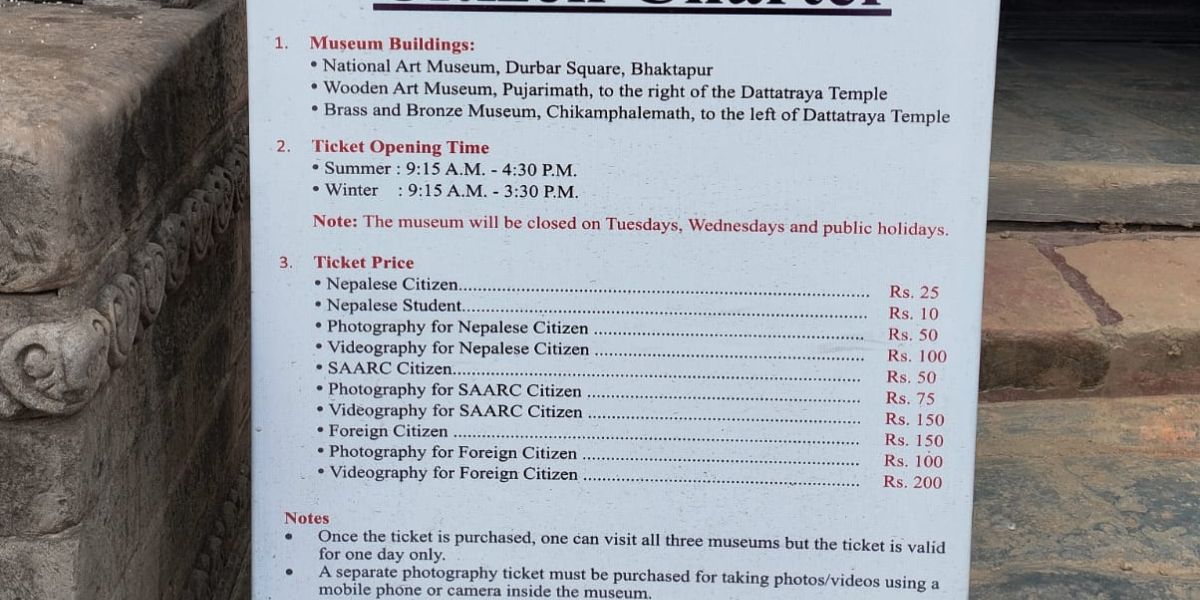
Do not buy separate tickets for the other two museums. The same ticket works for the Brass and Bronze Museum and the Wood Carving Museum.
Entry Fee for the museum:
|
Visitor Category
|
Entry Fee (per person)
|
Camera Fee (photography)
|
Camera Fee (videography)
|
|
Foreign Citizen
|
NPR 150
|
NPR 100
|
NPR 200
|
|
SAARC Citizen
|
NPR 50
|
NPR 75
|
NPR 150
|
|
Nepalese Citizen
|
NPR 25
|
NPR 50
|
NPR 100
|
|
Nepalese Student
|
NPR 10
|
NPR 50
|
NPR 100
|
Opening Hours of the Museum:
|
Period Time
|
Museum Visiting Hour
|
Ticket Counter Hours
|
|
Magh 16 to Kartik 15 (Thursday-Monday)
|
9:00 AM to 5:00 PM
|
9:15 AM to 4:30 PM
|
|
Kartik 16 to Magh 15
(Thursday-Monday)
|
9:00 AM to 5:00 PM
|
9:30 AM to 3:30 PM
|
Note: The museum is closed on Tuesday, Wednesday, and Government/Public holidays.
Other Museums Nearby (Part of National Art Museum)
Within a few minutes' walk from Durbar Square, you can also explore other museums, and they are:
Brass and Bronze Museum
Located behind the Dattatreya Temple at Dattatreya Square, the Brass and Bronze Museum is filled with the metalwork section that was used by nobility and the Newar community in previous centuries.
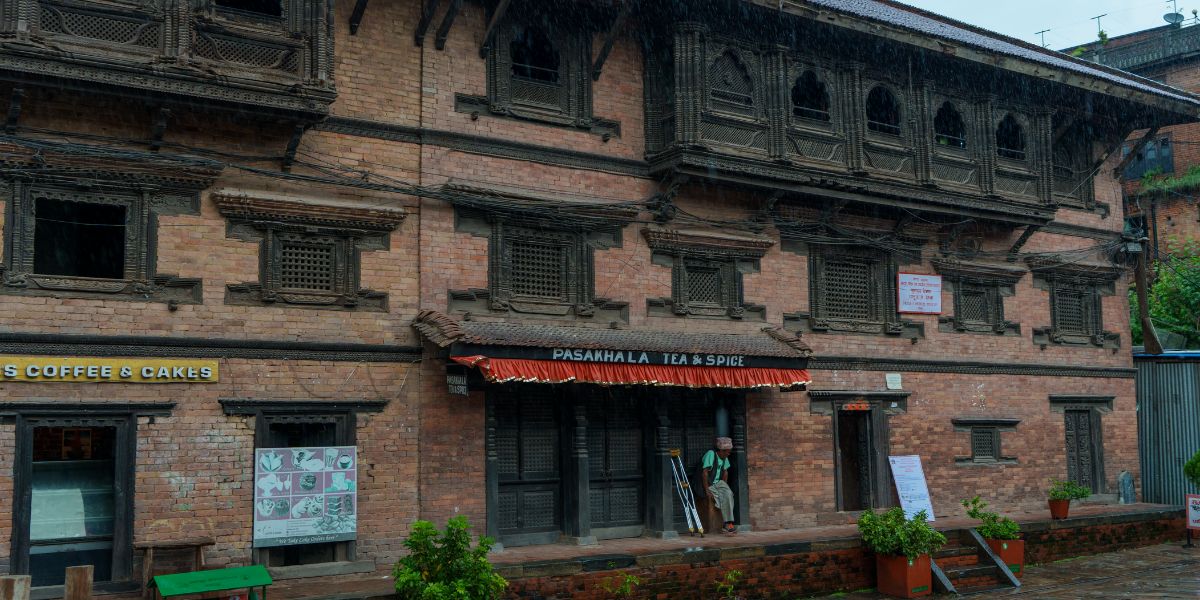
There are several metal objects like traditional water vessels, household utensils, sacred temple objects like Kalash, Diyo, Temple bell, and incense stand.
Wood Carving Museum
Wood Carving Museum, previously Pujari Math, is located beside the Dattatreya Temple in Dattatreya Square, too.
It was known as Pujari Math because it was a math (priest house), where a pujari stayed. Now, it has already been converted into a museum that showcases and preserves the traditional woodcarving heritage of Nepal.
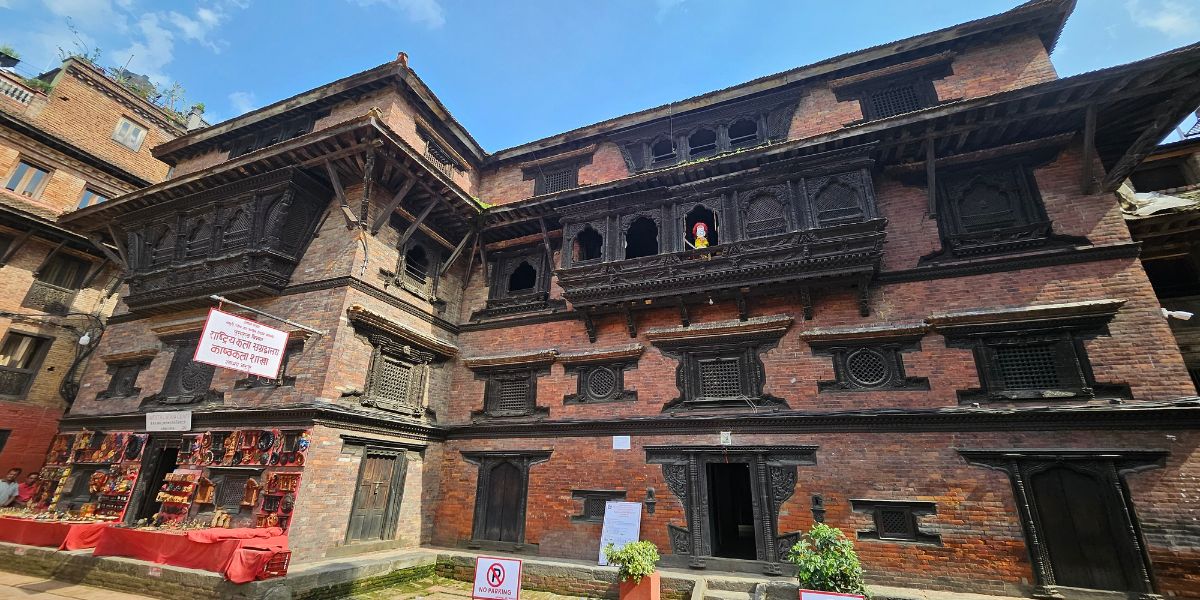
There is an impressive collection of traditional wooden artwork from the 15th century. The courtyards of the museum are decorated with elegantly carved windows and pillars.
Additionally, there are some magnificent specimens of woodcarving from past centuries: the Mara Vijaya, Pooja Devi, Viswaroop, and Aryatara.
Also, on the second floor of the museum, there is a wooden idol of a priest. He is Mahanta Guru Bakshya Giri, the first priest of the Pujari Math.
Local Life Around Durbar Square
Moving towards the local and cultural life around the Durbar Square, this square is one of the prominent tourist areas in the city. The open courtyards and temples on brick-paved ground always welcome you here.
Daily Life
Life in Bhaktapur Durbar Square starts quite early in the morning. The temple bells ring, and their sound is spread throughout the area. People visit the nearby temples and shrines, offering flowers, oil lamps, prayers, and seeking blessings.
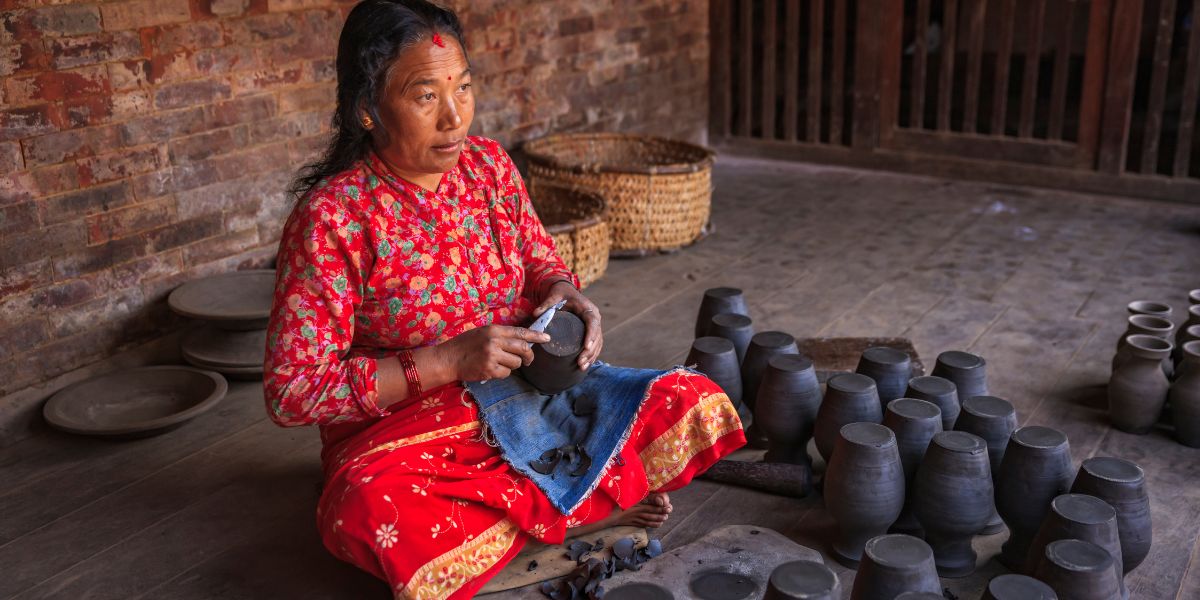
The shopkeepers start opening their handicraft shops, while the local food shops and cafes are busy preparing authentic food items, like Haluwa Papad Roll, Bara, Chatamari, Tea, etc. Likewise, the courtyard is less crowded, with only some joggers and morning people.
During the day, Bhaktapur Durbar Square is filled with tourists (both domestic and international). You can watch the craftsmen carving wood and shaping it for windows, doors, or other essentials, pottery artisans shaping their clay, some creating metal sculptures, and shopkeepers welcoming guests and customers to their shops.
The square is crowded during this time with people exploring the area, clicking photos and videos, and food-hunting.
As the sun sets, the area becomes calmer and more peaceful. The courtyard has fewer visitors than during the daytime.
Likewise, soft lights make the surroundings beautiful. Additionally, the monuments and shrines glow extra with the lights, making it a perfect time to click photos and videos.
Local People
The people of Bhaktapur are contributing to preserving their traditions and heritage around the Durbar Square.
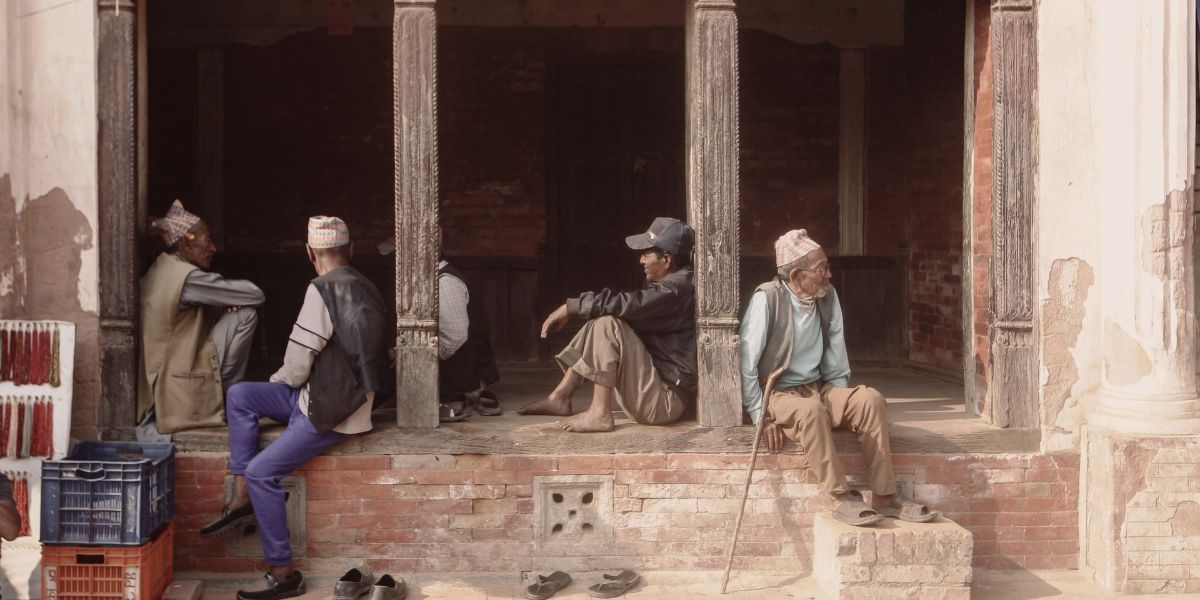
The area is dominated by the Newar community, and the most common language you hear is Nepal Bhasa (Newari). The majority of the population follows Hinduism, while a minority follows Buddhism.
Here, people are busy with their own work, like painting, wood carving, running shops, knitting, preparing food, cleaning the areas, celebrating festivals with community spirit, and gathering together for development work.
Main Festivals Celebrated in Durbar Square Area
Festivals are an important part of life in Bhaktapur, and they are celebrated in and around the Durbar Square. Here are the few major festivals celebrated:
Bisket Jatra
Bisket Jatra is considered the major festival of Bhaktapur and is celebrated with great devotion and enthusiasm. It aligns with the Nepali New Year (based on the Hindu Bikram Sambat calendar) and starts around Chaitra 27/28, continuing till Baisakh 5 (around mid-April every year).
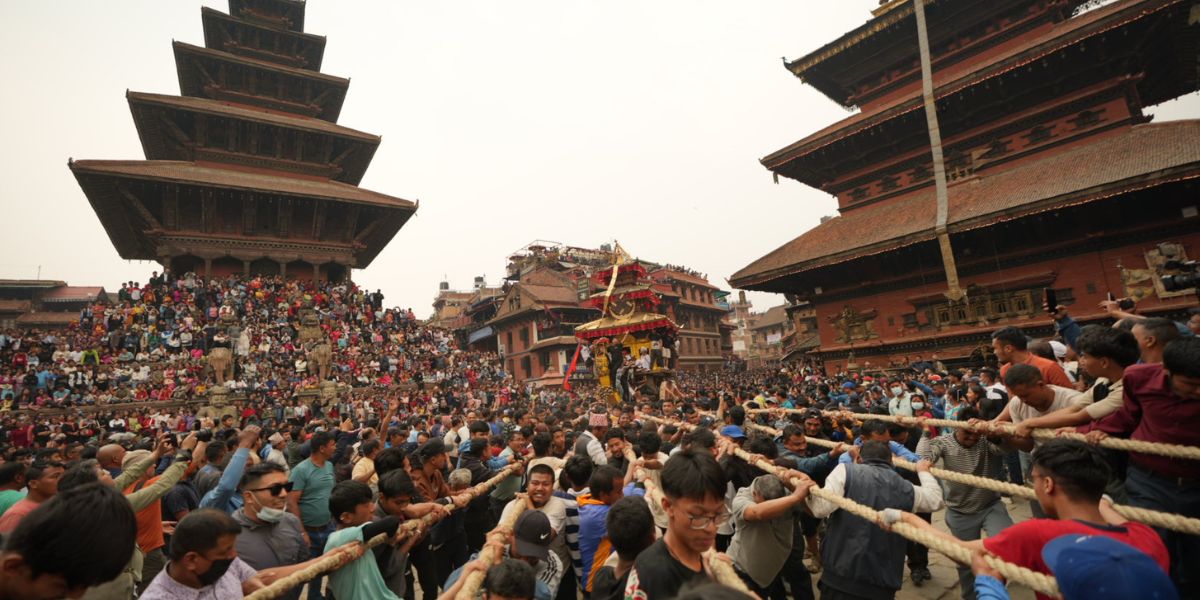
This festival is celebrated by the Newari community, but people of every ethnic group gather around the square areas to observe and take part. Celebrated for nine days, each day something new is celebrated, and unique ceremonies and processions take place that are really worth watching!
The chariot pulling is the main attraction of this festival on Day 1. The wooden chariot of Bhairavnath and the chariot of Bhadrkalai are traditionally pulled from the five-storied temple courtyard to the upper and lower streets of the city.
Before the chariot pulling begins, an employee of Guthi Sansthan goes to Durbar Square and brings the Khadga (sword), a symbol of the king, and hands it over to the priest of the Taleju Temple.
Likewise, on the 5th day of the Jatra, various musical instruments are played, and worship of Bhariavnath, Bhadrakali, Betal, and the longo (pole) will be performed. Once the puja is completed, in the evening, Dumaju Jatra is celebrated at Taleju.
Gai Jatra
Gai Jatra is another big festival of the Newar community and is celebrated on the first day of the waning (darkening) moon in the month of Bhadra (late August or early September as per the Gregorian calendar).
The festival has different names: Saa yaa(t), Gai Yatra, or Sa Paru. This festival starts with the worship of Taleju in Bhaktapur, Taumadhi Square, and the ceremonial procession of the cow from the temple.
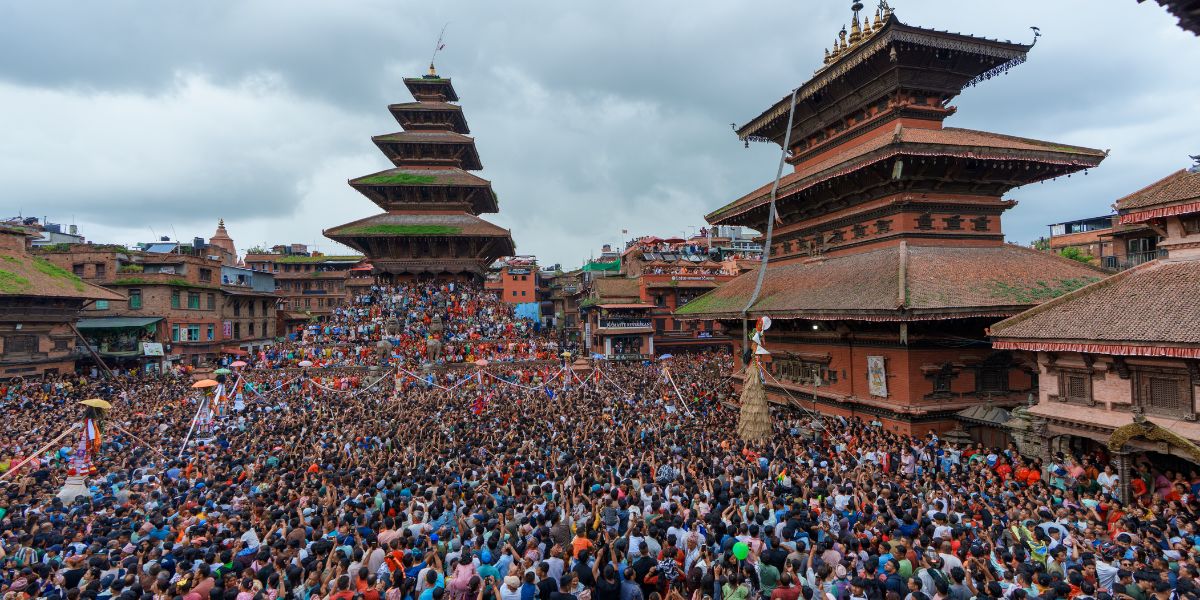
29 Tahamachas, including one Bhailadya Tahamacha, are paraded around the courtyard of the Nyatapola Temple and the Durbar Square area.
People celebrate this festival in remembrance of their deceased ones for a week. The traditional Ghintang Ghisi dance is performed, and traditional instruments like Dhime, Bhusya, and Khin are played during the processions.
Dashain
Dashain is celebrated with great fanfare all over the country. During this festival, the Taleju temple of Bhaktapur Durbar Square comes alive.
On the ninth day (Maha Navami), a total of 54 goats, 32 buffaloes, and 24 ducks are sacrificed, and other worship rituals are also performed. Just like the Taleju of Kathmandu, it is also open to the public on this day. Thousands of devotees stand in queue to worship the Taleju Goddess.
Additionally, Ekantakumari (living goddess of Bhaktapur) and 11 Ganakumaris are worshipped in the Taleju Temple on the same day. The Ekantakumari is worshipped at Chaturbrahma Mahavihar and enthroned at Taleju Temple.
Later, after all the rituals are performed, Kumari Jatra is also observed.
White Horse (Seto Ghoda) Jatra
This Jatra is celebrated in the Bhaktapur Durbar Square area during the Dashain festival. Seto Ghoda Jatra is believed to have started with the arrival of Taleju Bhawani, and the white horse is an important part of performing puja during the Dashain festival.
The White Horse festival is celebrated on the night of Bijaya Dashami and the day after that.
Before the jatra starts, the puja rituals are performed to the Goddess Taleju as per the tantric traditions. Once the rituals are completed at Taleju, the white horse is worshipped with a sacrifice of a lamb.
After this, the horse is taken around the ancient Bhaktapur town in a procession and is driven through Khauma, Itanchhe, Bharwacho, Banshagopal, Bhujikokha, Narayanchowk (lower part of the Durbar area), Khichhen, Bholachhen, Thalachhen, Dattatreya, Golmadhi, Sukudhoka, Tamari, and Narayanchok (upper area).
Indra Jatra
Indra Jatra is celebrated grandly in Kathmandu, and Bhaktapur also celebrates it in different ways.
The Lakulache community builds a Pulukisi, a symbolic representation of Airvata (an elephant and divine vehicle of Lord Indra). Then, the community begins the procession with four people carrying the Pulukisi. One of the people rings the bell at the Bhairavnath Temple in Taumadhi Square and signifies the start of the procession.
Mupatra Jatra is a part of Indra Jatra and is celebrated in a grand way in Bhaktapur. It is also known as “Raksas Jatra” because demons are portrayed in a unique way.
The performance of the Mupatra is the highlight of the festival, where a demon character is represented by three individuals, with one main demon and two assistants called “Dhicha”. All of them are dressed in demon attire with colorful makeup on their faces. They parade through the streets of Bhaktapur.
The above-mentioned information was about the jatra. In the Taleju Temple of Bhaktapur Durbar Square, the traditional lamps (Ya Matah) are lit by the Manandhars of Golmadhi, and the statue of Chhuma Ganesh is carried to the temple (on the second day of Jatra).
Yomari Punhi
The Newari people of Bhaktapur celebrate Yomari Punhi with great joy. Yomari is a traditional steamed dumpling made from rice flour and is filled either with Chaku and Til (molasses and sesame) or Khuwa (dried milk solids).
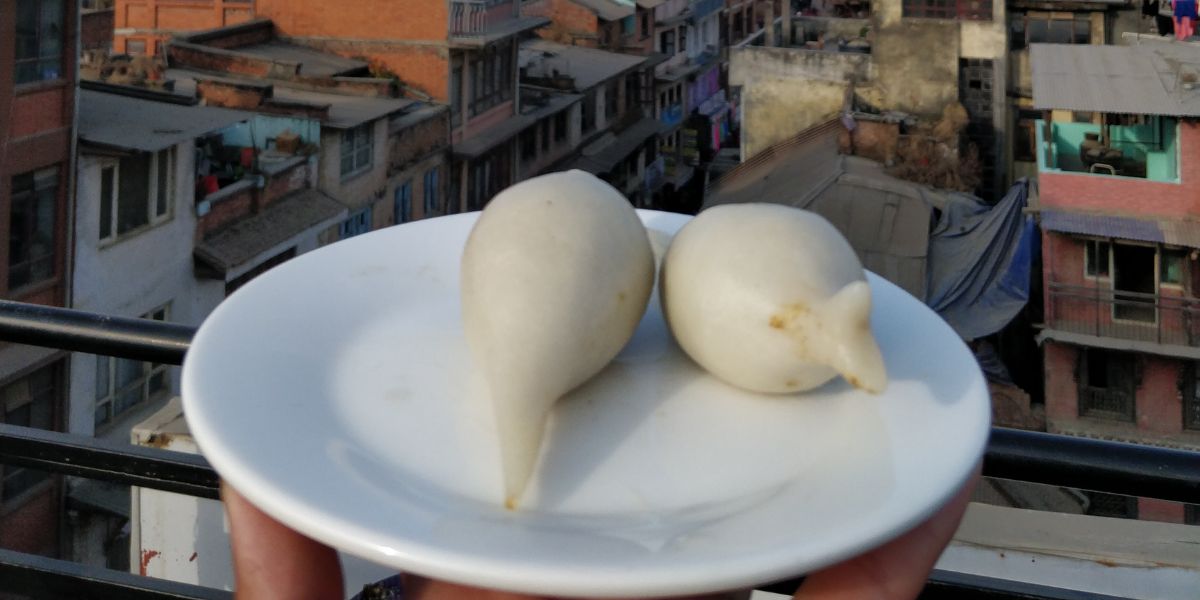
On this festival, they prepare Yomari and first serve it to the deity, then the families gather together and enjoy this festival. On this day, you can find many local shops near Durbar Square selling Yomari throughout the day!
Bhaktapur Durbar Square Suggested Walking Route
Wondering how to explore the entire Bhaktapur Heritage area? There are multiple walking routes to reach the square, and it can be done either independently or with a guide.
And here is a suggested route that provides you with an opportunity to explore the city’s oldest neighbourhood along with Bhaktapur’s vibrant and living heritage:
Thulo Byasi → Nag Pokhari → Dattatraya Square (Tachupal Tole) → Inacho Tole → Bhaktapur Durbar Square (Royal Palace Complex) → Taumadhi Square → Pottery Square → Dudhpati
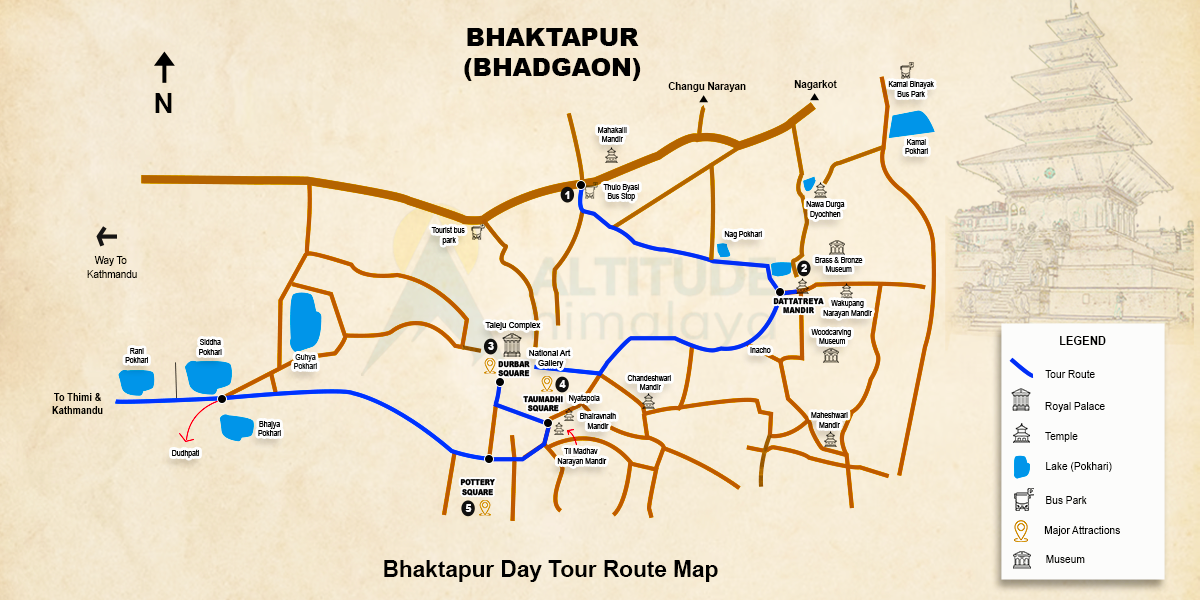
At Altitude Himalaya, we already organize a similar walking tour package (with Changu Narayan Temple, Madhyapur Thimi, and even a Nagarkot visit), where we include a government-licensed tour guide who knows the ins and outs of Bhaktapur.
Your journey starts from Sano Byasi (Tourist Parking Area). Unlike regular, straightforward routes, you’ll go through the hidden alleys of Bhaktapur.
Walking via this route means you will get to see multiple Ganesh shrines, wells, courtyards (also called Nanee), a traditional beaten-rice (chiura) mill, ponds (pukhu), thangka painting schools, stone water spouts (hiti), resthouses (pati), monasteries (vihar), beautiful Newari houses, plus other various monuments and landmarks.
After exploring the alleys for 30-45 minutes, you can reach Dattareya Square in Tachupal Tole. Then, head towards Inacho Tole, where you can explore souvenirs, singing and healing bowls, local food, and various shops.
After walking approximately 700 meters, the way leads to Durbar Square, and you will be welcomed by the Phasi Dega and the open courtyards of the premises.
Then, from Durbar Square, you can head southeast for 3-5 minutes and reach Taumadhi Square. Also, just after a 4-minute walk from Taumadhi, you can visit Pottery Square.
While returning, instead of repeating the same route, you can return via Dudhpati, which is home to several ponds (pokhari) like Guhya Pokhari, Bhajya Pokhari, Siddha Pokhari, and Rani Pokhari.
Tips for Visitors
Bhaktapur Durbar Square is home to numerous ancient Hindu temples, palaces, culture, and traditions. So, there are a few things to keep in mind before your visit:
- The courtyards and the alleys around the square are stone-paved. Hence, we highly recommend putting on comfortable shoes as you will be strolling around on foot.
- Do not forget to carry an umbrella specially during rainy seasons and when it’s too sunny.
- Additionally, carry a bottle of water to keep yourself hydrated.
- Also, bring sunglasses and sunscreen with you.
- Be sure to dress in a plain manner. Also, please take off your shoes and slippers if you plan to enter the temples.
- What do you prefer? A quiet and peaceful walk? Gatherings of people? Or, an evening with softer lights and vibrant weather? You can visit early in the morning for a peaceful walk with fewer crowds. Otherwise, visit during the afternoon or in the evening for food hunting, photographs, soft lights, and fresh air.
- Want to know more about festivals or participate on it? The Bhaktapur Durbar Square comes alive during the Bisket Jatra (falls in April), Gai Jatra, and Indra Jatra (August-September). So, visit during this time to witness the unique festivals of Bhaktapur.
- Most areas of the Durbar Square are allowed for photos and videos. But please do not forget to seek permission before filming. Also, before clicking photos or recording videos of any person, obtain consent.
- If you ask what comes to mind when thinking of Bhaktapur, then my answer will be the typical Newari food and Juju Dhau that are easily available around the square. My favorite ones are Chatamari, Newari Khaja Set (Samay Baji), Bara, and Khuwa Yomari, so I recommend you try these.
Final Thoughts
Overall, Bhaktapur Durbar Square is a live museum that has been preserving centuries-old monuments, palaces, and temples. Each of them portrays the incredible skills of the artisans and the stories of the Malla kings who actively contributed to the formation and development of this square.
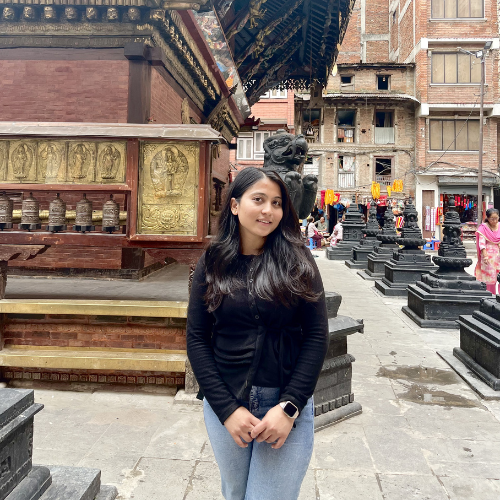
After my personal visit to Bhaktapur Durbar Square, I realized the area is not only fascinating because of the museums and architecture but also because of the people, traditions, daily rituals, and festivals celebrated here.
Hence, strolling around Bhaktapur Durbar Square is more than sightseeing for the visitors. Each carved window, courtyard, statues offers a glimpse into the historic and spiritual world.
Despite the damage caused by the major earthquakes, active involvement of the community and restoration efforts have continued to protect the heritage!


 Garima Bhandari